
Terracotta Army facts for kids
| UNESCO World Heritage Site | |
|---|---|
 |
|
| Location | Lintong District, Xi'an, Shaanxi, China |
| Criteria | Cultural: i, iii, iv, vi |
| Inscription | 1987 (11th Session) |
| Terracotta Army | |||||||||||||||||||
|---|---|---|---|---|---|---|---|---|---|---|---|---|---|---|---|---|---|---|---|
| Simplified Chinese | 兵马俑 | ||||||||||||||||||
| Traditional Chinese | 兵馬俑 | ||||||||||||||||||
| Literal meaning | Soldier and horse tomb-figurines | ||||||||||||||||||
|
|||||||||||||||||||
The Terracotta Army is a huge collection of clay sculptures. These sculptures show the armies of Qin Shi Huang, who was the very first emperor of China. This amazing army was buried with the emperor around 210–209 BCE. Its main job was to protect him in the afterlife.
These clay figures were made in the late 200s BCE. Local farmers found them by accident in 1974. This happened in Lintong District, near Xi'an, in China. The figures are different heights, depending on their rank. Generals are the tallest. The army includes brave warriors, chariots, and horses. Experts believe there are over 8,000 soldiers, 130 chariots with 520 horses, and 150 cavalry horses. Most of them are still in their original spots near Qin Shi Huang's tomb. Other clay figures have also been found. These include officials, acrobats, strongmen, and musicians.
Discovering the Terracotta Army

.png)
Building a Grand Tomb
The building of Emperor Qin's tomb was a massive project. The historian Sima Qian wrote about it a century after it was finished. Work started in 246 BCE, when Emperor Qin was only 13 years old. Sima Qian said that 700,000 workers were forced to help build it.
The tomb was designed to be like a grand palace. Sima Qian wrote that it had palaces, towers, and many valuable items. He also described 100 rivers made of mercury. Above them, the ceiling looked like the night sky with stars. Below, it showed the lands of China that the emperor had united. Scientists have found high levels of mercury in the soil of the tomb mound. This suggests Sima Qian's descriptions might be true.
An Amazing Find
The Terracotta Army was discovered on March 29, 1974. A group of farmers were digging a well near Mount Li. They found pieces of clay figures and other ancient items. This discovery led Chinese archaeologists, like Zhao Kangmin, to investigate. They uncovered the largest group of pottery figures ever found. Today, a large museum covers the main excavation site.
The Emperor's Underground World


A City for the Afterlife
The Terracotta Army is part of a much bigger underground city. This city is called a necropolis. It was built to be a miniature version of the emperor's real palace. This huge area covers about 98 square kilometers (38 square miles).
The emperor's tomb mound is shaped like a pyramid. It is surrounded by two strong walls made of packed earth. The necropolis also has offices, halls, stables, and even an imperial park. The warriors stand guard to the east of the tomb. This was the direction from which the emperor's enemies might have come.
The Unopened Tomb
The main tomb of Emperor Qin Shi Huang is still sealed. It has not been opened yet. This is partly because experts worry about how to protect the ancient treasures inside. For example, when parts of the Terracotta Army were first dug up, their original paint started to flake off very quickly. The dry air in Xi'an can damage these delicate surfaces in minutes.
Exploring the Pits of Warriors

The Main Battle Formations
Archaeologists have found four main pits, about 7 meters (23 feet) deep. These pits are located about 1.5 kilometers (1 mile) east of the emperor's tomb. The soldiers inside are arranged in battle formations. They look ready to protect the tomb from the east.
- Pit 1: This is the largest pit, measuring 230 meters (755 feet) long and 62 meters (203 feet) wide. It holds the main army of over 3,000 figures. It has eleven long corridors. These corridors had wooden ceilings, covered with mats and clay for waterproofing.
- Pit 2: This pit contains cavalry and infantry units. It also has war chariots. It might have been a special military guard.
- Pit 3: This pit seems to be the command center. It holds high-ranking officers and a war chariot.
- Pit 4: This pit is empty. It might have been left unfinished by the builders.
Some figures in Pits 1 and 2 show signs of fire damage. Burnt wood from the ceilings has also been found. This suggests that the site might have been damaged or disturbed long ago. Many of the figures we see today have been carefully put back together from broken pieces.
Other Amazing Discoveries
Beyond the main warrior pits, other interesting areas have been found. These include bronze carriages and figures of entertainers. There are also acrobats, strongmen, and officials. Stone armor suits, burial sites for horses, and even bronze cranes and ducks have been discovered. These show that the emperor's underground world was very diverse.
Meet the Terracotta Figures
.jpg)
Soldiers, Acrobats, and More
The terracotta figures are life-sized. They usually stand between 1.75 meters (5 feet 9 inches) and 2 meters (6 feet 7 inches) tall. Officers are generally taller. Their height, uniform, and hairstyle all show their rank. Each face looks unique, almost like real people.
- Warrior Types: There are armored infantry, unarmored infantry, cavalrymen, and chariot drivers. You can also see crossbowmen, archers, generals, and other officers. Their uniforms vary a lot, even within the same rank. There are also many terracotta horses.

- Original Colors: The figures were originally painted with bright colors. These colors came from ground precious stones, burnt bones, and natural pigments. Imagine how realistic they looked with black eyebrows, facial hair, and pink faces! Sadly, most of these colors flaked off quickly after the figures were exposed to air.
- The Acrobats: In one pit, archaeologists found figures of "Acrobats." These sculptures show a great understanding of the human body. They are bare except for a loincloth. These figures are very lively and unique. They show different body types and movements.
.jpg)
How the Army Was Made
The Terracotta Army figures were made in workshops. Many government workers and local artists helped. They made heads, arms, legs, and torsos separately. Then, they joined the pieces together. After assembly, clay was added to give each face unique features. This was like an early assembly line production.
Workers were required to carve their names on the items they made. This helped ensure good quality. This also helps modern historians learn about the workshops involved. Studies have shown that the faces of the statues look very similar to people from the region today. This suggests they might have been modeled after real soldiers.
Building such a huge tomb and army required many workers. Burial sites for some of these workers have been found. Studies of these sites show that people from different parts of China helped with this massive project.
Ancient Weapons and Armor


Most of the figures originally held real weapons. These would have made them look even more realistic. Many weapons were lost or rotted away over time. However, over 40,000 bronze weapons have been found. These include swords, daggers, spears, and crossbows.
Many arrowheads were found in bundles of 100. Scientists found that these arrowheads were made using a system similar to modern factory production. Some weapons were thought to have a special coating that protected them for over 2,200 years. However, recent research suggests that the soil itself helped preserve them.
A Lasting Legacy
Before the Terracotta Army, very few large human-like figures were made in China. This army was a new and dramatic artistic style for its time. It showed a very realistic way of sculpting people and animals.
The Terracotta Army inspired later dynasties. They also created clay armies for tombs, but these were usually smaller. The grand, human-sized style of Emperor Qin's army was unique. It wasn't seen again until much later with large Buddhist sculptures.
Unlocking Ancient Secrets
Scientists continue to study the Terracotta Army. In 2007, researchers found that the special purple dye used on the figures came from ancient Chinese alchemists. These alchemists were trying to create jade-like ornaments.
Since 2006, an international team has used advanced chemistry to learn about how the army was made. They studied 40,000 bronze arrowheads. They discovered that different groups of arrowheads were made by different workshops. This shows an organized production system, much like a modern factory.
Scientists have also found marks on the weapons. These marks suggest that ancient Chinese workers used early forms of lathes for polishing. This was a very advanced technique for that time!
The Terracotta Army Around the World

The Terracotta Army is so famous that parts of it have traveled the world. The first exhibition outside China was in Melbourne, Australia, in 1982.
Many exhibitions have taken place since then. For example, in 2007-2008, a special exhibition at the British Museum in London was incredibly popular. It attracted more visitors than almost any other exhibition before it. People lined up for hours to see these ancient warriors!
The Terracotta Army has been displayed in many countries. It has visited cities like Barcelona, Bogotá, Santiago de Chile, San Francisco, Toronto, New York City, Liverpool, and many more. In fact, exhibitions are planned for Perth, Australia, and Budapest, Hungary, in 2025-2026. These exhibitions allow people all over the globe to marvel at this incredible ancient wonder.
Images for kids
-
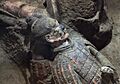
A close-up showing some of the original colors on the figures.
-
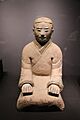
A rare sitting terracotta figure.
-
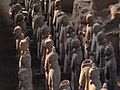
Detail of the front rank in Pit 1.
-
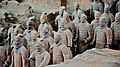
Warriors standing in formation.
-
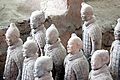
A group of warriors with different uniforms.
-
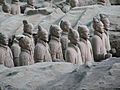
Soldiers standing together.
-
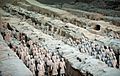
A view of the army from above.
-
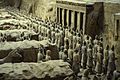
Detailed view of a warrior's face.
-
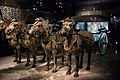
A bronze chariot found near the tomb.
-
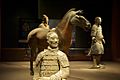
A large group of warriors.
-
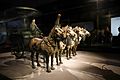
Inside the museum, showing the scale of the discovery.
-
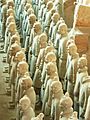
Another view of the warriors.
-
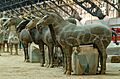
A general and his soldiers.
-
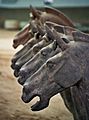
Terracotta horses, ready for battle.
-
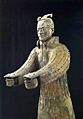
Close-up of a warrior's armored sleeves.

.jpg)

.jpg)
.jpg)

.jpg)


.jpg)


See also
 In Spanish: Guerreros de terracota para niños
- List of World Heritage Sites in China
- Qin bronze chariot
