
Tuskegee Institute Silver Anniversary Lecture facts for kids
Quick facts for kids 
Booker T. Washington at Carnegie Hall in 1906. Mark Twain is seated behind him.
|
|
| Date | January 23, 1906 |
|---|---|
| Location | Carnegie Hall |
| First reporter | The New York Times |
| Participants | Booker T. Washington, Mark Twain, Joseph Hodges Choate, Robert Curtis Ogden, John D. Rockefeller, Henry H. Rogers, Clarence H. Mackay, Morris K. Jesup, J. G. Phelps Stokes, Isaac Newton Seligman, George Foster Peabody, John Crosby Brown, Carl Schurz, W. H. Schieffelin, William Jay Schieffelin, Joseph Hodges Choate, Henry Villard, Nicholas Murray Butler, Cleveland H. Dodge, Alfred Shaw, Felix M. Warburg, R. Fulton Cutting, Collis P. Huntington, Robert Bowne Minturn, Jr., Jacob H. Schiff, Paul M. Warburg |
The Tuskegee Institute Silver Anniversary Lecture was a special event held at Carnegie Hall in New York City on January 23, 1906. Its main goal was to raise money to help educate African Americans in the Southern United States.
Many important people from New York attended and spoke at the event. Famous speakers included Booker T. Washington, the writer Mark Twain, and well-known lawyer Joseph Hodges Choate. This lecture was the start of a big fundraising effort by Booker T. Washington for the Tuskegee Institute. He wanted to raise money to cover the school's yearly costs, improve its buildings, and create a special fund to help it grow.
The fundraising had three main goals. They wanted to add $90,000 to the school's yearly income. They also aimed to create a large fund of $1,800,000. Finally, they hoped to raise $34,000 to install a new heating system at the school. People were asked to donate because they felt it was important to support the education of African Americans, especially after slavery ended.
The event at Carnegie Hall celebrated the "silver jubilee" of the Tuskegee Institute. A "silver jubilee" means 25 years. The school was founded in April 1881, so 1906 marked its 25th anniversary.
A Special Night at Carnegie Hall

The lecture took place on January 23, 1906. The very next day, The New York Times newspaper wrote about it as the most important story on its front page.
Many great speakers of the time shared their thoughts. These included Booker T. Washington himself, the famous author Mark Twain, and the respected lawyer Joseph Hodges Choate. Between the speeches, eight African American singers performed lively revival songs, entertaining the audience.
Carnegie Hall was completely full that night. A large crowd even gathered outside because they couldn't get in. The New York Times said the crowd was as big as those seen when a local politician, William Travers Jerome, held his campaign events there.
Many important people from New York society came to the lecture. Some of these well-known figures included John D. Rockefeller, Henry H. Rogers, Clarence H. Mackay, and Felix M. Warburg.
The Speakers and Their Messages
William Jay Schieffelin, a successful businessman and socialite, started the lecture. He introduced Joseph Hodges Choate, who was a very famous lawyer and diplomat. Choate had been involved in many important legal cases in American history. He also helped create the Metropolitan Museum of Art.
Mark Twain's speech was a big hit. The audience often laughed and clapped during his talk. He especially got a good reaction when he joked about rich people who try to avoid paying taxes.
Booker T. Washington was introduced by Robert Curtis Ogden. Ogden was a progressive businessman and a strong supporter of the Tuskegee Institute. Parts of Booker T. Washington's speech were later printed in The New York Times.
He spoke about the importance of African Americans to the country: "The negro in many ways has proved his worth and loyalty to this country. What he now asks is that through such institutions as Hampton, Fisk, and Tuskegee he shall be given the chance to render high and intelligent service to our country in the future. I have faith that such an opportunity will be given him."
Images for kids
-
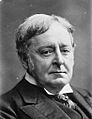
Joseph Hodges Choate, 1910
-
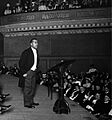
Booker T. Washington delivering his speech
-
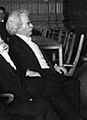
Mark Twain after speaking at Carnegie Hall, listening to Booker T. Washington's speech


