
Vladimir Markovic facts for kids
Quick facts for kids
Vladimir Marković
|
|
|---|---|

Vladimir Marković in 2014, portrait via the Royal Society
|
|
| Born |
Vladimir Marković
October 1973 (age 52) Germany
|
| Citizenship | British |
| Alma mater | University of Belgrade (BSc, PhD) |
| Known for | Surface subgroup conjecture Ehrenpreis conjecture |
| Awards |
|
| Scientific career | |
| Fields |
|
| Institutions |
|
| Thesis | Jedinstveno ekstremalna kvazikonformna preslikavanja i stacionarne tačke integrala energije (1998) |
Vladimir Marković is a famous mathematician. He is a Professor of Mathematics at the University of Oxford in the United Kingdom. Before this, he was a professor at the California Institute of Technology (Caltech) from 2013 to 2020. He also taught at the University of Cambridge from 2013 to 2014.
Early Life and Education
Vladimir Marković was born in Germany in 1973. He studied at the University of Belgrade in Serbia. There, he earned his first degree in science in 1995. He then completed his PhD in 1998.
Career and Research
Professor Marković has worked at several other universities. These include the University of Warwick, Stony Brook University, and the University of Minnesota. He also helps edit the Proceedings of the London Mathematical Society, which is a major math journal.
His main research areas are in different types of geometry and topology. These fields study shapes, spaces, and how they change. He also works on dynamical systems, which look at how things change over time. His work often involves functional analysis and geometric analysis, which are advanced math topics.
Awards and Achievements
Professor Marković has received many important awards for his work.
- In 2014, he became a Fellow of the Royal Society (FRS). This is a very high honor for scientists in the UK.
- He won the Clay Research Award in 2012.
- In 2004, he received both the Whitehead Prize and the Philip Leverhulme Prize.
- In 2015, he was a special member at the Institute for Advanced Study.
- In 2016, he was given a Simons Investigator Award.
His nomination for the Royal Society said he is a world leader. It mentioned his work on quasiconformal homeomorphisms and low-dimensional topology. He has solved many difficult math problems. For example, with Jeremy Kahn, he proved a key idea by William Thurston. This idea was about hyperbolic 3-manifolds and how they contain certain types of surfaces.
Images for kids
-
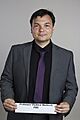
Vladimir Marković in 2014, portrait via the Royal Society
