
Warren Motor Car Company Building facts for kids
Quick facts for kids |
|
|
Warren Motor Car Company Building
|
|

Office Building, 2020
|
|
| Location | 1331 Holden St. Detroit, Michigan |
|---|---|
| Built | 1910 |
| Architect | Rogers and MacFarlane |
| Architectural style | Commercial style |
| NRHP reference No. | 100005108 |
| Added to NRHP | March 20, 2020 |
The Warren Motor Car Company Building, also known as the Lincoln Motor Car Company Building, is an old factory in Detroit, Michigan. You can find it at 41331 Holden Street. This important building was added to the National Register of Historic Places in 2020 because of its interesting history.
A Look Back: The Building's History
The Warren Motor Car Company Story


In the early 1900s, Detroit was a busy city with many new businesses. Car companies were especially popular. One of these was the Warren Motor Car Company. It was started in 1909 by Homer Warren, a successful real estate person.
The company first worked from a building on Michigan Avenue. In its first year, they made 1,000 cars! In 1910, Homer Warren bought the land on Holden Street where this factory now stands. Another company had started building something there but never finished it. Warren then hired a Detroit architecture firm, Rogers and MacFarlane, to design the factory buildings. These buildings were finished and used in 1910.
Changes in the 1910s
The Warren Motor Car Company started well, but it didn't last. They kept changing their car models every year. Their cars were also quite expensive, so fewer people bought them. The company was reorganized in 1912, but by 1913, it went out of business.
The Holden factory was then sold to William C. Rands. His company, Rands Manufacturing, made car parts. In 1916, Rands' company joined with four others to form Motor Products. This new company needed more space. They traded factory buildings with the Lozier Motor Company. Motor Products moved to a different factory, and Lozier took over the Holden factory.
Lozier didn't stay long, less than a year. In 1917, Henry M. Leland bought the property. He used it for his new company, the Lincoln Motor Company. Leland quickly set up the factory to build Liberty engines for fighter planes during World War I. He even added another building. However, the Holden factory soon became too small. By early 1918, most of the engine production moved to a brand new Lincoln Motor Company Plant. Only a small part of the work stayed at the Holden factory.
What Happened Later
After World War I, Lincoln Motor Company had problems. Henry Ford bought the company in 1922. By 1923, the Holden factory was changed to make Model T cars. It likely continued making Model Ts until about 1927.
After that, the building was used by different companies. These included Dietrich Inc. and several companies owned by Dallas E. Winslow. He owned another car company and two refrigerator companies that used the factory.
Starting in 1946, a grocery company called Grosse Pointe Quality Foods used the Holden plant. They stayed there until at least 1977. Another grocery company, Metro Groceries, Inc., used it in the 1980s. In 2019, the Holden building was home to a recycling center, an artist's studio, and a public art gallery.
Exploring the Building's Design
The Warren Motor Car Company Building sits on a triangle-shaped piece of land. It covers about 4.67 acres. Holden Street, Lincoln Street, and the Grand Trunk Western Railroad tracks surround it. The building grew over time with many additions. These additions used different materials and styles.
Five main parts of the building are important for its history. These include the office building, the first factory, and three factory additions. All these were built between 1910 and 1917. Six smaller additions were also built later, from the 1950s to the 1970s. These were added for the grocery companies that used the building.
The older buildings are mostly made with strong timber frames and brick walls. One building from 1917 is made of reinforced concrete. The newer additions have steel frames and concrete floors. Their outside walls are made of masonry.
The Office Building
The office building was designed by Rogers and MacFarlane and built in 1910. It has two stories and is built in the Commercial style. It has a timber frame and walls made of dark red brick with stone decorations.
The front of the building has five sections, called bays. The main entrance is in the middle section. Two windows are on each side of the entrance. Red brick columns separate these sections. The windows have stone sills. A stepped brick design is between the first and second floors. The second floor also has five sections of windows, matching the ones below.
Each window section has three double-hung windows with a horizontal window above them. On the second floor, there are stone panels between and above the windows. A brick wall at the top, called a parapet wall, has brown terra cotta on it. Above that, there's a decorative brick design with diamond shapes.
Building 2: The First Factory
Building 2 was the first factory part of the building. It was also designed by Rogers and MacFarlane and built around 1910. This building has two stories and a flat roof. It is about 159 feet long and 60 feet wide. It has a timber frame and brick walls. It connects to the office building on one side and Building 3 on the other.
The windows are different on each floor. The first-floor windows were meant for single double-hung windows. The second-floor windows are larger. They were designed for multi-paned steel factory windows and have stone sills.
Building 3: Another Factory Section
Building 3 is directly connected to Building 2. It was built around the same time and has a similar design. It also has two stories, a flat roof, a timber frame, and brick walls. It is about 118 feet long and 60 feet wide. The windows on its first and second floors are different sizes. This building connects to one end of Building 2 and to Building 4 on its other end.
Building 4: The Last Factory in Line
Building 4 connects to the end of Building 3. This means the office building and Buildings 2, 3, and 4 form a long line. Building 4 was also designed by Rogers and MacFarlane. It was built a little later than the others, probably in 1911. It is a two-story building with a flat roof, timber frame, and brick walls. It measures about 215 feet long and 67 feet wide. One side has 12 window sections, all looking the same. A small, one-story addition without windows is at one end.
Building 5: A Later Factory Addition
Building 5 is a two-story building made of reinforced concrete with a brick outside. It was built in 1917. It is attached to Building 3. Originally, it was shaped like the letter "C." It covered an area of 153 feet by 87 feet. By 2020, newer additions completely surrounded this building. The middle part of the "C" shape has also been filled in.
Images for kids
-
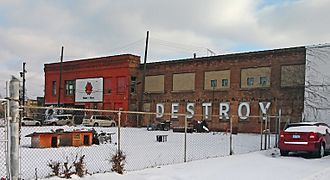
Office (left) and building 2 (factory, now studio space)
-
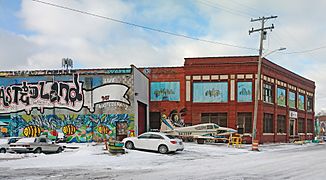
Building 2 (factory) with addition in the foreground, and office (right)
-
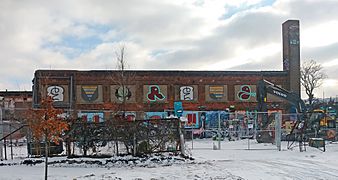
Building 4 (factory) with Lincoln Street Art Park in the foreground
-
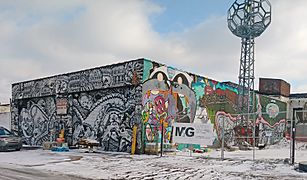
Later addition between buildings 3 and 4
-
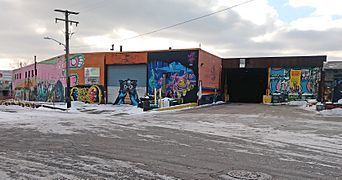
Recycling center (later addition)


