
Western water-holding frog facts for kids
Quick facts for kids Western water-holding frog |
|
|---|---|
 |
|
| Female | |
Scientific classification  |
|
| Kingdom: | Animalia |
| Phylum: | Chordata |
| Class: | Amphibia |
| Order: | Anura |
| Family: | Pelodryadidae |
| Genus: | Ranoidea |
| Species: |
R. occidentalis
|
| Binomial name | |
| Ranoidea occidentalis (Anstis et al, 2016)
|
|
| Script error: The function "autoWithCaption" does not exist. | |
| Synonyms | |
|
|
Script error: No such module "Check for conflicting parameters".
The western water-holding frog (Ranoidea occidentalis) is a special type of frog. It lives only in Australia. This means it is endemic to Australia. Its scientific name, occidentalis, means "western." This name tells us it lives in the western part of the continent.
Contents
Meet the Western Water-Holding Frog!
What Does It Look Like?
This frog is quite large and strong. Male frogs grow to about 60 millimeters (2.4 inches) long. Females are a bit bigger, reaching about 70 millimeters (2.8 inches). We measure their length from their nose to their bottom.
Their skin color can be grey or dark brown. The frog has a flat head with big eyes on top. It also has a large mouth. Its legs are short, and its toes have webbing. This helps it move in water. When it's time to find a mate, the male frog makes a low "waah waah waah" sound. It can do this about 80 times every minute!

How Does It Live? (Behavior and Life Cycle)
The western water-holding frog has an amazing way to survive dry times. It can aestivate for many months. This means it digs a burrow and rests deep underground. While resting, it sheds its skin. This shed skin forms a special cocoon around its body. This cocoon helps it stay moist and safe from the dry weather.
The frog stays in its burrow until heavy rains arrive. These rains fill up puddles and ponds in the landscape. This signals the frogs that it's time to come out. They then start their breeding activities. Females lay many eggs, sometimes up to 500 at once. They lay these eggs in temporary water bodies.
Where Can You Find This Frog? (Habitat)
You can find the western water-holding frog across a large area of central Western Australia. It lives in dry and semi-dry regions. Its home stretches south from Karratha to Kalgoorlie. It also lives eastwards from the west coast. You can find it all the way to the Canning Stock Route and Mavis Rock.
Fun Facts About Western Water-Holding Frogs
- Their scientific name, Litoria platycephala, means "flat head."
- They only emerge from their underground homes after heavy rainfall.
- Western water-holding frogs create a waterproof cocoon from their own shed skin to prevent drying out.
- They can store enough water to survive months, or even years, without drinking!
- These frogs can "aestivate" (a super-long sleep) for extended periods, waiting for rain.
- They dig their own burrows up to a meter deep.
More Photos
-
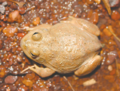
Female frog seen from above
-
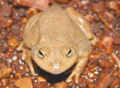
Female frog seen from the front
-
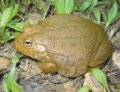
Another side view of a female frog


See also
 In Spanish: Cyclorana occidentalis para niños
