
Winged Victory of Samothrace facts for kids


The Winged Victory of Samothrace is a very famous ancient Greek statue. It is also called the Nike of Samothrace. This amazing sculpture is made from Parian marble, which is a special type of white stone. Today, you can see it in the Louvre Museum in Paris, France.
Experts believe this statue was created around 190 BC, which is over 2,200 years ago! It was found in 1863. The statue was made to celebrate a big win in a sea battle near a place called Samothrace. It shows Nike, who was the Greek goddess of victory.
About the Statue
This statue is very tall, standing about 2.44 meters high. That's taller than most adults! It shows Nike with huge wings, looking like she just landed on the front of a ship.
What Makes It Special?
The Winged Victory is famous for a few reasons:
- Movement and Stillness: The artist made it look like Nike is moving very fast, but she is also perfectly still. It's like a moment frozen in time.
- Flowing Clothes: Her clothes look like they are blowing in a strong wind. You can almost feel the breeze! This makes the statue feel very real and alive.
- Balance: Even though it looks like she's moving, the statue has a beautiful, graceful balance.
The statue is missing its head and arms, but it is still one of the most important and beautiful artworks from ancient Greece.
Images for kids
-
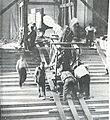
The statue was carefully lowered down a ramp in 1939 when it was removed from the Louvre and Paris for safekeeping.
-
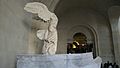
The Winged Victory of Samothrace, side view
-

The Winged Victory of Samothrace, before restoration
-
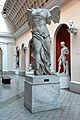
A plaster copy of the Winged Victory in the National Museum of Fine Arts in Rio de Janeiro, Brazil
-
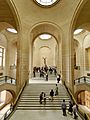
The Daru staircase leading to the statue
-
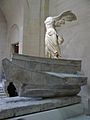
The statue after last restoration
-

The statue on its pedestal
-
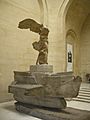
The statue before restoration, standing on a marble block
-
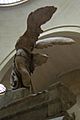
The Winged Victory of Samothrace, back view


.JPG)
.JPG)


See also
 In Spanish: Victoria alada de Samotracia para niños
