
Winslow Ames House facts for kids
Quick facts for kids |
|
|
Winslow Ames House
|
|

Winslow Ames House on the grounds of the Lyman Allyn Art Museum
|
|

 Location in Connecticut

Location in the United States
|
|
| Location | 132 Mohegan Avenue, New London, Connecticut |
|---|---|
| Area | less than one acre |
| Built | 1933 |
| Architect | Robert W. McLaughlin, Jr. |
| Architectural style | International style |
| NRHP reference No. | 95000283 |
| Added to NRHP | March 23, 1995 |
The Winslow Ames House is a special kind of home in New London, Connecticut. It's a "prefabricated" house, meaning parts of it were built in a factory and then put together on site. It was designed in a cool, modern way called the International Style.
This unique house was built in 1933 by Robert W. McLaughlin, Jr.. A man named Winslow Ames, who taught art history at Connecticut College, had it built. He got the idea after seeing similar houses at a big fair called the Century of Progress Exposition in Chicago. The house cost about $7,500, which was a good amount of money back then. It's one of only two "Motohomes" (that's what McLaughlin's company, American Houses Inc., called them) that are still standing today.
The Winslow Ames House is made of three main parts, like big rectangles, and has a flat roof. It sits on a concrete base and has a strong steel frame. It was originally built with special panels that contained asbestos, which was a common building material at the time. The house has a central part that handles all the heating and plumbing. The other parts include two bedrooms and a garage for one car.
Winslow Ames and his family lived in the house for a short time. Later, in 1949, Connecticut College bought the house. They used it to house their teachers until 1986. By 1989, the house was in bad shape and had problems because of the asbestos. It was almost torn down! But a person named Ms. Hendrickson worked hard to save it after learning about its history. The house was fixed up in 1994 and then added to the National Register of Historic Places in 1995. Another house built by Ames, the House at 130 Mohegan Avenue, was also added to the National Register in 2009.
Contents
What Makes the Winslow Ames House Special?
The Winslow Ames House was very different from most homes built in the 1930s. It was a "modular" home, meaning it was made from parts that could be put together easily. It was built on a concrete base and had a strong frame made of welded steel.
Who Designed This Unique Home?
The house was designed by Robert W. McLaughlin, Jr., who started a company called American Houses Inc. in 1932. McLaughlin wanted to make homes that were affordable for many people. He did this by using new building methods and materials, like making parts in a factory. His designs were part of the International Style, which focused on simple shapes and modern looks.
What are "Motohomes"?
McLaughlin's houses were called "Motohomes." They were designed to be easy to make bigger, take apart, or even move if needed. A cool feature was their "motounits," which were central parts that held all the heating and plumbing equipment. Using steel for these factory-made homes became harder during World War II because steel was needed for the war effort. After the war, most factory-made homes were built with wood instead.
Why Did Winslow Ames Build It?
Winslow Ames, an art history professor, was very interested in the Modernism movement. He believed that modern, factory-made houses would become very popular. After seeing these types of homes at the Century of Progress Exposition in Chicago in 1933, he decided to build two of them on land owned by the Lyman Allyn Art Museum. The Ames house cost $7,500, which was similar to other McLaughlin houses from that time.
How Was the House Built?
The Winslow Ames House sits on a solid concrete base and has a skeleton made of welded steel. Its walls were made from white panels, about 4 feet (1.2 m) wide. These panels had asbestos board on the outside and an insulating layer inside. The house has two floors and is made of three rectangular sections. These sections are placed a bit off-center, giving the house an interesting shape. It also has a flat roof.
The largest section in the middle holds the kitchen and bathroom. The section on the left has the main entrance, a staircase, and two bedrooms. The section on the right is a one-car garage. The second floor only covers the part of the garage that overlaps with the middle section.
How the House Was Used Over Time
The house was ready for people to live in by 1934. Winslow Ames and his family lived there for a short time. Many different people rented the house over the years. In 1949, the Ames family sold the house to Connecticut College.
College Housing and Changes
From 1949 to 1987, the college used the house as a place for their teachers to live. For example, Mary Kent, her husband, and their three children lived there from 1958 to 1961. Over the years, some parts of the house were updated, like the furnace, kitchen cabinets, and plumbing. But the main "core module" that handles heating and plumbing always kept its original purpose.
Facing Demolition
Eventually, the house started to look run down and became an "eyesore." By 1989, the college was worried about the asbestos in the building. They even got permission to tear the house down because they wanted to use the land for a boathouse.
A New Purpose
After its restoration was finished, Connecticut College decided to use the house for offices and meeting rooms instead of tearing it down.
Saving and Restoring the House
The Winslow Ames House was saved thanks to the hard work of Ms. Hendrickson. She discovered the important history of the house and its designer. The house was considered very rare because only one other "Motohome" like it still existed in White Plains, New York.
A Community Effort
Ms. Hendrickson gathered many people to help save the house, including students and teachers from the college, and a group called New London Landmarks. Because of their efforts, the plan to tear down the house was put on hold. In May 1990, the Connecticut Historical Commission gave the college $24,000 to help. The college also put in the same amount of money, which they had originally planned to use for tearing the house down.
What Was Done During Restoration?
During the restoration, the original asbestos panels were covered with new, safe panels that looked just like the old ones. A new roof was put on, and the windows were replaced with vertical casement windows, which were the type originally used. The inside and outside of the house were painted white. However, the restoration did not change the flooring back to the original Masonite rectangles. The whole restoration project was finished in 1994, and the house was officially listed on the National Register of Historic Places in 1995.
Images for kids
-
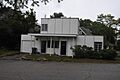
Winslow Ames House on the grounds of the Lyman Allyn Art Museum
