
Abbott's sphinx facts for kids
Quick facts for kids Abbott's sphinx |
|
|---|---|
.jpg) |
|
Scientific classification  |
|
| Kingdom: | Animalia |
| Phylum: | Arthropoda |
| Class: | Insecta |
| Order: | Lepidoptera |
| Family: | Sphingidae |
| Genus: | Sphecodina |
| Species: |
S. abbottii
|
| Binomial name | |
| Sphecodina abbottii (Swainson, 1821)
|
|
| Script error: The function "autoWithCaption" does not exist. | |
| Synonyms | |
|
|
Script error: No such module "Check for conflicting parameters".
The Abbott's sphinx moth, also known as Sphecodina abbottii, is a unique insect. It belongs to the Sphingidae family, which are often called sphinx moths or hawk-moths. A scientist named William Swainson first described this species in 1821.
Contents
Where the Abbott's Sphinx Lives
This moth makes its home in eastern North America. You can find it in many different areas across this region.
Life Cycle and Habits
Adult Abbott's sphinx moths fly during certain times of the year. In cooler northern areas, they usually fly in May and June. However, in warmer southern regions, they can have several generations. This means they complete their life cycle more than once in a single year.
The young moths, called larvae (or caterpillars), eat specific plants. They like to feed on grape plants (Vitis). They also enjoy Parthenocissus quinquefolia, which is also known as Virginia creeper, and plants from the Ampelopsis genus.
What the Abbott's Sphinx Looks Like
The Abbott's sphinx moth has some cool features. Its underwings have a bright yellow band. When it flies, it makes a buzzing sound, which makes it look a bit like a bee!
The front wings, called forewings, are a violet-grey color when the moth is newly emerged. They have swirly black lines that look like tree bark. When the moth rests, it raises its abdomen (the back part of its body). This helps it blend in perfectly with tree bark, making it look like a broken branch. This is a great way for the moth to hide from predators.
Larval Stages
The young caterpillars, known as instars, change their appearance as they grow. When they are very young, they are a pale greenish-white color. At first, they have a small horn near their back end. As they get older, this horn changes into a brown knob.
When the caterpillars are fully grown (about 75 millimeters long), they come in two main patterns. One type has brown bands and ten large, pale green spots on its back. It also has a special eyespot near its rear. This form might mimic grapes, helping it blend in with the plants it eats.
The other type of fully grown caterpillar is completely brown. It has a pattern that looks like wood grain. This brown form also has the eyespot near its rear. In this final stage, the knob on their back looks very much like a real eye, even having a white spot that looks like a reflection. If a caterpillar is poked or squeezed, it can make a squeaking sound and even try to bite! This helps it scare away anything that might try to eat it.
Gallery
-
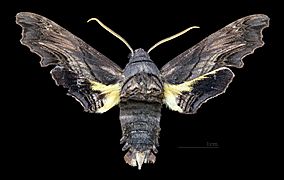
Male Abbott's sphinx moth, seen from above.
-
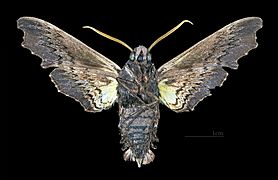
Male Abbott's sphinx moth, seen from below.
-
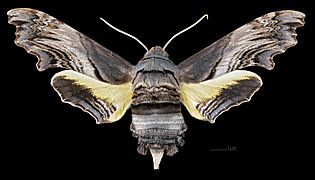
Female Abbott's sphinx moth, seen from above.
-
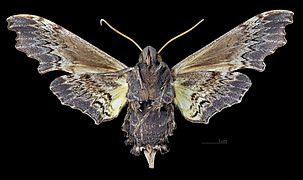
Female Abbott's sphinx moth, seen from below.


