
Barony of Newton facts for kids
The Barony of Newton is a special historical title in Scotland, like a very old noble rank. It's located near a town called Grangemouth in Stirlingshire. The Barony was officially created on April 3, 1685, with a man named Edward Wright as its first baron. Later, a King named George III confirmed this title.
Even before 1685, there were mentions of "Newton of Bothkennar" as a place. For example, people like John Callendar and William Bruce were linked to Newton in the 1600s. But it wasn't until Edward Wright, who was a lawyer, became the first official Baron of Newton in 1685.
Contents
Early Barons: The Wright Family
Edward Wright's time as baron was short. Just a few years later, his son, also named Edward, took over the lands and title. Records show that on May 30, 1690, Edward Wright the second officially inherited the lands of Newton, including fishing rights in the River Carron and a new mill. These lands were all part of the Barony of Newton.
Edward Wright the second also had a short time as baron. Within a few years, he passed away, and his brother, John Wright, inherited the barony.
John Wright's Time
John Wright became the Baron of Newton on December 16, 1695. He was the second son of the first Edward Wright. John also expanded his family's property in Stirlingshire. On January 2, 1702, he was granted the lands and barony of Kersey (also called Kerse).
It seems Kersey was later given to his younger brother, Richard, before 1710. Richard Wright of Kersey was involved in several legal cases in the 1720s and 1730s.
Richard Wright Takes Over
Richard Wright of Kersey officially inherited half of Newton and the lands of Kersey from his brother John, who died in March 1714. This happened on February 2, 1733.
The Dundas Family and Industrial Growth
Around the mid-1700s, the Barony of Newton came into the hands of a very important family, the Dundas family.
Sir Lawrence Dundas (1712–1781)
Sir Lawrence Dundas was born in 1712. He was a very successful businessman and politician. He became a Member of Parliament and was made a baronet in 1762. Sir Lawrence acquired many properties in the Forth Valley area, including the lands and Barony of Newton. This area was quickly becoming a center for industry.
Sir Lawrence was a smart businessman who saw many opportunities. He played a big part in building the Forth and Clyde Canal. This canal connected the east coast of Scotland with the west coast, running right through his estates. The canal was mainly used to transport goods like coal.
He also founded the town of Grangemouth in 1777. Grangemouth was built at the eastern end of the Forth and Clyde Canal to help with shipping and services. Today, Grangemouth is one of Scotland's busiest ports.
Carron Iron Works
Many historians believe that the Industrial Revolution in Scotland truly began with the creation of the Carron Iron Works. This important factory was built nearby in Falkirk in 1759.
The most famous product made at the Carron Iron Works was the carronade. This was a short, powerful iron cannon. It was specially designed for use by the British Royal Navy.

Thomas Dundas (1741–1820)
Sir Lawrence Dundas passed away in 1781, and his only son, Thomas, took over. Sir Thomas Dundas was born in 1741. He also held important political roles, serving as a Member of Parliament. In 1794, he was given the title Baron Dundas of Aske.
Sir Thomas is famous for asking William Symington to build the Charlotte Dundas around 1803. This boat was designed to be a tugboat for his canal. It is known as the world's first steamboat! Thomas Dundas died in 1820, and his eldest son, Lawrence, succeeded him.
Lawrence Dundas (1766–1839)
Lawrence Dundas was born in 1766. He became the Lord Mayor of York and was later given the title Earl of Zetland in 1838. He passed away in 1839, and his son, Thomas, became the 2nd Earl of Zetland.
Thomas Dundas (1795–1873)
Thomas Dundas was born in 1795 and became the 2nd Earl of Zetland. He was also a very important Freemason in England. In 1848, he sold some lands at Seabegs to a railway company. He died in 1873 without children, so the titles and lands went to his nephew.
Lawrence Dundas (1844–1929)
Lawrence Dundas was born in 1844. He went to famous schools like Harrow and Cambridge. He became a Member of Parliament and even the Lord Lieutenant of Ireland. In 1892, he was given the title Marquess of Zetland. He died in 1929, and his elder son, Lawrence, succeeded him.
Lawrence John Lumley Dundas (1876–1961)
Lawrence John Lumley Dundas, the 2nd Marquess of Zetland, also studied at Harrow and Cambridge. He was an army officer and a Member of Parliament. He served as the Governor of Bengal from 1917 to 1922 and later as the Secretary of State for India from 1935 to 1940.
Lawrence Aldred Mervyn Dundas (1908–1989)
Lawrence Aldred Mervyn Dundas, the 3rd Marquess of Zetland, was born in 1908. He served as a Major in the British Army during World War II. He was also a well-known Freemason and a Governor of Harrow School. He was succeeded by his son, Lawrence Mark Dundas.
Lawrence Mark Dundas
Philip David Pickering
In December 2011, the rights and title of the Barony of Newton were passed to Philip David Pickering. He became the 13th Baron of Newton. Philip was born in the UK in 1948, grew up in Canada, and now lives in Australia. He used to work as a chief technology officer and systems engineer.
Philip married Fiona McTaggart in 1969, and they had a daughter named Joanne Alexandra Pickering. They later divorced. Philip then married Patricia Anne Campbell before moving to Australia. His daughter Joanne is currently the heir to the barony.
Barons of Newton
| Barons of Newton (born and died where known/relevant) | Succeeded |
|---|---|
| Edward Wright (d. 1690) | 3 Apr 1685 |
| Edward Wright II (d. 1695) | 1690 |
| John Wright (d. Mar 1714) | 16 Dec 1695 |
| Richard Wright | 1714 |
| Sir Lawrence Dundas, baronet (1712 – 21 Sep 1781) | 1760s or 1770s |
| Sir Thomas Dundas of Kerse, baronet (16 Feb 1741 – 14 Jun 1820) | 1781 |
| Lawrence Dundas, 1st Earl of Zetland (10 Apr 1766 – 19 Feb 1839) | 1820 |
| Sir Thomas Dundas, 2nd Earl of Zetland (5 Feb 1795 – 6 May 1873) | 1839 |
| Sir Lawrence Dundas, 1st Marquess of Zetland and Earl of Ronaldshay (16 Aug 1844 – 11 Mar 1929) | 1873 |
| Lawrence John Lumley Dundas, 2nd Marquess of Zetland (1876 – 1961) | 1929 |
| Lawrence Aldred Mervyn Dundas, 3rd Marquess of Zetland (12 Nov 1908 – 1989) | 1971 |
| Lawrence Mark Dundas, 4th Marquess of Zetland (born 1937) | 1989 |
| Philip David Pickering (b. 1948) | 2011 |
Images for kids
-
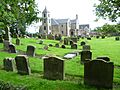
Bothkennar Parish Church

 | John T. Biggers |
 | Thomas Blackshear |
 | Mark Bradford |
 | Beverly Buchanan |
