
Black-fronted duiker facts for kids
Quick facts for kids Black-fronted duiker |
|
|---|---|
 |
|
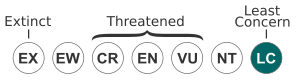
| Conservation status | |
Scientific classification  |
|
| Kingdom: | Animalia |
| Phylum: | Chordata |
| Class: | Mammalia |
| Order: | Artiodactyla |
| Family: | Bovidae |
| Genus: | Cephalophus |
| Species: |
C. nigrifrons
|
| Binomial name | |
| Cephalophus nigrifrons Gray, 1871
|
|
 |
|
| Distribution of Black-fronted duiker | |
| Script error: The function "autoWithCaption" does not exist. | |
Script error: No such module "Check for conflicting parameters".
The black-fronted duiker (Cephalophus nigrifrons) is a small, shy antelope. It lives in the forests of central and west-central Africa. This amazing animal gets its name from a special black stripe on its face.
Contents
What Does the Black-Fronted Duiker Look Like?
The black-fronted duiker is a small, strong antelope. It has a short neck and is very active. Its coat is shiny and can be deep reddish-brown or a lighter orange-brown. The hair on its long legs is darker and not as thick.
A special black stripe runs from its nose all the way to its forehead. This stripe helps tell it apart from other duikers. Its short tail is black with a white tip. Both male and female duikers have short, pointed horns. These horns measure about 4–12 cm (1.6–4.7 in) (1.5 to 4.7 inches) long. They use their horns to protect themselves from other duikers and from predators.
Their long hooves help them move easily in wet places. This duiker usually weighs about 14–18 kg (31–40 lb) (31-40 pounds). It stands about 43 cm (17 in) (17 inches) tall at its shoulder.
Where Do Black-Fronted Duikers Live?
Black-fronted duikers are found in central and west-central Africa. You can find them from southern Cameroon east to western Kenya. They also live south into northern Angola. There is also a small group living in the Niger Delta in eastern Nigeria.
What Kind of Home Does It Like?
The black-fronted duiker lives in different types of forests. These include mountain forests, lowland forests, and swampy forests. They can live from areas near the sea up to high altitudes of 3,500 metres (11,500 ft) (about 11,500 feet). They are often seen in very wet areas. This includes marshes or along the edges of rivers and streams.
How Do Black-Fronted Duikers Live?
Black-fronted duikers are very protective of their homes. They live in pairs, and each pair has its own territory. They defend this area from other duikers. They mark their territory using special smells from glands on their faces.
These pairs have regular paths they use within their territory. These paths connect their sleeping spots with places where they find food. They are active both during the day and at night. They mostly eat leaves and twigs from plants. However, they also enjoy eating fruit when they can find it.
