
Brown-tailed mongoose facts for kids
Quick facts for kids Brown-tailed mongoose |
|
|---|---|
 |
|
| Plate of Galidia olivacea, a synonym of the brown-tailed mongoose, from 1839. The tail is incomplete. | |
| Conservation status | |
Scientific classification  |
|
| Kingdom: | Animalia |
| Phylum: | Chordata |
| Class: | Mammalia |
| Order: | Carnivora |
| Suborder: | Feliformia |
| Family: | Eupleridae |
| Genus: | Salanoia |
| Species: |
S. concolor
|
| Binomial name | |
| Salanoia concolor (I. Geoffroy Saint-Hilaire, 1837)
|
|
 |
|
| Brown-tailed mongoose range | |
| Script error: The function "autoWithCaption" does not exist. | |
Script error: No such module "Check for conflicting parameters".
The brown-tailed mongoose, also known as the brown-tailed vontsira or salano (scientific name: Salanoia concolor), is a special kind of mammal. It belongs to the family Eupleridae, which includes many unique animals found only on the island of Madagascar.
This animal is found nowhere else in the world, meaning it is endemic to Madagascar. It lives in the warm, wet lowland tropical forests. Sadly, its home is shrinking, and it is considered a threatened species because of habitat loss.
Contents
What is a Brown-tailed Mongoose?
The brown-tailed mongoose is a small, furry creature. It is part of a group of animals called "vontsiras" in Madagascar. These animals are often mistaken for mongooses, but they are actually part of their own special family, the Eupleridae. This family is unique to Madagascar.
These animals are carnivores, which means they mostly eat meat. They are important predators in their forest homes. They help keep the ecosystem balanced by controlling populations of smaller animals.
Where Do They Live?
Brown-tailed mongooses live only in the eastern part of Madagascar. They prefer the moist lowland tropical forests. These forests are very dense and full of different plants and animals. They provide the perfect hiding spots and hunting grounds for the mongoose.
The forests are warm and humid, with lots of rain. This creates a rich environment where many species thrive. The brown-tailed mongoose relies on these specific conditions to find food and raise its young.
Why Are They Special?
The brown-tailed mongoose is a fascinating animal because it is found only in Madagascar. This island is famous for its unique wildlife. Many animals and plants there exist nowhere else on Earth. The brown-tailed mongoose is a great example of this special biodiversity.
Its scientific name, Salanoia concolor, helps scientists around the world identify it. The name concolor means "of uniform color," which likely refers to its brownish fur.
How Was It Discovered?
The brown-tailed mongoose was first described by a French zoologist named Isidore Geoffroy Saint-Hilaire in 1837. When he first wrote about it, he gave it a slightly different name. Over time, scientists studied it more closely. They realized it was a unique species and gave it the name Salanoia concolor that we use today.
Scientists continue to study these animals to learn more about their lives. In 2010, another species of Salanoia, called Salanoia durrelli, was discovered. This shows that there are still many amazing animals to find and learn about in Madagascar's forests!
Protecting the Brown-tailed Mongoose
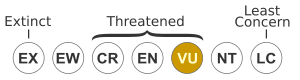
The brown-tailed mongoose is listed as "Vulnerable" by the International Union for Conservation of Nature (IUCN). This means it faces a high risk of becoming extinct in the wild. The biggest threat to these animals is habitat loss.
Threats to Their Home
- Deforestation: Forests are being cut down for farming, logging, and charcoal production. This destroys the homes of the brown-tailed mongoose and many other animals.
- Human Activity: As human populations grow, more land is needed. This often leads to forests being cleared.
- Climate Change: Changes in weather patterns can also affect their forest habitat.
What Can Be Done?
Protecting the brown-tailed mongoose means protecting its forest home. Conservation efforts include:
- Creating Protected Areas: Setting aside parts of the forest where animals and plants are safe from human activities.
- Sustainable Practices: Encouraging ways of farming and living that don't harm the environment.
- Education: Teaching people, especially children, about the importance of protecting wildlife and their habitats.
By working together, we can help ensure that the brown-tailed mongoose and other unique animals of Madagascar continue to thrive for future generations.
