
Bullying facts for kids
_in_March_5,_2007.jpg)
Bullying is when someone repeatedly shows rude or mean behavior to another person. The people who do this are called bullies. Bullying doesn't always have to be physical. It can also be things people say or do online.
Bullying also happens when others see it but don't help. When people who witness bullying step in, they can make a big difference. Bullying isn't just direct meanness. It also happens when people hide it from adults like teachers, ignore it, or even help the bully get away with it. School staff try to stop bullying, even when they don't see it, because they know it can be easy to hide. Some places even have laws against bullying.
Contents
History of the Word
The word "bully" has changed meaning completely over the centuries. In the 1530s, "bully" was actually a term of endearment, similar to "sweetheart" or "good friend." It came from the Dutch word boel, meaning a loved one or brother.
During the 1600s and 1700s, the meaning slowly shifted. It went from meaning a "fine fellow" to a "bragger," and eventually to someone who harasses weaker people. By 1710, the word was officially used as a verb describing aggressive mistreatment of others.
In the early 1900s, United States President Theodore Roosevelt used the term positively as an exclamation, shouting "Bully!" to mean "Superb!" or "Wonderful!" He also coined the term "bully pulpit" to describe using a high office to share positive ideas with the public. Today, the word is used almost entirely to describe harmful behavior.
Where Bullying Happens
Bullying can happen in many places. It often takes place at school, at home, or online. When bullying happens on the internet, it's called cyberbullying.
Bullies use different ways to hurt others. These can include:
- Scaring others: This is called intimidating.
- Being overly pushy: This is like a "steamroller" tactic.
- Making others feel worthless: This is called devaluing.
- Threatening or forcing others: This is like "arm-twisting."
Sometimes, bullying is a mix of these different ways. For example, someone might try to control what others say. If they don't like it, they might try to "run over" or bully that person.
Bullying also involves misusing power. This can be making comments or threats that make someone feel unsafe. For example, a bully might make someone feel unsure about themselves. It can also involve changing rules or goals so that someone can't succeed.
Why Bullying Happens
Bullying happens for different reasons. Sometimes, a person might not be getting the attention they want. Or they might be going through a tough time at home. They might want to control someone else.
Another reason is that the bully might not feel good about themselves. They bully others to feel more powerful. When a bully wants attention or to show off, they might start by saying mean things. This can sometimes lead to physical meanness.
If You Are Being Bullied
- Stay calm and walk away: Bullies often look for an angry or upset reaction. If possible, calmly tell them to stop and walk away to a safe place.
- Tell a trusted adult: Talk to a parent, teacher, school counselor, or coach right away. Telling an adult is not "tattling"—it is standing up for your safety.
- Keep evidence: If the bullying is online, take screenshots of messages or posts, save dates and times, and do not reply to the messages.
- Block and report: Use privacy settings on social media and gaming platforms to block the person and report their account.
- Stay with friends: Bullies are much less likely to target people who are surrounded by supportive friends.
How to Be an Upstander
If you see someone else being bullied, you can help make the situation better without putting yourself in danger:
- Do not join in or laugh: Refusing to laugh or watch takes away the audience the bully wants.
- Speak up if it is safe: A calm statement like "That is not cool" or "Leave them alone" can stop bullying quickly.
- Support the target privately: Sit next to them at lunch, walk with them to class, or simply ask, "Are you okay?"
- Report the behavior: Tell a teacher or school counselor what you saw so they can handle the issue confidentially.
Related Topics
Images for kids
-
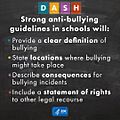
A Centers for Disease Control and Prevention graphic presenting school anti-bullying guidelines.

See also
 In Spanish: Acoso psicológico para niños
