
Cable car facts for kids

A cable car is a super cool type of transportation system that uses strong, moving cables to carry people or goods. These amazing machines help us travel in places that are too steep for regular cars or trains, or simply offer breathtaking views from high above. They come in different shapes and sizes, but they all share the magic of cables!
Contents
Flying High
When most people think of a "cable car," they often picture vehicles suspended high in the air, dangling from strong cables. These are called aerial lifts, and they offer some of the most spectacular rides you can imagine!
Aerial Tramways
Imagine a giant bus, but instead of wheels, it's attached to a cable and soaring through the sky! That's pretty much what an aerial tramway is.
Aerial tramways usually have one or two large cabins that travel back and forth between two stations. Each cabin is supported by a thick, stationary cable (like a bridge) and pulled along by a separate, moving cable. They often operate in pairs, with one cabin going up while the other comes down, helping to balance the system.
You'll often see aerial tramways in very mountainous areas, taking people to ski resorts, hiking trails, or famous viewpoints. They are perfect for crossing deep valleys or climbing very steep slopes.
The Palm Springs Aerial Tramway in California, USA, takes visitors on an incredible journey up the Chino Canyon, offering stunning desert and mountain views. Another famous one is the Sugarloaf Mountain Aerial Tramway in Rio de Janeiro, Brazil, which has been operating since 1912!
Gondola Lifts
Gondola lifts are probably what you think of when you picture ski resorts or theme parks with little cabins moving along a cable.
Unlike tramways that go back and forth, gondola lifts usually have many smaller cabins (often seating 4 to 12 people) that are attached to a continuously moving loop of cable. They travel in one direction, constantly picking up and dropping off passengers at stations. When a cabin reaches a station, it detaches from the fast-moving cable, slows down for people to get on or off, and then reattaches to continue its journey. Gondola lifts are super popular at ski resorts, amusement parks, and even in some cities as a way to connect different areas or offer scenic tours.
Types of Gondola Lifts
- Monocable Gondola Lift: This is the most common type, where a single cable does both the supporting and the pulling.
- Bicable Gondola Lift: This uses two cables – one for support and one for pulling. This makes them more stable and allows them to travel faster or carry heavier cabins.
- Tricable Gondola Lift: As the name suggests, this type uses three cables – two for support and one for pulling. These are the most advanced and stable, perfect for long distances, high speeds, and windy conditions.
The Peak2Peak Gondola in Whistler, Canada, holds a world record for the longest unsupported span between two towers for a lift of its kind – that's a really long stretch of cable without any support underneath!
Chairlifts
If you've ever been skiing or snowboarding, you've probably ridden a chairlift. Chairlifts are similar to gondola lifts in that they have a continuous loop of cable, but instead of enclosed cabins, they have open chairs. You sit on the chair, often with a safety bar that comes down in front of you, and your skis or snowboard hang below. They are designed for quick loading and unloading. You'll find them almost exclusively at ski resorts, taking skiers and snowboarders up the mountain.
On the Ground:Cable Railways
Not all cable cars fly through the air. Some stay firmly on the ground, running on rails or a road, but still get their power from a hidden cable. These are called cable railways.
Cable Car (Railway Type)
When people in the United States say "cable car," they often think of the famous ones in San Francisco, California.
These unique vehicles run on tracks, just like a train or a tram. But here's the clever part: underneath the street, there's a continuously moving steel cable. The cable car has a special device called a "grip" that the driver (called a "gripman" or "gripwoman") uses to grab onto the moving cable. When they want to go, they grip the cable; when they want to stop, they let go and use brakes. It's like a giant, invisible conveyor belt pulling them up and down San Francisco's incredibly steep hills.
Funiculars
Funiculars are another fascinating type of cable railway, especially good for very steep slopes.
A funicular typically has two cars that are permanently attached to opposite ends of the same cable. This cable runs through a pulley system at the top of the slope. As one car goes up, the other car comes down, and they help to counterbalance each other. This makes them very energy-efficient. They always run on a dedicated track, often with a section in the middle where the tracks split to allow the two cars to pass each other.
Funiculars are common in cities built on hills (like Lisbon, Portugal, or Naples, Italy) and in mountainous regions, providing a quick and easy way to get to higher elevations.
Why Do We Love Cable Cars So Much?
Cable cars aren't just cool to look at; they serve many important purposes:
- Their biggest advantage is their ability to climb incredibly steep hills or cross wide valleys that would be impossible or very difficult for roads or traditional railways. This opens up access to beautiful mountain areas for tourism and recreation.
- Because they often travel high above the ground or up steep slopes, cable cars offer unparalleled panoramic views. Imagine seeing entire cities, vast forests, or sparkling oceans spread out beneath you!
- Many cable car systems are powered by electricity, making them a more environmentally friendly option compared to cars or buses that run on fossil fuels. They also reduce the need for extensive road construction in sensitive natural areas.
- In hilly cities, cable cars and funiculars provide efficient public transportation, helping people get around quickly and avoid traffic.
History of Cable Cars
The idea of using cables to move things isn't new! People have been using simple rope and pulley systems for centuries. But modern cable cars, as we know them, started to appear in the 19th century.
At the beginning of the 19th century, cable railways were often used in mining operations to transport heavy materials up and down slopes.
The first successful and widely used urban cable car system for passengers was invented by Andrew Smith Hallidie and began operating in San Francisco on August 2, 1873. Hallidie was inspired to create a safer way to transport people up the city's steep, often slippery, hills after seeing horses struggle and fall.
While simple aerial systems existed earlier, the first modern aerial tramways for industrial use (like moving timber or ore) appeared in the late 19th and early 20th centuries. Soon after, people realized their potential for tourism. The first passenger aerial tramway in Europe opened in Germany in 1908, and the famous Sugarloaf Mountain tramway in Brazil followed in 1912.
After World War II, with the rise of winter sports, chairlifts and gondola lifts became incredibly popular, especially in ski resorts across Europe and North America.
Today, engineers continue to make cable cars safer, faster, more comfortable, and more energy-efficient, using advanced materials and computer control systems. They are truly marvels of engineering!
Cable Cars Around the Globe
Cable cars are found in almost every corner of the world, each with its own unique charm and purpose.
- San Francisco Cable Cars (USA): As mentioned, these are iconic, moving museums on wheels, offering a bumpy but charming ride through the city's historic districts.
- Table Mountain Aerial Cableway (South Africa): This aerial tramway takes visitors to the flat top of Table Mountain in Cape Town, offering incredible 360-degree rotating views of the city and coastline. It first opened in 1929!
- Peak2Peak Gondola (Whistler, Canada): This record-breaking gondola connects the peaks of Whistler and Blackcomb mountains, providing stunning views of the Coast Mountains.
- Aiguille du Midi Cable Car (France): Located in the French Alps, this incredible aerial tramway takes you to a dizzying height of 3,842 meters (over 12,600 feet!) near Mont Blanc, offering breathtaking views of glaciers and mountain ranges.
- Lisbon Funiculars (Portugal): The hilly city of Lisbon boasts several historic funiculars, like the Bica Funicular, which are not just tourist attractions but also essential public transport for locals.
- Ngong Ping 360 (Hong Kong): This spectacular gondola lift offers a 25-minute journey with panoramic views of Lantau Island, the South China Sea, and the Big Buddha statue.
Fun Facts About Cable Cars
- The very first chairlift was built in Sun Valley, Idaho, USA, in 1936! It was inspired by a system used to transport bananas!
- Some of the largest aerial tramways can carry over 100 people in a single cabin!
- The San Francisco cable cars are the last manually operated cable car system in the world, making them a living piece of history and a major tourist attraction.
- In Japan, funiculars are often simply called "cable cars" (ケーブルカー, kēburukā).
- The first funicular in Japan opened in 1918.
See also
- Cable ferry
- Reaction ferry
- Ski lift
- Skyline logging
- Surface lift
- Transporter bridge
- Zip-line
- Gondola lift
Images for kids
-
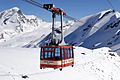
Cable car in Rote Nase, Swiss Alps
-
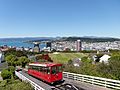
Cable car in Wellington, New Zealand
-
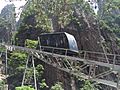
Cable car at Huangshan, China
-
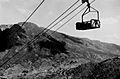
The former Asmara-Massawa Cableway in Eritrea (late-1940s).
-
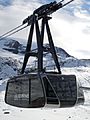
Plateau Rosa cable car, in Italy, reaches 3480m of the Testa Grigia.
-
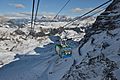
The Arabba Porta Vescovo Funifor
-
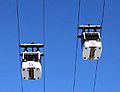
Squaw Valley Funitel, Jan 2005


