
Conference at the Highest Court of the Russian Empire facts for kids
| Конференция при Высочайшем дворе Конференция министров |
|
 |
|
| Agency overview | |
|---|---|
| Formed | 1756 |
| Preceding |
|
| Dissolved | 1762 |
| Superseding agency |
|
| Jurisdiction |  Russian Empire Russian Empire |
The Conference at the Highest Court was a very important government group in the Russian Empire. It was also called the Ministerial Conference. This group was created in 1756 by Chancellor Alexey Bestuzhev-Ryumin. It stopped existing in 1762.
Even though it was officially just an advisory group, it often made big decisions on its own. These decisions were made on behalf of the empress. The Conference had the power to make laws. It also gave orders to other important groups. These included the Senate and the Synod.
Contents
How the Conference Started
The Conference at the Highest Court grew out of earlier meetings. These meetings were not held regularly. They were called "Conference on Foreign Affairs." They started in 1741. Empress Elizabeth Petrovna ordered these meetings. Their main purpose was to talk about important foreign policy issues.
On March 14, 1756, the empress decided something new. She said these meetings should happen regularly. They would be held on specific days. The same people would always attend. This is how the Conference became a permanent group.
What the Conference Did and Who Was In It
The Conference had a lot of power. Its exact duties were not always clear. But it was as important as the Senate and the Synod. In fact, by October 1756, it could send orders to them. These orders had to be followed. The Conference also sent special messages from the empress. It received reports back from various places.
The main goals of the Conference were set in March 1756. It focused on special tasks. These tasks were mostly about managing Russia's actions. This was especially true during the Seven Years' War. The Conference helped guide both domestic and foreign policy.
The Conference had two main parts. One part was the "presence" of the ministers. The other was the office that supported them. The "presence" included top officials. These were the heads of diplomacy, the army, and the navy. It also included the head of secret investigations. The Senate Prosecutor General was also a member.
The empress could also add other influential people. For a while, the future emperor, Pyotr Fyodorovich, was a member. Dmitry Volkov was the secretary of the Conference. He also led its office. He had a team of 12 people working for him.
What the Conference Achieved
The Conference handled many important areas.
- It managed Russia's relationships with other countries. This was done through the Collegium of Foreign Affairs.
- It helped create new agreements and treaties with other nations.
- It oversaw the Russian armed forces.
- It guided military leaders.
- It planned army campaigns against Prussia during the war.
- It managed the Königsberg Province. This area was taken by Russia during the war.
Count Peter Shuvalov was a very important member. Many of his big ideas were put into action by the Conference. These included:
- Creating new types of cannons called "licornes."
- Forming a new military group called the Western Corps.
- Changing Russia's money system.
- Starting the Copper Bank.
The Conference also dealt with many administrative tasks. It handled issues about government staff. However, its work on domestic policy was limited. It did not take over all the Senate's duties.
The Conference met twice a week. These meetings were usually on Mondays and Thursdays. Some historians have a negative view of the Conference. For example, Anton Kersnovsky said it was not very good. He felt it was too influenced by Austria. He believed it often put Austria's interests first.
The conference immediately fell entirely under Austrian influence and, commanding the army a thousand versts from St. Petersburg, was led, it seemed, first and foremost by respecting the interests of the Vienna Cabinet.
Why the Conference Ended
When Peter III became emperor in January 1762, things changed. The Conference lost its power. It was officially ended by an imperial order on February 8, 1762. This happened because Russia planned to leave the Seven Years' War.
The Conference's duties were later given to a new group. This group was called the Imperial Council. Later, under Empress Catherine II, it was called the "Council at the Highest Court." This new council took over the Conference's office and its way of managing things.
Important Conference Ministers

- Stepan Apraksin (1756 – 1757)
- Alexey Bestuzhev-Ryumin (1756 – 1758)
- Mikhail Bestuzhev-Ryumin (1756 – 1757)
- Alexander Buturlin (1756 – 1760)
- Mikhail Vorontsov (1756 – 1762)
- Roman Vorontsov (1761 – 1762)
- Mikhail Golitsyn (1756 – 1757)
- Ivan Neplyuyev (1760 – 1762)
- Nikita Trubetskoy (1756 – 1762)
- Yakov Shakhovskoy (1760 – 1761)
- Alexander Shuvalov (1756 – 1762)
- Peter Shuvalov (1756 – 1762)
- Grand Duke Pyotr Fyodorovich (1756 – 1757)
Images for kids
-
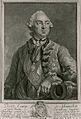
Count Peter Shuvalov, one of the most influential conference ministers
