
Cynthia's fritillary facts for kids
Quick facts for kids Cynthia's fritillary |
|
|---|---|
 |
|
Scientific classification  |
|
| Kingdom: | Animalia |
| Phylum: | Arthropoda |
| Class: | Insecta |
| Order: | Lepidoptera |
| Family: | Nymphalidae |
| Genus: | Euphydryas |
| Species: |
E. cynthia
|
| Binomial name | |
| Euphydryas cynthia (Denis & Schiffermüller, 1775)
|
|
| Script error: The function "autoWithCaption" does not exist. | |
| Synonyms | |
|
|
Script error: No such module "Check for conflicting parameters".
Euphydryas cynthia, also known as the Cynthia's fritillary, is a beautiful butterfly that belongs to the Nymphalidae family. You can find this butterfly in the high Alps mountains and in some parts of Bulgaria. It lives in alpine meadows, which are grassy areas high up in the mountains, from about 400 to 2,300 meters above sea level.
Contents
What Does Cynthia's Fritillary Look Like?
The Cynthia's fritillary butterfly has a wingspan of about 32 to 42 millimeters. This is how wide it is when its wings are spread out. Its upper wings have a cool orange and brown checkered pattern. These patterns are separated by the veins in the wings and are arranged in lines.
Boys and girls of this butterfly look a bit different! This is called sexual dimorphism.
- The male butterfly has white checkered patterns near the base and middle of its wings.
- The female butterfly has orange checkered patterns all over its wings.
On the underside of the wings, the male has orange with light checkered patterns on both the front and back wings. The female's front wings are checkered with darker colors, while her back wings are orange with light checkered patterns. Also, on both the top and bottom of the female's wings, the orange checkers in a certain band have a small black dot in the middle.
There are also different forms of this butterfly:
- The Euphydryas cynthia alpicola form is smaller and has some black coloring on its front.
- The Euphydryas cynthia drenovskii and Euphydryas cynthia leonardi forms are larger and have brighter colors.
How Does Cynthia's Fritillary Live?
The young butterflies, called larvae or caterpillars, love to eat certain plants. They mostly feed on Plantago species, like P. alpina, and also Alchemilla species.
These caterpillars and their pupae (the stage before they become butterflies) have special chemicals inside them. These chemicals are called iridoid glucosides. Even small amounts of these chemicals make the caterpillars taste bad to predators, like birds or other insects that might try to eat them. This helps the caterpillars stay safe!
The Cynthia's fritillary caterpillar spends the winter sleeping. It takes two full seasons for a caterpillar to grow into an adult butterfly. These butterflies usually fly in just one group each year, from late June to early August.
Cynthia's Fritillary Family Tree
The Euphydryas cynthia butterfly belongs to a special group called the Hypodryas subgenus. This group includes other similar butterflies.
Images for kids
-
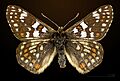
Male dorsal view
-
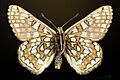
Male underside
-
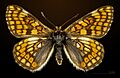
Female dorsal view
-
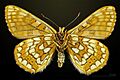
Female underside
-
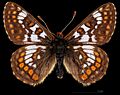
Euphydryas cynthia alpicola- Male
-
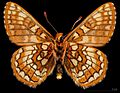
Euphydryas cynthia alpicola- Male underside
-
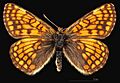
Euphydryas cynthia alpicola- Female
-
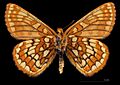
Euphydryas cynthia alpicola- Female underside


_Euphydryas_cynthia_alpicola_-_Thyon_2000m_-_Valais_Suisse_-_male_dorsal.jpg)
_Euphydryas_cynthia_alpicola_-_Thyon_2000m_-_Valais_Suisse_-_male_ventral.jpg)
_Euphydryas_cynthia_alpicola_-_Moiry_2000m_-_Valais_Suisse_-_female_dorsal.jpg)
_Euphydryas_cynthia_alpicola_-_Moiry_2000m_-_Valais_Suisse_-_female_ventral.jpg)
