
Square-tailed drongo facts for kids
Quick facts for kids Common square-tailed drongo |
|
|---|---|
.jpg) |
|
| Mkhuze Game Reserve, South Africa | |
| Conservation status | |
| Scientific classification | |
| Genus: |
Dicrurus
|
| Species: |
ludwigii
|

The square-tailed drongo (Dicrurus ludwigii) is a small, shiny black bird that lives in southern Africa. It's known for being brave and a bit feisty, even though it's only about 19 centimeters (about 7.5 inches) long! These birds are part of a group called passerines, which are often called "perching birds." They are common in forests and thick bushes.
Square-tailed drongos are great at catching insects, which is what they mostly eat. They are very protective of their nests and young. They will even chase away much bigger birds if they feel threatened! You can often see them sitting upright on a branch, like a shrike, looking for their next meal. They might dart out to catch an insect in the air or pick one up from the ground. Their call is a harsh sound, like "cherit-cherit."
Contents
Meet the Square-Tailed Drongo
The male square-tailed drongo is mostly glossy black, but its wings are a bit duller. The female looks similar but isn't quite as shiny. They have a strong black beak and bright red eyes.
How to Tell Them Apart
The square-tailed drongo looks a lot like another bird called the fork-tailed drongo. But there are a few ways to tell them apart:
- The square-tailed drongo is smaller.
- Its tail is shorter and doesn't have the deep "fork" that gives the fork-tailed drongo its name.
- You'll usually find square-tailed drongos in forests or dense bushes, while fork-tailed drongos prefer more open areas.
Nesting and Young
When it's time to build a nest, square-tailed drongos make a cup-shaped nest high up in a tree, often in a fork where branches split. The female usually lays two or three eggs.
Drongo Family Tree: Taxonomy
Scientists use something called "taxonomy" to name and group living things. It helps us understand how different animals are related.
The square-tailed drongo was first described by a Scottish zoologist named Andrew Smith in 1834. He saw these birds near what is now Durban, South Africa. He gave it the scientific name Edolius ludwigii. The "ludwigii" part of the name was chosen to honor a German botanist, Baron von Ludwig, who collected plants in South Africa.
Later, scientists decided to place this bird with other drongos in a group called Dicrurus. This group name was created by a French bird expert, Louis Pierre Vieillot, in 1816.
Drongo Family Updates
In 2018, scientists did a special study using DNA to learn more about the drongo family. Because of this study, some changes were made to how square-tailed drongos are grouped:
- Sharpe's drongo, which used to be considered a type of square-tailed drongo, is now its own separate species (Dicrurus sharpei).
- Some square-tailed drongos found in western Africa (between Senegal and the Niger River) are now also considered a separate species called the western square-tailed drongo (Dicrurus occidentalis).
Different Types of Square-Tailed Drongos
Even within the square-tailed drongo species, there are four slightly different types, called subspecies. They live in different parts of Africa:
- D. l. muenzneri (found from southern Somalia and eastern Kenya to Tanzania and northern Mozambique)
- D. l. saturnus (found in Angola, northern Zambia, and northern Mozambique)
- D. l. tephrogaster (found in Malawi and southern and central Mozambique)
- D. l. ludwigii (found from South Africa up to the Limpopo River)
Images for kids
-
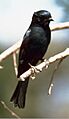
Square-tailed drongo, by United States Fish and Wildlife Service

