
Dravidian languages facts for kids
Quick facts for kids Dravidian |
|
|---|---|
| Ethnicity: | Dravidian peoples |
| Geographic distribution: |
South India, north-east and central Sri Lanka and south-west Pakistan |
| Linguistic classification: | One of the world's primary language families |
| Proto-language: | Proto-Dravidian |
| Subdivisions: |
North
Central
South-Central
South
|
| ISO 639-2 and 639-5: | dra |
 Distribution of the Dravidian languages
|
|
The Dravidian languages are a large language family spoken by about 250 million people. Most speakers live in South India, northeastern Sri Lanka, and southwestern Pakistan. There are also smaller groups of speakers in other parts of South Asia.
The four most common Dravidian languages are Telugu, Tamil, Kannada, and Malayalam. These languages have a very long history of writing and literature. There are also smaller languages in this family, such as Tulu, Gondi, and Brahui. Brahui is interesting because it is spoken far away from the others, mostly in the Balochistan region of Pakistan.
People who speak these languages have moved to many places around the world. You can find Dravidian speakers in Southeast Asia, the Middle East, Europe, and North America.
Scholars believe the Dravidian languages are native to India. Some experts think they might be related to the ancient Indus Valley Civilisation, but this is not yet proven.
Contents
Where Dravidian Languages Are Spoken


Most Dravidian languages are found in the southern and central parts of the Indian subcontinent. However, there are two interesting exceptions located far from the main group:
- Brahui: Spoken in the northwest, mainly in Pakistan.
- Kurukh: Spoken in the east, in states like Jharkhand and even in Nepal and Bhutan.
Historically, these languages might have covered a much larger area. Place names and grammar rules in some northern Indian languages suggest that Dravidian languages were once spoken there too.
Today, about 227 million people speak these languages. This is roughly 13% of all the people in the Indian subcontinent. The largest group is the South Dravidian branch, which includes Tamil, Kannada, and Malayalam.
The Four Major Languages
There are four main languages that most Dravidian speakers use. These are also official languages in different states of India.
| Language | Main Location | Number of Speakers |
|---|---|---|
| Telugu | Andhra Pradesh, Telangana | ~85 million |
| Tamil | Tamil Nadu, Sri Lanka, Singapore | ~75 million |
| Kannada | Karnataka | ~44 million |
| Malayalam | Kerala | ~37 million |
History and Origins of the Family
The history of the Dravidian family is very old. Linguists (people who study languages) have tried to find out where it came from.
Ancient Roots
The original language, called Proto-Dravidian, is not written down anywhere. Scientists have reconstructed it by comparing modern languages. They believe it was spoken around 4,500 years ago.
Some researchers think the Dravidian languages are connected to the famous Indus Valley Civilisation (3300–1900 BCE). This ancient civilization had a writing system that no one has been able to read yet. Some experts, like Asko Parpola, suggest that the people of the Indus Valley might have spoken a Dravidian language.
Connection to Other Languages
Scholars have tried to link Dravidian to other language families, such as Japanese, Korean, or the ancient Elamite language. However, none of these connections have been proven to be true. For now, Dravidian is considered a unique family native to South Asia.
Even though they are different families, Dravidian languages have influenced the Indo-Aryan languages (like Hindi and Sanskrit). For example, Sanskrit borrowed sounds and words from Dravidian over thousands of years.
How Dravidian Languages Work
Dravidian languages have some special rules that make them different from English.
Building Words
These languages are agglutinative. This is a fancy word that means "gluing together." In Dravidian languages, you start with a root word and add little pieces (suffixes) to the end to change the meaning. You do not use prefixes (pieces added to the start).
For example, in English, we use separate words like "to the house." In a Dravidian language, this might be just one word like "house-to."
Sentence Order
In English, a sentence usually follows the order: Subject – Verb – Object (e.g., "I ate an apple"). In Dravidian languages, the order is usually: Subject – Object – Verb (e.g., "I an apple ate").
Unique Sounds
Dravidian languages have special sounds called retroflex consonants. To make these sounds, you curl your tongue back to touch the roof of your mouth. This gives the languages a distinct sound. These sounds were later borrowed by neighboring languages like Sanskrit.
Words We Use in English
Did you know you might already know some Dravidian words? English has borrowed several words from this family:
- Mango: From the Tamil word māṅkāy or Malayalam māṅṅa.
- Curry: From the Tamil word kaṟi.
- Catamaran: From the Tamil word kaṭṭumaram (meaning "bound logs").
- Mongoose: From the Telugu word muṅgisa or Kannada muṅgisi.
- Orange: The root of this word comes from a Dravidian word for "fragrant."
Writing and Literature

The Dravidian languages have a rich history of books and poetry.
- Tamil: Has the oldest literature. Inscriptions found in caves date back to the 2nd century BCE. The oldest book is a grammar book called the Tolkāppiyam.
- Kannada: Its oldest inscription was found on a temple pillar from 370 CE. A famous book on poetry called Kavirajamarga was written in the 9th century.
- Telugu: The first written work is a translation of the epic Mahābhārata from the 11th century.
- Malayalam: The earliest writing dates to the 9th century.
See also
 In Spanish: Lenguas drávidas para niños
Images for kids
-
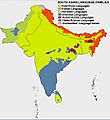
Language families in South Asia

