
Euproctis facts for kids
Quick facts for kids Euproctis |
|
|---|---|
.jpg) |
|
| Euproctis chrysorrhoea | |
Scientific classification  |
|
| Kingdom: | Animalia |
| Phylum: | Arthropoda |
| Class: | Insecta |
| Order: | Lepidoptera |
| Superfamily: | Noctuoidea |
| Family: | Erebidae |
| Tribe: | Nygmiini |
| Genus: | Euproctis Hübner, [1819] |
| Synonyms | |
|
|
Euproctis is a group of tussock moths. These moths belong to the Erebidae family. A scientist named Jacob Hübner first described this group in 1819.
You can find Euproctis moths all over the world. They live in many different regions. These include parts of Europe and Asia (Palearctic), Africa, and Australia. They also live in the Oriental region, which covers much of Asia.
Contents
What are Euproctis Moths?
Euproctis is a genus of moths. In science, a genus is a way to group very similar animals or plants together. Think of it like a family name for different species. All moths in the Euproctis genus share many common features.
These moths are part of the tussock moth group. Tussock moths are known for their hairy caterpillars. These hairs can sometimes cause skin irritation if touched. The adult moths often have fuzzy bodies too.
Where Do Euproctis Moths Live?
Euproctis moths are found across a huge area. This wide distribution means they can adapt to many different environments. They live in:
- Palearctic region: This includes Europe, northern Africa, and most of Asia.
- African region: Many species are found across the continent of Africa.
- Oriental region: This covers Southeast Asia, India, and parts of China.
- Australian region: You can also find them in Australia and nearby islands.
This wide range shows how successful these moths are at surviving in various climates.
Common Euproctis Species
There are many different species within the Euproctis genus. Each species has its own unique features. Here are a couple of well-known examples:
The Brown-tail Moth
The Euproctis chrysorrhoea is one of the most famous Euproctis species. It was first described by Carl Linnaeus in 1758. This moth is known for its white wings and a distinctive brown tuft of hairs at the end of its body.
The caterpillars of the brown-tail moth are often considered a pest. Their hairs can cause itchy rashes in people. They also feed on the leaves of many trees and shrubs. This can damage plants in gardens and forests.
The Yellow-tail Moth
Another common species is the Euproctis similis. This moth was described by Füssli in 1775. It looks similar to the brown-tail moth. However, it has a bright yellow tuft of hairs at the end of its body.
Like the brown-tail moth, its caterpillars can also cause skin irritation. Both species are important to study. This helps us understand how they interact with their environment.
Life Cycle of Euproctis Moths
Like all moths, Euproctis species go through a complete metamorphosis. This means they have four main life stages: egg, larva (caterpillar), pupa, and adult moth.
- Eggs: Female moths lay their eggs in clusters. They often cover the eggs with hairs from their own bodies. This protects the eggs from predators and bad weather.
- Caterpillars (Larvae): Once the eggs hatch, tiny caterpillars emerge. These caterpillars are the feeding stage. They eat a lot of leaves to grow quickly. Many Euproctis caterpillars are hairy. These hairs can be irritating if touched.
- Pupae: After growing enough, the caterpillar forms a pupa. This is a resting stage. Inside the pupa, the caterpillar transforms into an adult moth.
- Adult Moths: Finally, the adult moth emerges from the pupa. Adult moths usually live for a short time. Their main job is to mate and lay eggs. This starts the life cycle all over again.
Images for kids
-
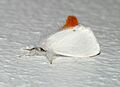
Euproctis chrysorrhoea (Brown-tail moth)
