
Flag of Pennsylvania facts for kids
 |
|
| Use | Civil and state flag    |
|---|---|
| Proportion | 27:37 (both 2:3 and 3:5 in use) |
| Adopted | June 13, 1907 |
| Design | A state coat of arms on a blue field |
The flag of the U.S. state of Pennsylvania is a special symbol. It shows the state coat of arms on a bright blue background. This flag represents Pennsylvania's history and values.
Contents
Understanding the Flag's Look
The official flag of Pennsylvania was chosen on June 13, 1907. It has a blue color, just like the blue part of the United States flag.
_(14598125807).jpg)
The flag is designed with specific measurements. For example, the cloth part of the flag is about six feet and two inches long. In the very center, you will see the detailed coat of arms of Pennsylvania. This design is embroidered in silk on both sides of the flag. The edges of the flag are often decorated with a yellow silk fringe. A cord with tassels, made of white and blue strands, is also attached to the flagpole.
The Pennsylvania Coat of Arms Explained
The Coat of arms of Pennsylvania is a very important part of the flag. Its design was officially set in 1875. It includes several symbols, each with a special meaning.
Shield: The shield shows a ship, a plow, and three bundles of wheat. Crest: An eagle is shown above the shield, ready to fly. Supporters: Two black horses stand on either side of the shield. Motto: The words "Virtue, Liberty, and Independence" are displayed. Flanking: A stalk of corn and an olive branch are on the sides.
- Shield: The main part of the shield shows three important symbols. At the top, there is a ship sailing, which stands for trade and business. In the middle, a plow represents farming and hard work. At the bottom, three bundles of wheat, called "garbs," symbolize the state's rich harvests and fertile land.
- Crest: Above the shield, you'll see an eagle, shown as if it's about to fly. The eagle is a strong symbol of freedom and power.
- Supporters: Two black horses stand on either side of the shield. They look strong and ready, representing the spirit of Pennsylvania.
- Motto: A ribbon below the shield carries the state's motto: "Virtue, Liberty, and Independence." These words show what the people of Pennsylvania value most.
- Flanking: On one side of the shield is a stalk of corn, and on the other side is an olive branch. These plants represent peace, growth, and the state's agricultural wealth.
A Look Back at Pennsylvania's Flags
Pennsylvania has had different flags throughout its history before the current one was made official.
Early Flags Before 1907
During the American Revolutionary War, around 1777, the Pennsylvania Navy used its own flag. This flag was blue with thirteen stripes (seven red and six white) in the corner. It flew from the back of state ships. There was also a long red flag and a shorter solid red flag used at that time.

In 1799, the Pennsylvania General Assembly allowed the state's military groups, called the militia, to use the state coat of arms on their flags. These flags changed over the years. Sometimes the coat of arms replaced the stars on the U.S. flag. Other times, it was simply placed on a blue flag. The look of the coat of arms itself also changed a bit over time, especially the colors and the horses.

For example, in 1805, a painter named Christian Gullage was asked to paint the state coat of arms on a blue banner. This banner was four feet by two feet and had gold fringe. In 1899, a man named J. C. Haydon gave a state flag to a hospital in Janesville. This flag was described as having a blue background with the state's coat of arms in the middle.

The Official Flag Since 1907
Lawmakers eventually decided to create one standard flag for everyone in Pennsylvania to use. They chose a design with the now-standardized coat of arms placed alone on a plain blue background. This blue color had to be the same as the blue on the flag of the United States. This new, official flag became law on June 13, 1907. This is the flag we see today representing the Commonwealth of Pennsylvania.
Galleries
Historical depictions of the Pennsylvania flag
-
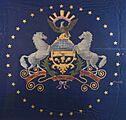
A Pennsylvania flag from 1863, featuring a ring of stars around the state coat of arms. This flag was made for Governor Curtin to use during the dedication of the Gettysburg National Cemetery in November 1863.
-
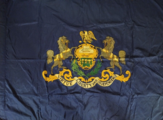
A Pennsylvania state flag that may have been used by a National Guard unit during World War I, showing a white scroll.
-
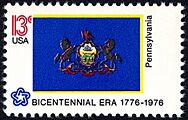
The Pennsylvania state flag as it appeared on a 1976 bicentennial postage stamp.
-
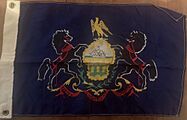
The flag with a golden eagle.

.png)


Flags associated with Pennsylvania
-
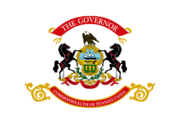
Standard of the governor of Pennsylvania.
-
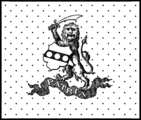
A 1747 flag of the Pennsylvania Associators, a military group from that time. This flag was designed by Benjamin Franklin.
-
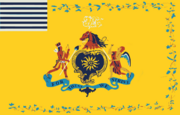
Flag of the First Troop Philadelphia City Cavalry, a cavalry unit formed before the Revolutionary War.
-
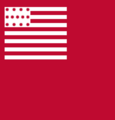
The Brandywine flag, an important historical flag.
-
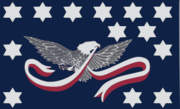
A flag used during the Whiskey Rebellion, a historical event.
-
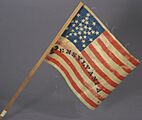
An American flag from around 1876 with 29 stars, showing Pennsylvania's name in the stripes.
-

The Pennsylvania Navy Ensign, used during the American Revolution.
-

A recreation of a Pennsylvania Bicentennial Flag, featuring a likeness of William Penn, the founder of Pennsylvania.

.png)


.jpg)


See also
- Flags of the U.S. states and territories
- List of Pennsylvania state symbols
- Keystone symbol
