
Fouad Serageddin facts for kids

Fouad Pasha Serageddin (born November 2, 1911 – died August 9, 2000) was an important Egyptian politician. He was also a leader of Egypt's Wafd Party.
Serageddin played a big role in Egyptian politics for many years. He helped bring the Wafd Party back into action. This happened in 1984 when President Hosni Mubarak allowed the party to become active again.
Contents
Who Was Fouad Serageddin?
Early Life and Political Start
Fouad Serageddin became a government minister when he was quite young. He was in his early thirties. During the 1940s, he held several important jobs in the government.
From 1950 to 1952, he served in the Wafd-led government. He was the Minister of Interior, which means he was in charge of internal security. He was also the Minister of Finance, handling the country's money.
Challenges in His Career
His political work was suddenly stopped around the time of the Free Officers' takeover. He faced difficulties and was unable to work in politics for a while. Later, under Colonel Nasser, he again faced periods where he could not be active in politics.
Serageddin did not return to the political scene until 1978. At that time, President Anwar Sadat was trying to bring more political parties back. Sadat even compared Serageddin to a famous king returning. However, more political problems followed. In 1981, Serageddin was among many people who were held back from political work.
The Wafd Party's History
Origins of the Wafd Party
The Wafd Party started in 1918. It began as a group led by the nationalist Saad Zaghloul. Their main goal was to demand complete independence for Egypt from the British. The party was officially formed a year later, in 1919.
Serageddin's Role in the Party
Fouad Serageddin strongly believed in the Wafd Party's values. These included democracy, which means people have a say in their government. He also supported "bisectarianism," meaning fairness to both Muslims and Christians. He believed in liberalism, which focuses on individual rights and freedoms.
He tried to make the party more popular by working with other groups. One of these was the Muslim Brotherhood. Some people thought this went too far for the party's usual approach.
Later Years and Legacy
Key Events and Impact
Serageddin later said he ordered police in Ismailia to fight British troops in 1952. This was known as the Battle of Ismailia. The police had rifles, but the British had light artillery, so it was a very difficult fight. This event led to the burning of Cairo the very next day, on January 26, 1952. The government was then dismissed immediately.
Serageddin's long political life showed how Egyptian politics sometimes stayed the same for a long time. Some people criticized him for leading a party that looked to the past, not the future. However, the New Wafd Party continued to be an important opposition party. It even played a part in the Egyptian Revolution of 2011.
The Al-Wafd Newspaper
When the Wafd Party became active again in 1984, Serageddin was very skilled at politics. He helped the Al-Wafd newspaper become very successful right away. The newspaper had a special column called Asfoura (Sparrow). This column helped show problems like corruption and poor management.
Images for kids
-
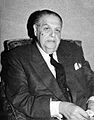
Fouad Pasha Serageddin
