
Gertrude Hunter facts for kids
Quick facts for kids
Gertrude Hunter
|
|
|---|---|

Gertrude Hunter
|
|
| Born |
Gertrude Teixeira
1926 Boston, Massachusetts, U.S.
|
| Died | (aged 79) Silver Spring, Maryland, U.S.
|
| Nationality | American |
| Occupation | Doctor, professor |
Gertrude Teixeira Hunter (born 1926, died 2006) was an important American doctor and professor. She helped lead health programs for children through Head Start. She also worked for the United States Public Health Service. Dr. Hunter spent much of her career at Howard University College of Medicine. She was also a strong supporter of healthcare for people with AIDS, especially in minority communities.
Contents
Early Life and Education
Gertrude Teixeira was born in Boston, Massachusetts in 1926. Her parents were Antonio Dias and Carrie Teixeira. Her father came from Cape Verde and owned a food company and a restaurant. Gertrude was the oldest of their four children.
Gertrude went to high school in Boston. At first, her school suggested she study "domestic arts," which was a path for housekeeping jobs. But her mother wanted her to go to college. So, Gertrude was moved to a college preparation program.
After high school, she went to Boston University. She did very well on a medical test. This helped her get accepted into Howard University College of Medicine in Washington, D.C. She was still in her third year of college when she got accepted! She earned her medical degree in 1950. She then completed her training at Freedman's Hospital in Washington, D.C., and the Homer G. Phillips Hospital in St. Louis, Missouri.
While in medical school, Gertrude met Charles H. Hunter, who also became a doctor. They got married in 1952 and had six children.
A Career in Medicine
After becoming a doctor, Gertrude Hunter taught at Howard University College of Medicine. She taught in the microbiology department and later became an assistant professor in the physiology department. There, she studied how the body's digestive system works.
In 1956, she started working as a doctor in the pediatrics department. Pediatrics is the study of children's health. She worked there until 1965. During this time, she wrote about her work with antibiotics and how African American children developed.
Leading Health Programs
In 1965, Dr. Hunter became the first national director of health services for Project Head Start. This program helps provide support and resources for children from low-income families. In this role, she helped create a national program. It gave healthcare and immunizations (shots to prevent sickness) to millions of young children before they started school.
In 1971, Dr. Hunter took on a new role. She became the regional health administrator for the United States Public Health Service in New England.
Return to Howard University
Dr. Hunter returned to Howard University in 1976. She became a professor and led the Department of Community Health and Family Practice. She started a program for doctors to train in family medicine. She also worked to get money for her department's international programs. She even helped create a School of Public Health.
In 1978, she worked with other Black doctors. They started a project to give vaccinations to people in need across the United States. She continued to lead the Community Health and Family Practice department until 1980. Then, she became the head of the community health service, which was part of that department.
Fighting for Health Equity
In 1985, Dr. Hunter led a medical task force for the National Council of Negro Women. As part of this work, she helped start a national effort. It encouraged African Americans to take care of their health.
Dr. Hunter retired from Howard University in 1988. After retiring, she started a non-profit organization called the Human Services Educational and Research Institute. This group works to create programs and policies that help people of color who are underprivileged or have low incomes. The organization especially focused on women's health and AIDS.
She helped minority groups set up their own health services. Dr. Hunter was one of the first doctors to focus on second-generation AIDS patients. These are people who got AIDS from their parents. She once said that helping AIDS patients in Black communities was "one of the last battles in the civil rights movement."
Images for kids
-
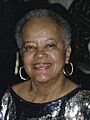
Gertrude Hunter
