
Golden-brown mouse lemur facts for kids
Quick facts for kids Golden-brown mouse lemur |
|
|---|---|
 |
|
| Conservation status | |
Scientific classification  |
|
| Kingdom: | Animalia |
| Phylum: | Chordata |
| Class: | Mammalia |
| Order: | Primates |
| Suborder: | Strepsirrhini |
| Family: | Cheirogaleidae |
| Genus: | Microcebus |
| Species: |
M. ravelobensis
|
| Binomial name | |
| Microcebus ravelobensis Zimmerman et al., 1998
|
|
 |
|
| Distribution of M. ravelobensis | |
| Script error: The function "autoWithCaption" does not exist. | |

Script error: No such module "Check for conflicting parameters".
The golden-brown mouse lemur (Microcebus ravelobensis) is a tiny lemur. It's actually the smallest type of lemur in the world! This animal lives in trees, is active at night, and often lives in social groups. Its name comes from the golden-brown color of its fur.
Like other mouse lemurs, it's a small primate. It has brown fur on its back and whitish-grey fur on its belly. All lemurs, including this one, live only on the island of Madagascar. Scientists first discovered this species in 1994.
Contents
Where They Live and Their Homes

The island of Madagascar is located off the southeastern coast of Africa. All types of lemurs are native to this island. The golden-brown mouse lemur lives only in the Ankarafantsika National Park. This park is a dry forest found in northwestern Madagascar.
This lemur shares its home with another type of lemur, the gray mouse lemur. Even though they live in the same area, they like different parts of it. Golden-brown mouse lemurs prefer humid spots near water. Gray mouse lemurs, however, like drier areas higher up and away from water.
Golden-brown mouse lemurs are known for building nests. They use small branches and leaves from nearby plants. These nests are often built in the early hours of the night and take about an hour to finish. Mother lemurs and their babies, along with other family members, might share a nest for over a month.
What They Eat
Golden-brown mouse lemurs are nocturnal, which means they sleep during the day. At night, they wake up to search for food. They eat a variety of things like insects, fruits, flowers, and other plants.
They mostly eat fruit, but they can also eat other foods. Some mouse lemurs can store a lot of fat in their hind legs and tail. This stored fat helps them survive when food is hard to find.
Their Appearance and How They Move

The golden-brown mouse lemur has a golden-brown back and a yellowish-white belly. It also has a white stripe that runs from its forehead down to its nose. These lemurs weigh about 40 to 70 grams, which is like a few strawberries. Their weight can change depending on the season.
They look similar to the gray mouse lemur. However, the golden-brown mouse lemur has a longer, thinner tail. Unlike some other mouse lemurs, it can't store fat in its tail. It moves through the forest by leaping from branch to branch.
Reproduction and Life Cycle
_(9629054607).jpg)
Golden-brown mouse lemur babies are usually born between November and December. A mother lemur typically has one to three babies at a time. Females can have one or two litters of babies each year.
After they are born, the young male lemurs leave their birth area during the winter months.
How They Live Together
Golden-brown mouse lemurs have interesting social habits. Unlike many other night-active lemurs, they often sleep in mixed-sex groups. They usually sleep in tree branches or in nests they build. Sleeping together helps them stay warm and protects them from predators.
Even though they sleep in groups, their active life at night is usually solitary. This means they often search for food alone. Within their sleeping groups, they might switch between different nest locations. However, the members of their community usually stay the same. This way of living creates overlapping territories where different families share an area.
Threats to Their Survival
The golden-brown mouse lemur is facing threats, mainly from deforestation. This is when forests are cut down, often for farming. This loss of habitat affects their numbers and how they spread out. The IUCN Red List, which tracks endangered species, says that "slash-and-burn agriculture" is a big threat.
They also have natural predators in their habitat. These include animals like the fossa, ring-tailed mongoose, owls, and the Madagascar harrier hawk. Some scientists believe that mouse lemurs help spread the seeds of the plants and fruits they eat. Because of deforestation, the golden-brown mouse lemur is at risk of extinction.
Images for kids
-
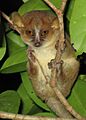
A golden-brown mouse lemur in its natural habitat.
