
Green-fronted hummingbird facts for kids
Quick facts for kids Green-fronted hummingbird |
|
|---|---|
 |
|
| Conservation status | |
Scientific classification  |
|
| Kingdom: | Animalia |
| Phylum: | Chordata |
| Class: | Aves |
| Order: | Apodiformes |
| Family: | Trochilidae |
| Genus: | Ramosomyia |
| Species: |
R. viridifrons
|
| Binomial name | |
| Ramosomyia viridifrons (Elliot, 1871)
|
|
 |
|
| Distribution | |
| Script error: The function "autoWithCaption" does not exist. | |
| Synonyms | |
|
Amazilia viridifrons, Leucolia viridifrons |
|

Script error: No such module "Check for conflicting parameters".
The green-fronted hummingbird (Ramosomyia viridifrons) is a small, colorful bird. It is a type of hummingbird found mostly in Mexico. Some scientists also think it might live in Guatemala.
Contents
About the Green-Fronted Hummingbird
Scientists group living things into categories. This helps us understand how they are related. The green-fronted hummingbird has had a few different scientific names over time.
For a while, it was placed in a group called Amazilia. Later, studies showed that this group needed to be changed. Scientists then moved the green-fronted hummingbird to a new group called Leucolia.
Even more recently, new research suggested a different name was better. Now, many scientists place it in the group Ramosomyia. This shows how science is always learning new things!
What Does the Green-Fronted Hummingbird Look Like?
This hummingbird is about 10 to 11.5 centimeters (4 to 4.5 inches) long. It weighs around 6.3 grams, which is about the same as two pennies!
Both male and female green-fronted hummingbirds have a red beak with a black tip.
- Males: Adult males have a shiny bluish-green head. Their neck and back are emerald or bronze-green. Their tail feathers can look coppery or purplish. Their belly and chest are pure white, with green on their sides.
- Females: Adult females look similar to males. Their head is usually a darker green, and their tail can be bronze-green or golden-green.
There are two main types, or subspecies, of this hummingbird. One type is slightly larger. It also has more white on its underside, making it look even whiter.
Where Does the Green-Fronted Hummingbird Live?
The green-fronted hummingbird lives in southern Mexico. You can find it in areas like Guerrero and Oaxaca. One type of this bird also lives in Chiapas.
These hummingbirds like to live in different kinds of places. They can be found in forests where trees lose their leaves. They also live in areas with thorny bushes, or places with scattered trees. They prefer areas that are dry or semi-dry. They live at elevations from about 60 meters (200 feet) up to 1,400 meters (4,600 feet) above sea level.
Behavior of the Green-Fronted Hummingbird
Movement and Travel
Green-fronted hummingbirds usually stay in the same area all year. They are considered residents. However, some individual birds might move short distances during different seasons.
What Do They Eat?
Like other hummingbirds, the green-fronted hummingbird drinks nectar from flowers. They can find nectar at all levels of their habitat, from low bushes to the tops of tall trees. They are often seen feeding higher up in the trees.
Scientists believe they also eat small insects. This is common for most hummingbirds, as insects provide important protein.
Reproduction and Life Cycle
The nesting season for the green-fronted hummingbird is not fully known. It seems they might nest in May, September, and October.
Very few nests have been found. One nest was shaped like a cup. It was made of soft plant material and covered with green lichens. This nest was found about 1.8 meters (6 feet) off the ground.
Female hummingbirds usually lay two eggs at a time. We don't know how long the eggs take to hatch or how long it takes for the young birds to leave the nest.
What Sounds Do They Make?
The main sound the green-fronted hummingbird makes is described as a soft, dry chattering noise.
Status of the Green-Fronted Hummingbird
The IUCN (International Union for Conservation of Nature) has looked at the green-fronted hummingbird. They have listed it as a species of "Least Concern." This means it is not currently considered endangered.
However, we don't know exactly how many green-fronted hummingbirds there are. Scientists believe their numbers might be going down. There are no specific threats identified for this bird. But, authorities in Mexico believe that losing their natural habitat is a problem for them.
Images for kids
-
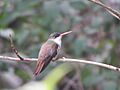
A green-fronted hummingbird perched on a branch.
-

Map showing the distribution of the green-fronted hummingbird.
