
Hand's Cove facts for kids
Quick facts for kids |
|
|
Hand's Cove
|
|
 |
|

 Location in Vermont

Location in the United States
|
|
| Location | Hand's Cove Rd., Shoreham, Vermont |
|---|---|
| Area | 160 acres (65 ha) |
| Built | 1775 |
| Architectural style | Greek Revival |
| NRHP reference No. | 80000324 |
| Added to NRHP | May 22, 1980 |
Hand's Cove is a special place on the eastern shore of Lake Champlain in Shoreham, Vermont. It's famous because of an important event during the American Revolutionary War. In 1775, brave colonial soldiers, led by Ethan Allen and Benedict Arnold, crossed the lake from this very spot. Their mission was to capture Fort Ticonderoga, a key British fort.
Hand's Cove is also home to a very old building called a blockhouse. This is the only known blockhouse from the colonial era in Vermont. Because of its history, Hand's Cove was added to the National Register of Historic Places in 1980.
Contents
The Story of Hand's Cove
Hand's Cove is a small bay on the east side of Lake Champlain. It's located just north of Larrabee's Point in Shoreham. The first person known to settle here was John Earl, who owned the land during the American Revolution.
After the war, a man named Rufus Herrick bought the property. For a while, people called it Herrick's Cove. Then, in 1793, Nathan Hand purchased the land. His family owned the property for three generations, which is how Hand's Cove got its current name. Some of Nathan Hand's family members, like Augustus C. Hand and Augustus Noble Hand, became important lawyers and judges.
Historic Buildings at Hand's Cove
There are two very old and important buildings on what used to be the Hand family's land.
The Mysterious Blockhouse
One of these buildings is a blockhouse. A blockhouse is like a small, strong fort, often used for defense. We don't know exactly when this blockhouse was built. It's made from heavy wooden beams stacked on top of each other. These beams are joined at the corners using a special method called dovetail joints, which makes them very strong.
The blockhouse sits on a stone foundation that might be even older than the building itself. The stones are similar to those found at Fort Ticonderoga. Records show there was a building here in 1775 when Ethan Allen and Benedict Arnold crossed the lake. However, it's not clear if it was this exact blockhouse. Many buildings in the area were destroyed by British raids during the war. Some people think the blockhouse might have originally been at Fort Ticonderoga. Its beams are similar in size to those found at the fort.
The Hand Family House
The second important building is a brick house built in the Greek Revival style. This style was popular in the 1800s and often looks like ancient Greek temples. The house is located a short distance inland from the blockhouse.
It has had many additions over the years and is surrounded by other farm buildings. It was probably built by Samuel Hand, Nathan Hand's son, who took over the property after his father.
Images for kids
-
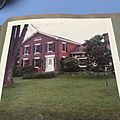
Hand's house in Shoreham, VT overlooking Hand Cove
-
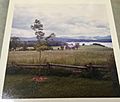
Hand's Cove, Summer 1964


