
Harrison's large-eared giant mastiff bat facts for kids
Quick facts for kids Harrison's large-eared giant mastiff bat |
|
|---|---|
| Conservation status | |
Scientific classification  |
|
| Kingdom: | Animalia |
| Phylum: | Chordata |
| Class: | Mammalia |
| Order: | Chiroptera |
| Family: | Molossidae |
| Genus: | Otomops |
| Species: |
O. harrisoni
|
| Binomial name | |
| Otomops harrisoni Ralph, Richards, Taylor, Napier & Lamb, 2015
|
|
 |
|
| Script error: The function "autoWithCaption" does not exist. | |
Script error: No such module "Check for conflicting parameters".
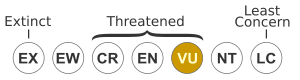
The Harrison's large-eared giant mastiff bat (Otomops harrisoni) is a special kind of bat. You can find it in parts of Northeast Africa and the Arabian Peninsula. Scientists officially described it as a new species in 2015. The IUCN says this bat is a vulnerable species. This means it needs our help to protect it.
Contents
Discovering a New Bat Species
This bat was once thought to be the same as another bat, the large-eared free-tailed bat (Otomops martiensseni). But in 2015, scientists looked closely at its body shape and its DNA. They found enough differences to say it was a completely new species. They named it harrisoni to honor a famous bat expert named David L. Harrison. He wrote many books about bats from Africa and Arabia.
What Does This Bat Look Like?
The Harrison's large-eared giant mastiff bat is the biggest bat in its group, called Otomops. It also has the strongest skull.
- Males usually weigh between 31.5 and 45 grams (about 1.1 to 1.6 ounces).
- Females weigh between 26.8 and 45 grams (about 0.9 to 1.6 ounces).
- Its forearm (part of its wing) is about 63.8 to 74 millimeters (2.5 to 2.9 inches) long.
- Its whole body, from head to tail, is about 138 to 163 millimeters (5.4 to 6.4 inches) long.
- Its tail is 30 to 48 millimeters (1.2 to 1.9 inches) long.
- Its hind foot is 11 to 16 millimeters (0.4 to 0.6 inches) long.
- Its ear is quite large, measuring 34 to 46 millimeters (1.3 to 1.8 inches).
This bat has 30 teeth in total. Its ears are very noticeable. They stick out over its face and meet in the middle, right above its nose. It also has tiny folds of skin around its lips. Male bats have a special gland at the base of their throats. Its back feet are wide and covered with long, white hairs.
Its fur is short and feels like velvet. On its back, the fur is a dark chocolate brown. It has a clear cream-colored "collar" around its neck. The fur on its belly is lighter than its back. The edges of its body and its wing membranes have a thin, white band of fur.
Bat Biology and Life Cycle
This bat is an insectivore, which means it eats insects. It mostly likes to eat moths. It seems to prefer moths from certain families, like Saturniidae, Noctuidae, and Geometridae.
Both male and female bats become old enough to have babies when they are about one year old. They also need to weigh at least 25 grams (about 0.9 ounces). Females usually have one breeding season each year. Pregnant females have been seen from October to January. Most babies are born in December. Each time, the mother bat gives birth to just one baby. The baby is born without fur and needs a lot of care from its mother.
These bats are very social. They live in large groups called colonies. These colonies can have hundreds or even thousands of bats! For example, a colony of 15,000 bats once lived in a cave in Mount Suswa.
Where Do These Bats Live?
The Harrison's large-eared giant mastiff bat lives in several countries. These include Yemen, Djibouti, Ethiopia, and Kenya. It probably also lives in the eastern part of Sub-Saharan Africa, including Eritrea.
Scientists predict that these bats like places that get at least 20 millimeters (0.8 inches) of rain in the driest month. They also prefer to live at high altitudes, more than 1,500 meters (about 4,900 feet) above sea level. They like areas that get less than 500 millimeters (about 20 inches) of rain in a whole year.
You can find them in different types of environments, such as woodlands, shrublands, mountain grasslands, dry grasslands, and thickets. During the day, they rest in mountain caves or lava caves.
Protecting the Harrison's Large-Eared Giant Mastiff Bat
The IUCN has listed this bat as a vulnerable species. This means its population is decreasing, and it could be in danger.
One big reason for this is that the caves where they live are being disturbed. For example, between 1997 and 2017, there were big drops in the number of bats at two of their main roosts: the Mount Suswa cave and Ithundu cave.
People disturb these caves in several ways:
- Mining for guano (bat droppings used as fertilizer).
- Tourism, where many people visit the caves.
- Caving, which is exploring caves.
- Blocking the entrances to the caves.
All these activities can make it hard for the bats to live safely in their homes. Protecting these caves is very important for the future of the Harrison's large-eared giant mastiff bat.
