
Heart-leaved kohuhu facts for kids
Quick facts for kids Heart-leaved kohuhu |
|
|---|---|
 |
|
| Conservation status | |
Scientific classification  |
|
| Kingdom: | Plantae |
| Clade: | Tracheophytes |
| Clade: | Angiosperms |
| Clade: | Eudicots |
| Clade: | Asterids |
| Order: | Apiales |
| Family: | Pittosporaceae |
| Genus: | Pittosporum |
| Species: |
P. obcordatum
|
| Binomial name | |
| Pittosporum obcordatum Raoul
|
|
| Script error: The function "autoWithCaption" does not exist. | |

Script error: No such module "Check for conflicting parameters".
Pittosporum obcordatum, also known as heart-leaved kohuhu or kohukohu, is a special plant found only in New Zealand. It belongs to the Pittosporaceae family and grows on both the North Island and South Island.
This unique plant was first discovered by Étienne Raoul in 1840 in Akaroa. However, it then disappeared from the Banks Peninsula area for 170 years! It was excitingly found again in 2012 by Melissa Hutchison in Okains Bay. A local plant expert, Hugh Wilson, confirmed the discovery.
Contents
What's in a Name?
The name "Pittosporum" means "pitch seed," which refers to its sticky seeds. "Obcordatum" means "reversed heart shape," describing the shape of its leaves.
What Does Heart-Leaved Kohuhu Look Like?
Pittosporum obcordatum is usually a small tree or shrub that can grow up to 10 meters (about 33 feet) tall. It has a single trunk and many thin, crisscrossing branches. These branches can be grey or reddish-brown and have small, woody seed pods and scattered leaves.
Leaves of the Kohuhu
The leaves of Pittosporum obcordatum are small, usually about 5–10 millimeters (0.2–0.4 inches) wide. They can be flat or slightly curled. What's cool is that the leaves change shape as the plant grows!
- Young plant leaves: These leaves are often oblong, narrow, or oval-shaped. They can be dark green, brown-green, or even mottled with yellow-green spots. They usually have deep cuts or lobes at the tips.
- Teenager plant leaves: These leaves are smaller, about 3.5–6 millimeters (0.14–0.24 inches). They can be oblong, heart-shaped with three lobes, or narrow and oval. They are usually dark green to yellow-green.
- Adult plant leaves: The leaves on mature plants are very small, about 2.8–4 millimeters (0.11–0.16 inches). They are often round or egg-shaped with a heart-shaped or blunt tip. These leaves are thick and leathery.
Flowers of the Kohuhu
The flowers of Pittosporum obcordatum are small, about 5–8 millimeters (0.2–0.3 inches) long. They can be pink-maroon or pale yellow, sometimes with red edges or stripes. They grow in small clusters of 1 to 5 flowers. These flowers smell nice at night!
Pittosporum obcordatum has separate male and female flowers on different plants. This is called being gynodioecious.
- Male flowers: These flowers have four stamens (the parts that produce pollen). The stamens are pink or yellow.
- Female flowers: These flowers have a small ovary (the part that develops into a fruit).
Fruits of the Kohuhu
After the flowers, the plant produces small, woody fruits called capsules. These capsules are about 6.5–10 millimeters (0.26–0.4 inches) long and split into two parts when ripe. Inside, they hold 2 to 6 shiny, dark black seeds.
Similar Plants
Even though Pittosporum obcordatum has special features, it can sometimes be confused with other small, crisscrossing shrubs. For example, Myrsine divaricata looks similar. However, Myrsine divaricata has purple, fleshy fruits with a single seed and a dark black spot at the base of its leaves.
Where Does Heart-Leaved Kohuhu Grow?
Pittosporum obcordatum is a plant that is endemic to New Zealand, meaning it's found nowhere else in the world!
It was first found near Akaroa around 1841. After that, its numbers dropped quickly. By 1981, it was estimated that fewer than 50 of these plants were left in the wild in New Zealand.
However, by 1994, the plant was found in 12 different places across New Zealand. The total number of wild plants had grown to about 2,500! About 60% of these were in the South Island. Some places, like Mangarouhi and Wairua in the North Island, had more than 300 plants each. It has also been found in the Paengaroa Mainland Island.
Where Does Heart-Leaved Kohuhu Live?
Pittosporum obcordatum likes to live in lowland forests, especially those with kahikatea and matai trees. It often grows near rivers, swamps, and old river bends, usually below 200 meters (about 650 feet) in altitude.
It prefers places with average temperatures of 9–15 degrees Celsius (48–59 degrees Fahrenheit) and about 1000–1500 millimeters (39–59 inches) of rain each year. It rains often in winter, but summers can be dry.
This plant can be found in both old, untouched forests and forests that have grown back. It is often seen in areas with many other crisscrossing shrubs and trees, which makes it a good sign of a healthy plant community.
Life Cycle of the Kohuhu
Pittosporum obcordatum grows very slowly and can live for a long time, possibly up to 120 years!
New growth usually starts from late August to October. After the seeds sprout, the young plants first grow 3–4 small leaves called cotyledonary leaves, followed by their first true leaves.
The plant is dioecious, meaning male plants only produce pollen, and female plants only produce seeds. However, sometimes a few male or female plants can produce a small number of seeds, becoming "inconstant" in their gender.
The plant usually flowers from late September to early December, and the flowering period lasts about 3 weeks. Plants in higher or more inland areas might flower a little later. The fruits develop from December to May and can stay on the plant for a long time.
Why Is Heart-Leaved Kohuhu in Danger?
Pittosporum obcordatum has low genetic diversity, which means it doesn't have much variety in its genes. This makes it harder for the plant to adapt to changes. In the past, floods might have helped new plants grow, but now, other things are causing its numbers to drop.
This plant is currently considered a threatened species. The main reasons are:
- Deforestation: Forests where it lives are being cut down.
- Browsing mammals: Animals like deer or possums eat the plants.
- Invasive weeds: Weeds like Carex divulsa grow over the Pittosporum obcordatum, making it hard for new plants to sprout and grow.
How Can We Help Heart-Leaved Kohuhu?
Pittosporum obcordatum is listed as "nationally endangered" in New Zealand. To help save it, experts recommend a few things:
- Remove invasive weeds: Getting rid of plants like Carex divulsa would allow Pittosporum obcordatum to grow back more easily.
- Fencing: Building fences around areas where Pittosporum obcordatum grows can protect the plants from animals that might eat them.
Cultural Uses
Historically, Pittosporum obcordatum has been used for its medicinal properties. It was used to make a soothing salve for skin conditions like eczema on the scalp and scabies. Parts of the plant would be dried in the sun, then crushed into a powder. This powder was then mixed with hinu-kōhia oil to create the salve.
Images for kids
-
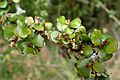
A close-up of the heart-leaved kohuhu.
