
Janina Hurynowicz facts for kids
Quick facts for kids
Janina Hurynowicz
|
|
|---|---|
| Born | 10 November 1894 Krystynopol, (now Chervonohrad, Ukraine)
|
| Died | 2 October 1967 Toruń, Poland
|
| Burial place | St. George Cemetery |
| Nationality | Polish |
| Alma mater | Women's Medical Institute Vilnius University |
| Occupation | Physician, neurophysiologist |
| Known for | Chronaxie research |
Janina Hurynowicz (1894–1967) was a Polish doctor. She was a specialist in the brain and nervous system, called a neurophysiologist and neurologist. She wrote many important papers about how nerves react to signals (this is called Chronaxie). She also studied how a hormone called insulin affects our body's automatic systems, known as the autonomic nervous system. Later, she became a professor at the Nicolaus Copernicus University in Toruń, Poland.
Contents
Her Life Story
Janina Hurynowicz was born on November 10, 1894. Her birthplace was Krystynopol. This area was once part of the Polish–Lithuanian Commonwealth. At that time, it was controlled by Russia.
In 1911, she finished secondary school in Vilnius, which is now in Lithuania. She did very well, graduating with top honors. The next year, she started studying medicine. She went to the Women's Medical Institute in St. Petersburg, Russia. She graduated in 1918, again with top honors. Even though she was a brilliant student, it was hard for women to get higher education back then.
Helping During World War I
From 1918 to 1920, Janina joined the Polish army. She served as a captain and a doctor. She worked in hospitals during the Russian Civil War. Her jobs included being a surgeon, an epidemiologist (someone who studies diseases), and a neurologist.
A special Polish Siberian Division was formed. Its goal was to fight against the Russian Bolsheviks. Janina joined this division. She was the only woman among thousands of men. She was in charge of the field hospital in Siberia.
In 1921, the Bolsheviks won the war. The Red Cross helped Janina and other prisoners of war. They traveled a long way through Japan, India, France, and Germany. Finally, they arrived in Poland, which had just become an independent country again. Throughout this journey, Janina took care of the injured prisoners.
University and Research
From 1922 to 1933, Janina worked at the University of Vilnius. She started as a junior assistant. She then became an assistant professor in the neurological clinic. In 1927, she earned her doctorate degree. Her research was about "The influence of insulin on the vegetative nervous system."
Between 1927 and 1939, she spent time in Paris. She worked in different scientific places. There, she learned and wrote about a method called chronaxiometry. This method helps measure how easily the human vasomotor system reacts. The vasomotor system controls the widening and narrowing of blood vessels. Her work was highly praised by the Paris Academy of Sciences.
In 1930, she earned her habilitation in neurology. This is a special qualification needed to become a professor. She got it from the Faculty of Medicine at Stefan Batory University (now part of Vilnius University). From 1937, she was a deputy professor. She also temporarily led the Neurological and Psychiatric Clinic there.
World War II and Later Life
When World War II started in 1939, Janina became very active. She joined the Polish Underground State. This was a secret organization fighting against the occupation. She often helped injured partisans (resistance fighters). She did this even though it put her own life at risk. For example, she helped save a famous Polish scholar. He hid in a mental hospital. Thanks to her help, he avoided being sent to the Soviet Union.
In the summer of 1945, she moved to Toruń. She became an associate professor at the Nicolaus Copernicus University. She led the Department of Neurophysiology and Comparative Physiology. In 1949, she became a full professor.
From 1946, she also helped set up new mental health centers. These were in Toruń and Bydgoszcz. She was the director of an outpatient clinic in Toruń until 1954.
Janina Hurynowicz retired when she was 70 years old. She passed away on October 2, 1967, in Toruń. She was buried in the St. George Cemetery there.
Images for kids
-
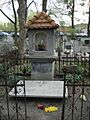
Gravestone of Janina Hurynowicz at the St. George Cemetery in Toruń

