
Kadamba dynasty facts for kids
Quick facts for kids
Kadambas of Banavasi
Banavasi Kadambaru
|
|||||||||||
|---|---|---|---|---|---|---|---|---|---|---|---|
| 345 CE–540 CE | |||||||||||

Extent of Kadambas, 500 CE
|
|||||||||||
| Capital | Banavasi | ||||||||||
| Common languages | Kannada Sanskrit |
||||||||||
| Religion | Jainism Hinduism |
||||||||||
| Government | Monarchy | ||||||||||
| Maharaja | |||||||||||
|
• 345–365
|
Mayurasharma | ||||||||||
|
• 516-540
|
Krishna Varma II | ||||||||||
| History | |||||||||||
|
• Earliest Kadamba records
|
450 CE | ||||||||||
|
• Established
|
345 CE | ||||||||||
|
• Disestablished
|
540 CE | ||||||||||
|
|||||||||||
| Today part of | India | ||||||||||

_at_Talagunda.JPG)

The Kadamba dynasty was an ancient royal family in India. They ruled parts of modern-day Karnataka and the Konkan region. Their capital city was Banavasi. The kingdom started around 345 CE.
Mayurasharma founded the Kadamba kingdom. He fought against other powerful groups like the Pallavas of Kanchi. The Kadambas grew stronger and even formed alliances with empires like the Vakatakas and Guptas. The kingdom was strongest under Kakusthavarma.
The Kadambas were one of the first local kingdoms to rule with independence in this area. They were also the first to use Kannada, the local language, for official government work. This period is very important for understanding the history of Karnataka and the development of the Kannada language. After the mid-6th century, the Kadambas became smaller kingdoms. They ruled under larger empires like the Chalukyas and Rashtrakutas. Some of their later branches include the Kadambas of Goa and the Kadambas of Hangal.
Contents
History of the Kadamba Kingdom
How the Kadamba Kingdom Began
_and_Hoysala_king_Veera_Ballala_II_(c.1196)_in_the_open_mantapa_of_the_Tarakeshwara_temple_at_Hangal.JPG)
There are many stories about how the Kadamba dynasty started. One popular legend says that Mayurasharma, the founder, was born near a Kadamba tree. This tree gave the family its name. Another story says he was blessed by a Jain monk.
Historians believe Mayurasharma was from Talagunda in Karnataka. Around 345 CE, he went to Kanchi for his studies. There, he had a disagreement with a guard and felt disrespected. This made him decide to become a warrior instead of a scholar.
Mayurasharma gathered followers and fought against the Pallavas. He established his kingdom in the dense forests of the Srisailam region. Eventually, he declared his independence. The Pallavas had to accept his rule over a large area. This is how the first native kingdom of Karnataka was born.
Growth and Important Rulers
Mayurasharma's son, Kangavarma, continued to protect the kingdom. He fought against the powerful Vakataka empire. His son, Bhageerath, worked to regain any lost territories.
Later, Kakusthavarma became the most powerful Kadamba ruler around 435 CE. Under him, the kingdom reached its greatest strength. He made important alliances by arranging marriages between his daughters and other powerful royal families. These included the Guptas and the Gangas.
The famous Sanskrit poet Kalidasa might have visited the Kadamba court during this time. This shows how important and respected the Kadamba kingdom was.
After Kakusthavarma, his son Santivarma ruled. He divided the kingdom to better manage threats from the Pallavas. His nephew, Ravivarma, later reunited the kingdom. Ravivarma was a strong ruler who expanded the Kadamba influence. He was also known for his tolerance, supporting different faiths like Buddhism.
The End of the Independent Kingdom
After Ravivarma, his son Harivarma ruled peacefully. However, around 530 CE, Krishnavarma II from another branch of the family attacked Banavasi. This briefly reunited the kingdom.
Around 540 CE, the Chalukyas, who were once under the Kadambas, conquered the entire kingdom. From then on, the Kadambas ruled as smaller states under the Chalukyas and other empires. The city of Banavasi was known for its beauty and prosperity, even after the Kadambas lost their independence.
How the Kadambas Governed
The Kadamba kings were known as Dharmamaharajas, meaning "Virtuous Kings." They were often well-educated and wise. For example, Mayurasharma was a master of ancient texts.
The government had many important officials. These included a prime minister, a chief secretary, and a chief justice. The king was the highest authority. There were also officers for collecting taxes and managing the army. The army used strategies like "Chaurangabala" and sometimes used guerrilla warfare.
Princes from the royal family often helped the king. They would govern different provinces to gain experience. This helped keep the kingdom stable. Important cities like Banavasi, Halasi, and Uchangi served as regional capitals.
The kingdom was divided into provinces, then districts, and then groups of villages. The smallest unit was the village, which had some local freedom under a headman. Banavasi was a major trade center with many toll collection points. This shows it was a busy and important city.
People paid taxes on farm produce, sales, and certain professions. The government also gave grants of land to families of warriors who died protecting the kingdom. These grants were a way to honor heroes and support their families.
Economy and Daily Life
The Kadamba kingdom's economy relied on farming and raising animals. Many records mention cattle raids and the importance of herding cows and sheep. Owning many cattle was a sign of wealth.
Farmers grew various crops like paddy (rice), sugarcane, barley, and wheat. They also cultivated areca nuts and fruits like plantains and coconuts. Garden lands were often used for growing flowers for temples.
Villages were carefully planned, with details about fields, water tanks, and irrigation channels. Leaders, including kings, invested in building and repairing water tanks. This helped turn dry land into fertile farmland. Taxes were collected on newly irrigated lands, encouraging more cultivation.
Cities and towns were centers for trade, religion, and government. They had markets for diamonds, cloth, and grain. There were also temples, palaces, and homes for merchants. These urban areas were bustling with activity.
Culture and Beliefs
Religion and Faith
The Kadambas supported both Jainism and Hinduism. Historians have studied inscriptions and grants to understand their religious practices. Some scholars believe the Kadambas had strong connections to Jainism from early times.
Many inscriptions show that the Kadamba kings supported Jain temples and scholars. For example, King Kakusthavarma's grants often began with a Jain prayer. King Mrigesavarma donated a whole village for Jain religious activities.
The Kadambas also supported Hindu traditions. They established learning centers for Vedic education. While they mainly supported Jainism and Hinduism, they were tolerant of other faiths. They even made donations to Buddhist institutions. The capital city of Banavasi was a center for both Jain and Buddhist learning.
Society and Customs
Kadamba society had different groups of people, similar to a caste system. Ancient texts from Jain, Buddhist, and Hindu traditions discuss these social divisions.
A special custom in medieval India was erecting "hero stones." These stones honored brave warriors who died in battle. They often had carvings and inscriptions telling the hero's story. Most were for men, but some honored women or even pets who showed great courage.
Physical fitness was very popular among men. Wrestling was a favorite sport for both royalty and common people. Kings sometimes had titles like "warrior-wrestler." There were different types of wrestling and fist-fighting. Skilled wrestlers were highly respected.
Archery and hunting were also popular activities, especially for royalty. Hunting was seen as entertainment, exercise, and a test of skill. Kings and queens would go on hunting expeditions in forests. They even used special hunting dogs known for their stamina.
Kadamba Architecture


The Kadambas are known for starting a unique style of architecture in Karnataka. Their temple design often featured a square inner sanctuary (garbhagriha) and a larger hall (mantapa). The tower (Shikhara) above the sanctuary was typically pyramidal, with stepped levels.
One of the earliest examples is the Praneshvara temple at Talagunda, dating back to the late fourth century. Many Kadamba temples can be found in Halasi and nearby areas. These include the Hattikesavara temple and the Bhuvaraha Narasimha temple.
The Kadamba style of temple tower became very popular. It influenced later temples built by other dynasties, like the Hoysalas. Besides temples, the Kadambas also created rock-cut cave temples in Goa. These caves feature simple pillars and sanctuaries dedicated to gods like Surya, Shiva, and Skanda.
Over time, Kadamba architecture was influenced by the styles of later empires, like the Kalyani Chalukyas. Examples of this blend can be seen in temples like the Mahadeva temple at Tambdi Surla in Goa.
Language and Inscriptions
Inscriptions are very important for understanding the history of the Kadambas. They provide details about kings, events, and the development of languages. Early inscriptions in the Deccan region were mostly in Prakrit. Later, they became bilingual, using both Sanskrit and Prakrit.
By the fifth century, Prakrit was replaced by local languages, especially Kannada. The Kadambas, along with the Gangas, played a key role in making Kannada an important language for inscriptions. The Halmidi inscription (around 450 CE) is one of the earliest Kannada inscriptions.
While many Kadamba inscriptions are in Sanskrit, they were among the first to use Kannada as an official administrative language. This shows that Kannada was the common language of the region. Recent discoveries, like a 5th-century copper coin with Kannada script, further prove the importance of Kannada during their rule.
Kadambas in Modern Times
The Government of Karnataka celebrates Kadambotsava every year. This festival honors the Kadamba kingdom and its contributions. A popular Kannada film called Mayura tells the story of the kingdom's founder, Mayurasharma.
India's advanced naval base in Karwar is named INS Kadamba. This base was opened in 2005. The state bus service in Goa, the Kadamba Transport Corporation, also uses the Kadamba dynasty's name. Its buses feature the royal lion emblem of the Kadambas as their logo.
Branches of Kadamba dynasty
- Kadambas of Goa
- Ruled Goa from the 10th to the 14th century CE.
- Kadambas of Hangal
- Ruled from around the 10th century to the 14th century CE.
See also
- History of Goa
- History of India
- History of South India
- Kadamba architecture
- Kadambas of Goa
- List of Hindu Empires and Dynasties
Images for kids
-
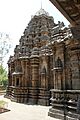
Tarakeshwara temple at Hangal, built by the Kadambas of Hangal
-
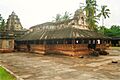
Madhukeshwara temple at Banavasi, built by the later Kadambas of Banavasi
-
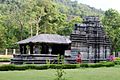
The Mahadeva temple at Tambdi Surla, Goa, built by the Kadambas of Goa
_in_the_Tarakeshwara_temple_at_Hangal.JPG)


