
Kung-fu facts for kids

Kung Fu is a super cool and ancient collection of fighting styles that started in China many, many centuries ago. It's not just about fighting; it's also about discipline, strength, and even a way of thinking! When people say "Kung Fu," they're usually talking about these special Chinese martial arts. But did you know that in China, "Kung Fu" (or gōngfu) actually means any skill you get from hard work and practice? So, if you're really good at playing an instrument or building with LEGOs, you could say you have "Kung Fu" in that skill! Another common name for these arts is "Wushu" (wǔshù), which literally means "martial art."
Contents
- History of Kung Fu
- The Shaolin Temple: A Special Place for Martial Arts
- Kung Fu in Modern Times: From Tradition to Sport
- Different Styles
- How is Kung Fu Trained? The Path of a Martial Artist
- Martial Morality: The Heart of Kung Fu
- Famous Faces: Kung Fu Heroes
- Kung Fu in Popular Culture
- Images for kids
- See also
History of Kung Fu
Kung Fu began a very, very long time ago, even before some of the oldest kingdoms in China!
Ancient Beginnings
Imagine a time over 4,000 years ago, when people needed to protect themselves, hunt for food, and train for battles. That's when the first ideas for Chinese martial arts started!
Legend says that a super important leader named the Yellow Emperor (around 2698 BC) might have introduced some of the earliest fighting systems. He was known as a great general and even wrote about medicine and martial arts. One of his rivals, Chi You, is said to have created an early form of Chinese wrestling called jiao di.
The first written mentions of Chinese martial arts appear in ancient books like the Spring and Autumn Annals. These texts talk about hand-to-hand combat and even mention ideas like "hard" and "soft" techniques, which are still important in martial arts today.
Ancient doctors like Hua Tuo (around 208 AD) created exercises like the "Five Animals Play" (tiger, deer, monkey, bear, and bird) to help people stay healthy. These movements later inspired many Kung Fu styles!
Philosophical Roots
As Chinese society grew, so did the ideas behind martial arts. Ancient Taoist thinkers like Zhuangzi (around 4th century BC) and Laozi, who wrote the Tao Te Ching, shared ideas about balance, harmony, and how to live in a peaceful yet strong way. These ideas influenced how martial artists thought about their movements and inner strength.
The Shaolin Temple: A Special Place for Martial Arts

One of the most famous places connected to Kung Fu is the Shaolin Temple.
The first Shaolin Temple was built in China's Henan province. Indian monks like Buddhabhadra and Bodhidharma (also known as Damo) came to teach Buddhism there. Historical records suggest that some of the early Chinese monks at Shaolin were already skilled in martial arts, perhaps even having a military background before becoming monks.
The earliest clear evidence of Shaolin monks using combat skills dates back to 728 AD. It tells how they defended their monastery from bandits around 610 AD and even helped a general in a big battle in 621 AD!
Over time, Shaolin monks became especially famous for their amazing skills with the staff, a long wooden weapon. A famous general named Qi Jiguang even wrote about Shaolin staff techniques in his book, which then influenced martial arts in other places like Okinawa and Korea.
You might have heard the story that Bodhidharma created Shaolin Kung Fu. While he was a very important monk, historians believe the legend about him creating Kung Fu actually became popular much later, around the 16th and 17th centuries. Still, it shows how important he was to the temple's story!
Kung Fu in Modern Times: From Tradition to Sport

The 20th century brought many changes to China, and these changes also shaped how Kung Fu was practiced and seen.
At the start of the 20th century, a group called the Righteous and Harmonious Fists, who practiced martial arts, rose up against foreign influences in China. This event, known as the Boxer Rebellion (1900-1901), showed the world the power of Chinese martial arts.
After the old dynasty fell, many martial artists started teaching their skills more openly. People saw Kung Fu as a way to build national pride and make China strong. Training academies were created, and martial artists even showed their skills at the Olympic Games in Berlin in 1936! The term kuoshu (meaning "national art") was used to connect martial arts with national identity.
After 1949, many martial arts masters moved to places like Taiwan and Hong Kong, and from there, they started teaching people all over the world. This helped Kung Fu become popular globally!
In mainland China, the government created a new sport called "Wushu." This modern Wushu focuses on beautiful forms and acrobatic movements for exhibitions and competitions, rather than just self-defense. It became a standardized sport taught in schools and universities.
During the Cultural Revolution (1966–1976) this time, traditional martial arts faced challenges, as the government wanted to change many old traditions. But later, in the late 1970s and 1980s, traditional Kung Fu began to be encouraged again.
Different Styles
China has hundreds of different Kung Fu styles, each with its own special moves and ideas! They are often grouped into "families" or "schools."
- Animal Styles: Many styles are inspired by animals, like the powerful tiger, the graceful crane, the quick monkey, or the slithering snake. Practitioners learn to mimic their movements and spirit.
- Internal vs. External: Some styles are called "internal" (nèijiāquán) because they focus on inner energy (qi), mind, and soft, flowing movements (like Tai Chi). Others are "external" (wàijiāquán), focusing more on muscle strength, speed, and powerful strikes (like Shaolinquan). But many styles actually use a mix of both!
- Northern vs. Southern: Styles are also sometimes grouped by where they came from in China, separated by the Yangtze River.
- Northern Styles: Often known for fast, powerful kicks, high jumps, and quick, flowing movements.
- Southern Styles: Tend to focus on strong arm and hand techniques, stable stances, and quick footwork.
Examples: Famous styles include Wing Chun, Hung Gar, Northern Praying Mantis, Eagle Claw, and Tai Chi.
How is Kung Fu Trained? The Path of a Martial Artist
_Mohammad_Akbari_23.jpg)
Training in Kung Fu is a journey that involves much more than just learning how to fight. It's about building your body, mind, and spirit!
Basics (基本功)
Just like building a house, you need a strong foundation! Basics include simple movements, stretching, conditioning exercises, and learning different stances. These help you build strong, flexible muscles and learn how to control your body and breath.
Stances (步法)
Stances are like the different ways you stand, which give you balance and power. The Horse Stance (mǎ bù) is a very famous one, where you stand with your feet wide apart, like you're riding a horse.
Meditation
Many Kung Fu styles include meditation. This helps you focus your mind, become calm, and connect with your inner energy (qi). It's like giving your brain a workout to help you be more aware and coordinated.
Use of Qi
In Chinese martial arts, qi (pronounced "chee") is a traditional idea about an inner energy or "life force" that flows through your body. While scientists don't measure qi in the same way they measure electricity, martial artists believe that learning to control and direct qi can help with healing, strength, and focus. It's a way of understanding how your body and mind work together efficiently.
Weapons Training (器械)
Once students are good at bare-hand techniques, they often learn to use weapons. The idea is to make the weapon feel like an extension of your own body! There are many traditional Chinese weapons, like staffs, swords, and spears.
Application and Sparring
This is where you learn how to use the techniques you've practiced in real situations. You might practice specific moves with a partner. Sparring is like a friendly, controlled fight with rules to keep everyone safe. It helps you learn to react quickly and use your skills.
Forms (套路)
Forms are like choreographed dances of martial arts movements. They are a series of predetermined moves put together in a sequence. Forms help you practice techniques, improve your flexibility, strength, speed, balance, and coordination. They also help pass down the knowledge of a style from one generation to the next. You can practice forms by yourself, or with a partner in "sparring forms" (dui lian), which are like choreographed fights.
While forms look beautiful and are great for exercise, they are also meant to teach practical techniques. Sometimes, forms are made more elaborate for performances, but their core purpose is still about martial skill and physical development.
Martial Morality: The Heart of Kung Fu
Beyond just physical techniques, traditional Chinese martial arts teach important values, often called Wude (武德), or "martial morality." This means learning to be a good person, not just a strong fighter. It includes:
- Virtue of Deed: Being respectful, honest, loyal, and brave in how you act towards others.
- Virtue of Mind: Cultivating inner peace, wisdom, and harmony within yourself.
- Respect: Showing respect for your teachers, fellow students, and the art itself.
- Discipline and Perseverance: Learning to work hard, stay focused, and never give up, even when things are tough.
These values help martial artists grow not just physically, but also as kind and responsible individuals.
Famous Faces: Kung Fu Heroes

Throughout history, many amazing people have practiced and taught Kung Fu, some becoming legendary heroes!
- Yue Fei (1103–1142 CE): A famous general from the Song dynasty, some Kung Fu styles like Eagle Claw and Xingyiquan are said to have been created by him, though this is mostly legend.
- Ng Mui (late 17th century): A legendary female master, said to be one of the founders of Southern martial arts like Wing Chun.
- Wong Fei Hung (1847–1924): A real-life folk hero whose adventures have been told in over a hundred movies! He was known for his amazing Hung Gar Kung Fu.
- Huo Yuanjia (1867–1910): Famous for challenging foreign fighters and promoting Chinese martial arts. His life was shown in the movie Fearless.
- Ip Man (1893–1972): A grandmaster of Wing Chun, he was the first to teach this style openly and was the teacher of the legendary Bruce Lee!
- Bruce Lee (1940–1973): A Chinese-American martial artist and actor who became a global superstar. He made Kung Fu famous in the West and developed his own unique martial arts philosophy called Jeet Kune Do.
- Jackie Chan (born 1954): A Hong Kong actor and martial artist famous for his incredible stunts and for adding humor to his fighting style in movies.
- Jet Li (born 1963): A five-time Wushu champion from China who later became a famous movie star, showing off his amazing skills on screen.
- Donnie Yen (born 1963): Another Hong Kong actor and martial artist, known for his powerful and realistic fight scenes.
- Wu Jing (born 1974): A Chinese actor and martial artist who was part of the Beijing Wushu team before becoming a director and actor.
Kung Fu in Popular Culture

Kung Fu has captured the imaginations of people all over the world, appearing in many forms of entertainment!
- Wuxia Stories: These are exciting adventure stories about chivalrous martial artists in ancient China, full of heroes, secret societies, and amazing fighting skills. They've been popular for centuries and are a big influence on how people imagine martial arts.
- Chinese Opera: Traditional Chinese opera often includes martial arts movements, making the performances even more dramatic and exciting.
- Kung Fu Movies: Bruce Lee's movies in the 1970s made Kung Fu incredibly popular in the West. Later, stars like Jackie Chan and Jet Li continued this trend, bringing incredible fight scenes and sometimes even comedy to the big screen. Movies like Crouching Tiger, Hidden Dragon, Hero, and Everything Everywhere All at Once (which came out in 2022!) show how Kung Fu continues to inspire filmmakers.
- Television: The TV series Kung Fu in the 1970s helped introduce Chinese martial arts philosophy to a wider audience. Today, you can see martial arts techniques in many action shows.
- Hip Hop Influence: In the 1970s, Kung Fu movies were very popular in New York City, especially among young people. The acrobatic moves and "battles" in these films even inspired the early pioneers of breakdancing, a cool street dance style that became part of hip hop culture!
From its ancient beginnings as a way to survive and protect, to its role as a sport, a philosophy, and a global cultural phenomenon, the history of Kung Fu is a truly fascinating journey of human skill, discipline, and imagination.
Images for kids
-
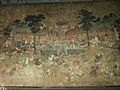
Mural at Shaolin temple from 1830's depicting forearm strikes and reverse kicks
-
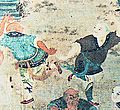
Depiction of fighting monks demonstrating their skills to visiting dignitaries (early 19th-century mural in the Shaolin Monastery).
-

Two Brazilian fighters in a Sanda/Sanshou match. Sanda is a modernized form of Kung Fu and one of the two disciplines of Sport Wushu
-
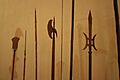
Ancient Chinese weapons
-
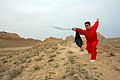
Kung fu sword
-
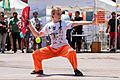
Martial arts fan
-
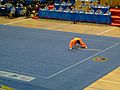
Modern forms are used in the sport of wushu, as seen in this staff routine
.jpg)


.jpg)
_Mohammad_Akbari_12.jpg)


See also
 In Spanish: Artes marciales de China para niños
