
Leptobrachium rakhinense facts for kids
Leptobrachium rakhinense is a special kind of frog that belongs to the Megophryidae family. It was first discovered in the Rakhine Mountains in Myanmar. Now, scientists know it also lives in Bangladesh and northeastern India.
Quick facts for kids Leptobrachium rakhinense |
|
|---|---|
 |
|
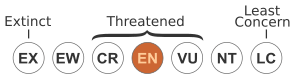
| Conservation status | |
Scientific classification  |
|
| Kingdom: | Animalia |
| Phylum: | Chordata |
| Class: | Amphibia |
| Order: | Anura |
| Family: | Megophryidae |
| Genus: | Leptobrachium |
| Species: |
L. rakhinense
|
| Binomial name | |
| Leptobrachium rakhinense Wogan, 2012
|
|
| Script error: The function "autoWithCaption" does not exist. | |
| Synonyms | |
|
|
Script error: No such module "Check for conflicting parameters".
What It Looks Like
This frog has a strong, sturdy body. Adult male frogs are about 48 to 57 millimeters (1.9 to 2.2 inches) long from their nose to their bottom. Female frogs are a bit bigger, measuring about 58 to 66 millimeters (2.3 to 2.6 inches) long.
Its nose is round. The frog's eardrum, called a tympanum, is hard to see. However, there is a clear fold of skin above it. The front legs are thin. Its fingers have small skin edges. The toes have thick webbing and wide skin edges that reach their tips. The frog's back is light gray with dark gray spots. Its eye has two colors: the top part is red, and the bottom part is black.
Where It Lives and How We Protect It
In Myanmar, Leptobrachium rakhinense lives in thick, green rain forests on low mountains. These forests are usually 600 to 900 meters (about 2,000 to 3,000 feet) above sea level. The very first frog of this species found was on the forest floor.
Male frogs have been heard calling from the ground among fallen leaves in September. This is usually at the end of the monsoon season, which is a time of heavy rain. Female frogs collected at the same time were carrying eggs. Sometimes, giant centipedes called Scolopendra try to eat these frogs.
This frog's home is at risk because of human activities. People sometimes clear parts of the forest for farming, which is called shifting agriculture. Logging, which is cutting down trees, also harms their habitat. This frog species is known to live in the Rakhine Yoma Elephant Range, which is a protected area.
