
Levee facts for kids

A levee (pronounced LEV-ee) is a raised ridge or wall built along the banks of a river or coastline. In American English, it is often called a levee, while in Commonwealth English, people often say dike or dyke. It is a type of embankment. Its main job is to provide protection against flooding for homes, towns, and farms. Levees usually run parallel to the flowing water.
Levees can be natural or human-made. They are usually built from earth and fill. When they work well, they keep rivers from spilling into the surrounding floodplain.
Contents
How Do Natural Levees Form?

Nature can build its own levees without any help from people. When a river overflows onto its flat floodplain, the water suddenly slows down. Slow water cannot carry as much heavy material.
Bits of rock, sand, and alluvium are quickly deposited right on the river's edge. Finer silt and mud travel farther away. Over many years and many floods, these layers of dirt pile up into natural ridges. They make the river banks higher, helping to stop smaller floods.
Human-Made Levees and Flood Control

People have built levees for thousands of years. Early builders in the Indus Valley Civilisation, ancient Egypt, Mesopotamia, and ancient China created huge earth walls along rivers like the River Nile.
Today, engineers design strong levees by piling earth broad at the base and narrower at the top. They plant Bermuda grass on the slopes because plant roots stop erosion. They also add flat steps called banquettes and stone revetments to protect the dirt from crashing waves. During sudden flood emergencies, workers and volunteers quickly pile sandbags to make barriers taller.
Huge systems protect major river valleys today:
- The Mississippi River system in the United States stretches for thousands of miles to protect cities like New Orleans.
- The Sacramento River system protects valleys and farmland in California.
- Long barriers along the Po River, Rhine, and Danube protect millions of people in Europe.
- The Netherlands built giant dikes to reclaim and protect low-lying farmland called a polder from the Wadden Sea.
Why Levees Fail

When water rises higher than the top of an embankment, overtopping occurs. Even worse is a levee breach, where the wall actually breaks open. Fast-moving water tears through the gap, causing serious disasters.
A famous failure happened during Hurricane Katrina in 2005, when huge levee breaches flooded New Orleans. To prevent disasters, scientists study soil strength and use tools like electrical resistivity tomography to find hidden weak spots before walls break.
Environmental Effects
While levees protect our towns, they can alter the local environment. By blocking floods, they stop natural nutrients from reaching wetlands. Trapping a river into a narrow path also makes the water rush faster, which can cause worse flooding further downstream.
Images for kids
-
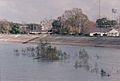
A levee keeps high water on the Mississippi River from flooding Gretna, Louisiana.

See also
 In Spanish: Dique para niños
