
Light's Fort facts for kids
Quick facts for kids Light's Fort |
|
|---|---|

The southwest view of Light's Fort in Lebanon, Pennsylvania.
|
|
| Former names | Johannes Leicht (John Light) Homestead |
| General information | |
| Type | Fort |
| Architectural style | COLONIAL: Pennsylvania German Traditional |
| Location | Lebanon, Pennsylvania |
| Address | 660 North 11th Street, Lebanon, PA |
| Coordinates | 40°20′57.048″N 76°25′50.3760″W / 40.34918000°N 76.430660000°W |
| Completed | 1742 |
| Cost | Unknown |
| Owner | Historic Preservation Trust of Lebanon County |
| Technical details | |
| Structural system | Limestone Building Stones (14 inches thick) |
| Floor area | Cellar: 1200 sq. ft.; First Floor: 1200 sq. ft.; Second Floor; 600 sq. ft.; Attic: 300 sq. ft. |
Light's Fort was built in 1742 by Johannes Peter Leicht, also known as John Light. This historic building is the oldest standing structure in Lebanon, Pennsylvania. John Light, an immigrant, bought the land in 1738 from Caspar Wistar for 82 pounds and 4 shillings. The fort was built on a large piece of land near the Quittapahilla Creek. This area was then part of Lancaster County, but it is now Lebanon County.
Contents
What Was Light's Fort Used For?
Past Uses of the Fort
Light's Fort had many important jobs in the past. It started as a home for a family on the frontier. It was also a place where the community could meet. Mennonites used it for religious gatherings. Later, it became a storage warehouse when the Union Canal (Pennsylvania) was busy. During the French and Indian War, it was a private fortress. It could protect up to 200 settlers during Native American attacks.
Modern Uses of the Fort
In more recent times, Light's Fort has been used for different things. It was a place to store grain and even a distillery. It also served as a beverage distribution center. For a while, it was an apartment building. Today, efforts are being made to turn it into a museum.
How Was Light's Fort Built?

Light's Fort is 30 feet (9.2 meters) wide and 40 feet (12.3 meters) long. It was built using local limestone and strong timbers. Its style is called Colonial: Pennsylvania German Traditional. This style was common among early German-speaking settlers in Pennsylvania during the 1700s.
Changes Over Time
When it was first built, the fort had two and a half stories. But over the years, strong storms and repairs changed it. Part of the second story and most of the attic were removed. The fort also has a large arched basement. You can reach it by walking down limestone stairs. This cellar was built over a fresh water spring that still runs today. It was used to keep things cold.
Special Plaque
Above the west side entrance, there is a bronze plaque. It says: “Home and Refuge of Johannes Leicht – (John Light) D. 1759, LIGHT’S FORT, Built 1742, Placed by the Tulpehocken Chapter of the Daughters of the American Colonists, 1974”.


Light's Fort During the French and Indian War
The Lebanon area was a busy crossroads during the French and Indian War. Because of this, there were often small battles with Native Americans. To stay safe, many forts and blockhouses were built in the area.
Private Fortresses
Light's Fort was a private fort. This means John Light, a regular citizen, built and paid for it himself. It was not built by the British government or the Pennsylvania army. Its walls were 14 inches thick and made of limestone. The roof was covered with clay tiles. This helped stop fires from flaming arrows. Most other buildings nearby were made of logs, which burned easily.
A Safe Haven
Local settlers and townspeople found safety in Light's Fort during attacks. Its strong build helped protect them from major Native American attacks during the war. It also helped the British win against the French and their allies.
Secret Tunnels of Light's Fort
The large arched cellar in Light's Fort was a safe place for townspeople. They would hide there during Native American attacks in the French and Indian War. There were even tunnels that ran from the cellar for almost a mile!
Tunnel Network
These tunnels allowed people from nearby areas to travel safely to Light's Fort during uprisings. The tunnels had two hidden entrances. One was in a wooded area (near North 10th Street and Willow Street today). It connected to another tunnel in a residential area (near North 8th Street and Cumberland Street today).
Tunnels Disappear
After the French and Indian War, the tunnels were no longer needed. In 1818, the original Lebanon County Courthouse was built over one entrance. In 1825, the Union Canal was built. This blocked the tunnel section leading into the cellar. By the 1890s, parts of the tunnels could still be reached through the basement of Stevens School. Eventually, the openings in the fort's cellar walls were closed off with limestone and concrete. These tunnels have been part of local stories for many years, and mysterious tales about them are still told.

Ghosts of Light's Fort
Many people have reported seeing ghosts at Light's Fort over the years. One famous sighting was of a Native American girl. Apartment tenants reported seeing her in the 1960s.
The Story of Marcella Light
In 1757, there was a foiled attack at Light's Fort. Marcella Light, John Light's daughter, found a crying Native American girl outside the fort on a cold night. The girl said she was lost, cold, and hungry. Marcella brought her inside and gave her food. As the girl lay down to sleep, a tinderbox fell from her clothes. Marcella thought this was strange, as the girl could have used it to make a fire. Marcella pretended to sleep and then saw the girl sneaking downstairs. Marcella followed her and saw the girl trying to set the barn on fire. Marcella stopped her and called her father. John Light told Marcella to deal with the girl, which she did. Soon after, a nearby Native American camp was found empty. It was believed they left after their plan to attack Light's Fort failed.
Other Sightings
Another ghost reported at Light's Fort is a man dressed in old colonial clothes. He has been seen on the second floor. In 2015, a worker doing repairs felt strange cold feelings while on a ladder, even though it was a warm day.
Bringing Light's Fort Back to Life
The Historic Preservation Trust of Lebanon County is working to restore Light's Fort. They are fixing both the inside and outside of the building.
Exterior Restoration
Outside, they will rebuild the parts of the walls and roof that were removed in the 1900s. Old limestone stones have been saved to use for the walls. New wooden roof beams will be put in, and the roof will be covered with clay tiles. This will make the building look like it did when it was first built.
Interior Restoration
Inside, the walls will be plastered and painted. All the floors will be covered with wood planks. The old doors and windows will be replaced with new ones that look like colonial-style products. They will also build solid wood shutters that open from the inside on all windows. A public restroom will be added on the first floor. The fireplace will be rebuilt with its original bricks. The goal is to make Light's Fort a living museum of United States colonial history.
Images for kids
-
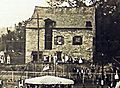
A circa 1915 picture of the south side of Light's Fort with the grain hoist way.

