
List of New York State Historic Markers in Montgomery County, New York facts for kids
This article lists some of the important historic markers in Montgomery County, New York. These markers are like special signs that tell us about interesting places, people, and events from the past. They help us learn about the rich history of this area, from early Native American villages to important moments in the American Revolution.
Contents
Historic Places in Amsterdam and Nearby Towns
Many markers in and around Amsterdam, New York tell stories of early settlers and important figures.
Sir William Johnson's Homes
Sir William Johnson was a very important person in the Mohawk Valley. He was a British official who worked closely with Native Americans.
- Claus Masion: Built in 1762 by Sir William Johnson for his daughter, Nancy. It stood near the river in Amsterdam.
- Guy Park, 1766: Sir William Johnson also built this home for his daughter Molly and her husband, Colonel Guy Johnson. They left for Canada in 1775 during the American Revolution.
- Fort Johnson, 1749: This was the third house Sir William Johnson built in the Mohawk Valley. It was an important military spot and a place where Native American councils were held between 1754 and 1760.
- Johnson Trail: This trail was used by Sir William Johnson from 1742 to 1774. It connected Fort Johnson to Johnson Hall.
- First Mohawk Valley Home: From 1738 to 1742, Sir William Johnson's first home and trading post in the Mohawk Valley was located here.
Early Settlements and Churches
- Old Manny Inn: This inn was located on Lot 8 of the 13th Patent. It was sold to Gabriel Manny in 1804 and later came into the Ross family in 1839.
- First Church in Hagaman: This church was built in Hagaman in 1835 as a Presbyterian church. It later became a Reformed Church.
- A Famous Inn: From 1795 to 1845, a hotel owned by John Van Eps stood here. He fought in the Battle of Oriskany. Famous people like Commodore Perry stayed here.
- Adriucha: The De Groot family settled here around 1700, and a mill was built around 1710.
- Evaskill: This place was named after Mrs. Eva Van Alstyne, who was attacked here in 1755.
- Manny's Corners Cemetery: This cemetery, dating back to about 1790, holds the graves of four soldiers from the Revolutionary War.
- Old Hagaman Cemetery: This cemetery from 1774 was restored in 1927. It is now cared for by the Town of Amsterdam.
Revolutionary War Events
- Cemetery-1774: This cemetery in Hagaman is the burial place of seven Revolutionary War soldiers.
- Compaanen Kill: Tradition says that Copaan, an Oneida Native American, is buried near here. He was involved in an event at West Canada Creek in 1781.
- Stantons Ford: In October 1781, 700 Tories (colonists loyal to Britain) and Native Americans crossed here. This was the last major raid in the county during the Revolutionary War.
- Wilgen Vlackte: Also known as Willow Flats, this area was settled by Claus Willemse Van Coppernowl in 1684. It was the westernmost settlement at that time.
Historic Sites in Canajoharie and Charleston
These towns also have markers that highlight their unique past.
Canajoharie's History
- Canajoharie: The name means "Pot That Washes Itself." This refers to a pothole in the creek bed at the entrance to Canajoharie Gorge.
- Clinton Camp: In June 1779, Colonel Weissenfels' 4th New York Regiment camped here. They were guarding the army's march to Otsego Lake. Another Clinton Camp was for Colonel Gansevoort's 3rd New York Regiment.
- Flint Homesite: This was the home of Robert Flint, a pioneer and lieutenant in the French and Indian Wars. Cornelius Flint, a Revolutionary War soldier, also lived here.
- Fort Failing: Built in 1770, this was a place of safety and the home of Colonel Hendrick Frey.
- Canajoharie Academy: From 1824 to 1892, this academy stood at the intersection of Cliff and Otsego Streets. Susan B. Anthony, a famous women's rights leader, taught here from 1846 to 1848.
- Johannes Reuff's Tavern: Built in 1750, this tavern became General James Clinton's headquarters in 1779. General George Washington visited here in 1783.
- Sullivan-Clinton Campaign 1779: This marker points out the portage route used by General James Clinton's army. About 2,000 men, 500 wagons, and 200 boats were moved overland from Canajoharie to Otsego Lake.
- Van Alstyne Homestead: Built in 1749, this home was where 16 of 31 meetings of the Tryon County Safety Committee were held during 1774-1775. General Nicholas Herkimer received his commission as a brigadier general here in 1775.
- Clinton Road: This road was part of the route for General Clinton's American army in 1779, moving men, wagons, and boats from Canajoharie to Otsego Lake.

Charleston's Early Days
- Baptist Church: This church was built in Charleston in 1793. Elijah Herrick was its first pastor.
- Christian Church: Erected in 1813 at Charleston Four Corners, James Wilson was its first pastor.
- Grave of Samuel Tallmadge: Samuel Tallmadge, a lieutenant and adjutant in the American Revolution, is buried here. He was born in 1755 and died in 1825.
- Grave of William McConkey: William McConkey, born in 1744, owned the ferry on the Delaware River that George Washington used to cross on December 25, 1776.
- Grist Mill: This mill was built in 1850 by Judah Burton, whose family were among the first settlers.
- Home of Lieut. Samuel Tallmadge: Built around 1800, this home replaced a log cabin from about 1789.
Florida and Glen: Historic Crossroads
These towns feature markers about early settlements, important forts, and Native American history.
Florida's Past
- "Yankee Street": Surveyed in 1795, this street was "Six Rods Wide, Straight Course S.E. From Creek To Division Line Between Warren & Remsen Patents." It is now Schuyler's Corner.
- Associate Church: This church was organized around 1786. Its first church building was constructed in 1800.
- Jan Wemp (Wemple): An early settler, Jan Wemp obtained 450 acres of land from the Mohawk Indians in 1737. He helped build the Queen Anne Chapel and Old Fort Hunter.
- Peter Young: Settled in 1726 near Young's Lake. He received the first land lease in Warrensbush in 1736.
- Queen Anne Parsonage: Built in 1712 for missionaries to the Mohawk Indians. In 1775, Rev. J. Stuart and J. Brant translated the Gospel of St. Mark into Mohawk here.
- Queen Anne Chapel: Built in 1711-1712 for the Mohawk Indians, this chapel was torn down in 1821 for the Erie Canal.
- Log Meeting House: This was the Warrensbush Church, built in 1778. It was the first Methodist Church in the Mohawk Valley.
- First Bridge: The first bridge across Schoharie Creek was built here by Isaac Deput in 1796-1797. It was partly destroyed by ice in 1814.
- Remsen's Bush Dutch Church: This church was built around 1784 on land given by L. Shuler. A new church was built in Minaville in 1808.
- Frederick's Mill: Philip Frederick and Francis Saltz leased land and built this mill in 1750.
- T-can-de-ro-ga or Ten-on-on-to-gen: This was the Lower Castle of the Mohawk's Wolf Clan, and the last Mohawk Indian village in the valley from 1700 to 1775.
- Old Fort Hunter: Built in 1711-1712 by Governor Hunter to protect the Mohawk Indians. It was surrounded by the Queen Anne Chapel.
- Pioneer Warrensbush Village: From 1770 to 1810, this prosperous village had a saw and grist mill. It was destroyed in Indian raids in 1781.
- First Town Meeting: The first town meeting was held at Ezra Murray's home in April 1794.

Glen's Historical Markers
- Andagoron: This was the Middle Mohawk Castle of the Bear Clan, located on a hilltop in 1642. It was destroyed in De Tracy's Raid of 1666.
- Block House: A block house was built on this site near the end of the Revolutionary War.
- Cromwell Home: Built around 1778 by Philip Cromwell, a surgeon in the Tryon County Militia.
- First School: The first school in the Town of Glen was located here in 1797, in the home of Abraham D. Quackenbush. John Hazzard was the teacher.
- Gandawague: This was the Lower Mohawk Indian Castle of the Turtle Clan in 1659. It was burned in De Tracy's Raid in 1666.
- Last Council: The last council between the Mohawk Indians and the Tryon County Committee of Safety was held here in October 1775.
- Ossernenon: This was the Lower Mohawk Indian Castle from 1642 to 1659. Father Jogues and Rene Goupil were martyred here. Tekawitha was also born here.
- Starin Tavern: Built in 1755, this tavern was the western end of the Albany Post Road in 1795.
- Van Epps Home: The first home in Fultonville (then called Van Epps Swamp) was built here in 1751 by John E. Van Epps.
Minden and Mohawk: Forts and Famous People
These towns have markers about military history, early churches, and important individuals.
Minden's Markers
- Reformed Church 1750: The first church organization in the Town of St. Johnsville was located here.
- Ancient Salt Springs: In 1739, David Linsey discovered these springs, which gave the village its name and were a source of salt for pioneers.
- Clinton March 1779: Colonel Lewis Dubois and the 5th New York Regiment left Fort Plain for Otsego Lake on June 25, 1779.
- Clinton Road Portage Route: This marker points to the route used by General Clinton's American army of 2,000 men, 200 boats, and 500 wagons.
- Can-a-wo-ge: A Mohawk village stood on this sand hill in 1634, with a burial ground nearby.
- Fort Clyde: A strong fort with a blockhouse, named for Colonel Samuel Clyde of Canajoharie, used from 1777 to 1783.
- Fort Plain: From 1776 to 1786, this was the northern limit of a raid by Brant's Indians and Tories on August 2, 1780. 16 people were killed, 60 captured, and 100 buildings burned.
- Fort Plank: This site marks the stockaded home of Frederick Planck, a military post and refuge from 1776 to 1783.
- Grave of Henry Seeber: Henry Seeber, a pioneer, patriot, and Revolutionary soldier, is buried here.
- Indian Trail & Military Road: This road was used by Clinton's Army in 1779 on their march to join General Sullivan.
- Ots-squa-go: The course of this creek changed when the Erie Canal was built between 1817 and 1825.
- Ots-tun-go: One of the first Mohawk Castles was located about three-quarters of a mile up Otstungo, from 1580 to 1625.
- Sand Hill School: This was the site of the first school built in this area before the Revolution.
- Sand Hill Dutch Reformed Church: The first church was built in 1750, burned in the 1780 raid, rebuilt in 1785, and torn down in 1840.
- Home and Grave of Sergeant John Jacob Diefendorf: Sergeant Diefendorf, born in 1747, served in the Revolution and fought in the Battle of Oriskany.
- Ta-ra-to-rees: Meaning "Hill of Health," this was the Mohawk Middle Town from 1700 to 1755.
- Te-no-to-ge: The largest Mohawk Indian town, visited by Van Den Bogaert in 1634. It had 55 houses and over 1,000 people.

Mohawk's Contributions
- Tekawitha Spring: This spring supplied water to the villages of Caughnawaga from 1667 to 1693. It was named after "The Lily of the Mohawks."
- Old Caughnawaga Church: This church was built in 1763.
- Camp Mohawk: The "Iron Hearted Regiment" drilled here and was mustered into service on August 16, 1862, under Colonel Simeon Sammons.
- Caughnawagae: This was the Lower Mohawk Indian Castle in 1667, ruled by the Turtle Clan. The Jesuit Mission of St. Peter's was destroyed here in a 1693 raid.
- Connolly Inn: This inn stood at Yosts, where there was a toll gate and a bridge across the Mohawk River. The bridge was swept away by high water and never rebuilt.
- Court House: Built in 1836 when Fonda became the county seat. It was a place for many social, religious, and political meetings.
- Danascara Place: Built in 1795 by Colonel Frederick Vischer, replacing a house burned in the Valley Raid of 1780.
- Davis Tavern: Famous in the days of stagecoach travel, built around 1781 by Matthew C. Davis.
- Fonda Cemetery: This old cemetery has been village property since 1855. Many early settlers and six Revolutionary soldiers are buried here.
- Fonda Tavern: Built around 1781 by John Fonda of the Tryon County Militia.
- Liberty Pole: Erected here, its occasion led to the first bloodshed in Old Tryon County in May 1775.
- Pappy Douw Fonda House: Built for Adam Douw Fonda on "The Winter Farm."
- Sammons' Home: This home was burned during the Revolution. Sampson Sammons and his three sons were taken prisoner. Jacob and Frederick escaped after much suffering.
- Van Horn House: Built by Abram Van Horn in 1826, it was used as a bakery and store.
- Veeder Home: Built around 1791 by Major Abraham Veeder, who kept an inn and operated a ferry across the river.
- Wemple Tavern: Built in 1780 by "Peggy" Wemple, a Revolutionary heroine.
- Home of Douw Fonda: This was the home of Douw Fonda, the first settler after whom the village was named. His house was burned, and he was killed by Tories and Native Americans in 1780.

Palatine and Root: Battles and Settlements
These towns hold markers about significant battles and early community life.
Palatine's Historical Markers
- Army Camp: General Van Rensselaer's American Army camped here on October 19, 1780. This was also the site of the Palatine Church, built in 1770.
- Fort Frey: This was the 1739 home of Major John Frey and Hendrick Frey. A British fort was nearby from 1701 to 1713.
- Fort Wagner: The stone part of this house was the stockaded home of Lieutenant Colonel Peter Wagner of the Palatine Regiment, Tryon County Militia, in 1750.
- Loucks Tavern: This was the site of the first meeting place for the Palatine District Committee of Safety on August 27, 1774.
- Settled by Hendrick Frey 1689: The village was settled by Palatine Germans. A bridge was built in 1803, and the village was chartered in 1867.
- Early Home of Major Jelles Fonda: This was the home of a prominent merchant and Indian trader in the Mohawk Valley. An Indian village was also located here.
- Spraker Inn: Built in 1795 by the Spraker family, this was a famous tavern along the river and turnpike.
- Stone Arabia Lutheran Church: Built in 1792, this was also the site of a log church from 1729. The area was settled by Palatines in 1712.
- Stone Arabia Battlefield: The battlefield lies east of the road. Colonel Brown's American Battalion was defeated here on October 19, 1780.

Root's Historic Sites
- Currytown Reformed Church: Organized in 1790, services were previously held in Jacob Dievendorf's barn.
- Home of Volkert Vrooman: Tradition says George Washington stayed overnight here during his visit through the valley.
- Raider's Camp: On October 18, 1780, the Indian-Tory raiders led by Sir John Johnson camped here.
- Raided by Tories and Indians: This area was raided by Tories and Native Americans on July 9, 1781. Fort Lewis provided a safe place for people.
Images for kids
-
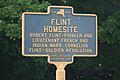
The Flint Homesite marker.
-
The Indian Trail Road marker.
-
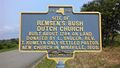
The Remsen's Bush Church historical marker.
-
The Fonda Cemetery.
-
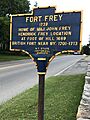
The Fort Frey historical marker.
See also
