
Maccoa duck facts for kids
Quick facts for kids Maccoa duck |
|
|---|---|
 |
|
| O. maccoa, male | |
| Conservation status | |
Scientific classification  |
|
| Kingdom: | Animalia |
| Phylum: | Chordata |
| Class: | Aves |
| Order: | Anseriformes |
| Family: | Anatidae |
| Genus: | Oxyura |
| Species: |
O. maccoa
|
| Binomial name | |
| Oxyura maccoa (Eyton, 1838)
|
|
| Script error: The function "autoWithCaption" does not exist. | |
| Synonyms | |
|
|

Script error: No such module "Check for conflicting parameters".
The Maccoa duck (Oxyura maccoa) is a special type of diving duck. You can find these ducks in parts of Eastern and Southern Africa. They are known for their stiff tails, which often stick up when they are in the water.
Contents
About the Maccoa Duck
Maccoa ducks are part of a group called stiff-tailed ducks. They spend a lot of time in the water, often with their tail feathers pointing upwards. Their bodies are built for swimming and diving underwater. This means their legs are set far back on their bodies. Because of this, they can look a bit clumsy when they walk on land.

Male Maccoa Ducks
When it's time to find a mate, male Maccoa ducks look very striking. They have a bright blue bill and a completely black head and throat. Their chest and back are a rich chestnut color. Their belly is often greyish-brown, and their tail and feet are black. When they fly, you can see their off-white feathers under their wings. Males who are not breeding look more like the females. However, they still have a darker head and some hints of chestnut on their back.
Female Maccoa Ducks
Female Maccoa ducks are not as colorful as the males. They have a greyish-black bill with a light tip. Their face is light brown, with a dark cap on their head and a dark stripe across their cheek. Their throat is off-white. Females also have a light brown chest, a darker brown back, and off-white underparts. Their feet and tail feathers are black.
Young Maccoa Ducks
Like many young birds, juvenile Maccoa ducks look similar to adult females. However, their tail feathers are thinner and have small notches. Their heads are also a darker brown.
Maccoa Duck Family Tree
The Maccoa duck belongs to a group called Oxyura, which means "stiff-tailed ducks." Scientists generally agree that Oxyura ducks are related to another duck group called Nomonyx. This group includes just one species, the Masked duck.
The Oxyura ducks are divided into two main groups:
- Old World ducks: These include the Maccoa duck (O. maccoa), the White-headed duck (O. leucocephala), and the Blue-billed duck (O. australis).
- New World ducks: These are found in the Americas, like the Lake duck (O. vittata) and the Andean duck (O. ferruginea).
Scientists are still working to figure out the exact relationships between all the different stiff-tailed duck species. Studies using different methods sometimes show slightly different family trees. However, it is clear that the Maccoa duck, White-headed duck, and Blue-billed duck are closely related.


Where Maccoa Ducks Live
When Maccoa ducks are not breeding, they live in inland waters. These can be fresh or slightly salty (brackish) waters. They like places full of nutrients, such as lakes, ponds, dams, and even sewage ponds. These spots give them plenty of room to land, take off, and dive for food.
For breeding, Maccoa ducks look for similar places. However, they need open freshwater next to tall plants growing out of the water. They especially like plants called Typha (also known as cattails or bulrushes). They usually build their nests hidden within bundles of these reeds.
Maccoa ducks live across the southern and eastern parts of Africa. They are a "sedentary" species, which means they do not migrate far for winter or breeding. Instead, they move around to find new wetlands with food and good nesting spots. Their populations are spread out because there are not many suitable wetlands across the continent. In 2012, there were about 11,000 Maccoa ducks in the world. About 75% of them lived in southern Africa, with South Africa being home to half of the global population.
Interestingly, human-made structures like dams can sometimes help Maccoa ducks. Large groups of these ducks have been found living behind dams in Namibia. These dams create deep freshwater habitats that are good for diving ducks. This can actually help with the conservation of the species.
Maccoa Duck Behavior
Vocalizations
Male Maccoa ducks make special sounds during their mating displays. They might give short whistles or a "prrrr'ing" sound that lasts a few seconds.
If a Maccoa duck feels threatened, both males and females will make low grunting sounds.
Diet
The Maccoa duck is an omnivore, meaning it eats both plants and animals. Its diet mainly includes small water animals (invertebrates) and aquatic plants. When diving, a Maccoa duck usually stays underwater for about 15 to 22 seconds. During this time, it scoops up dark debris from the bottom of the lake or pond. This debris is often full of small invertebrates. The duck then sifts through the material with its bill, keeping the seeds, plant pieces, and insects it wants to eat.

When looking for plants underwater, Maccoa ducks eat various types. They seem to prefer plants from the Persicaria and Polygonum groups. They will eat their seeds, roots, and other plant parts. They also hunt different stages of water insects and worms. This includes Tubifex worms, fly larvae, and Daphnia eggs. Other small creatures on their menu include snails and tiny crustaceans called ostracods.
Reproduction and Life Cycle
Maccoa ducks typically mate and lay their eggs between January and May. During this time, they stay in small, protected freshwater areas with tall plants.
Male Maccoa ducks are polygynous. This means one male will mate with several females. They are very protective of their breeding territory. Males do not help with building the nest or raising the young. After mating, females stay in the male's territory. They either build a new nest from reeds and soft down feathers, or sometimes they use old nests built by other water birds like coots or grebes.
A female usually lays 5 or 6 eggs, but sometimes up to 12. This can happen if females lay their eggs in another female's nest. Females have also been seen leaving their young before or during the incubation period. The eggs usually hatch after 25 to 27 days. When chicks are born, they have dark legs, feet, and bills. Their faces are white, and their bodies are covered in grey-brown down feathers.
Interestingly, a male Maccoa duck's breeding colors can be affected by its social standing. A study in 1985 found that male ducks who were picked on by more dominant males did not develop bright breeding plumage.
Status and Threats
The Maccoa duck is considered an endangered species. This means its population is at risk.
Pollution
Maccoa ducks eat both plants and small animals. This puts them higher up in the food chain compared to ducks that only eat plants. Because of this, they are more easily affected by pollution. Toxins like pesticides and herbicides from nearby farms can get into the water. These toxins can build up in the small animals and plants that the ducks eat, making the ducks sick.
Climate Change
As the Earth's climate gets warmer, the wetlands in southern Africa that Maccoa ducks rely on might start to dry up. Without these important habitats for breeding and feeding, the number of Maccoa ducks could decrease even more.
Accidental Capture
Another threat to Maccoa ducks is getting caught by accident in gill nets. These nets are used by people to catch fish. This problem is becoming more common as the need for fish grows. It seems to affect Maccoa duck populations in eastern Africa more, especially those living on large lakes.
Images for kids
-

The blue-billed duck (Oxyura australis), a relative of the Maccoa duck.
-

The white-headed duck (Oxyura leucocephala), another relative.
-
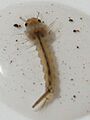
Mosquito larva, a small invertebrate that Maccoa ducks eat.
