
Madagascan fruit bat facts for kids
Quick facts for kids Madagascan fruit bat |
|
|---|---|
 |
|
| Conservation status | |
Scientific classification  |
|
| Kingdom: | Animalia |
| Phylum: | Chordata |
| Class: | Mammalia |
| Order: | Chiroptera |
| Family: | Pteropodidae |
| Genus: | Eidolon |
| Species: |
E. dupreanum
|
| Binomial name | |
| Eidolon dupreanum Schlegel & Pollen, 1866
|
|
 |
|
| Madagascan fruit bat range | |
| Script error: The function "autoWithCaption" does not exist. | |
Script error: No such module "Check for conflicting parameters".
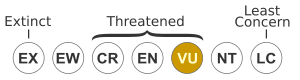
The Madagascan fruit bat (scientific name: Eidolon dupreanum) is a special type of bat. It belongs to a family of bats called Pteropodidae, which are often known as "fruit bats" or "flying foxes." This bat lives only on the island of Madagascar. Sadly, it is considered "Vulnerable" by a group called the IUCN. This means its numbers are going down, mainly because people hunt it for food.
Contents
Where Madagascan Fruit Bats Live
The Madagascan fruit bat was named after Marie Jules Dupré. He was the Governor of Réunion from 1864 to 1869. He helped many scientists with their research.
These bats can be found all over Madagascar. They live near the coast and also in the high central areas. Even if they haven't been seen in some places, they might still be there. They just haven't been observed yet.
Their Home During the Day
Madagascan fruit bats need safe places to rest during the day. They like to roost in rock cracks and caves. A group of these bats, called a colony, can have anywhere from ten to five hundred bats living together.
What Madagascan Fruit Bats Eat
Scientists have studied the droppings of these bats. They found that the bats mostly eat fruit. But they also enjoy the flowers of Eucalyptus trees.
Food Journeys
These bats are willing to fly far to find their favorite foods. They have been seen flying up to 5 kilometres (3.1 mi) (about 3 miles) to reach Polyscias trees. Interestingly, they often ignore guava trees (Psidium) that are much closer to their roosts.
Helping Plants Grow
When bats eat fruit, they often swallow the seeds. Seeds smaller than about 7 mm (0.3 in) (about a quarter inch) usually get swallowed. When the bats drop these seeds later, it helps spread new plants. Studies show that seeds grow even better after passing through a bat's stomach!
When fruit is hard to find, these bats switch to eating nectar from flowers. They have been seen visiting the flowers of the rare baobab tree (Adansonia suarezensis). They also visit the kapok tree (Ceiba pentandra). It is believed that these bats help pollinate these trees. This means they help the trees make new seeds.
Life Cycle and Reproduction
Each year, a female Madagascan fruit bat usually has only one baby. This slow rate of reproduction is a problem for the bats. It means their numbers can't grow back quickly if too many are hunted.
Protecting the Madagascan Fruit Bat
The IUCN has listed this bat as "Vulnerable" on its Red List of Threatened Species. This means the bat's population is decreasing. The biggest danger to these bats is being hunted for bushmeat, which is wild animal meat.
Hunting Rules
In Madagascar, there are laws about hunting these bats. People are only allowed to hunt them between May and August. However, many people do not follow this rule. They hunt the bats all year round.
Some bat colonies have completely disappeared because of too much hunting. But sometimes, new bats move into these empty roosts a few years later.
Protected Areas
The Madagascan fruit bat lives in several protected areas. In these places, they should be safe from hunting. These bats are also quite good at adapting. If their usual food sources disappear, they can switch to eating other things. However, they seem to prefer fruit from native trees over trees that were brought to the island by people.
