
Makuuchi facts for kids

Makuuchi (pronounced Mah-koo-oo-chee) is the highest and most exciting division in professional sumo wrestling. It's where the strongest and most skilled wrestlers compete. Since 2004, there are always 42 wrestlers, called rikishi, in this division. They are ranked into five levels based on how well they performed in past tournaments.
This is the only sumo division shown live on regular TV in Japan, with English commentary available. This shows how important and popular the makuuchi division is!
The word makuuchi means "inside the curtain." This name comes from a long time ago. Back then, the top wrestlers had a special curtained-off area where they waited before their matches.
Wrestlers can move up or down in rank before each big tournament. If a wrestler wins more matches than they lose (this is called kachi-koshi), they usually get promoted. If they lose more than they win (called make-koshi), they might move down. Getting to the very top ranks has even stricter rules.
Contents
Understanding the Top Ranks
At the very top of the makuuchi division are special ranks known as san'yaku. These include the yokozuna, ōzeki, sekiwake, and komusubi. There are usually 8 to 12 wrestlers in these top spots. All other wrestlers in makuuchi are called maegashira, and they are ranked from 1 downwards.
The word san'yaku means "the three ranks," even though there are actually four. This is because the yokozuna was once seen as a very special ōzeki.
Wrestlers in the san'yaku ranks have many special benefits and duties. They earn more money and get more help from junior wrestlers. They also represent all sumo wrestlers on important occasions. For example, they stand with the head of the Sumo Association during speeches at the start and end of tournaments. They might also help welcome important guests, like members of the Imperial Family.
The san'yaku ranks are often split into two groups:
- Senior Ranks: Yokozuna and Ōzeki. These wrestlers have very strict promotion rules and even higher salaries. They also have more responsibilities, like helping with advertising and meeting sponsors.
- Junior Ranks: Sekiwake and Komusubi. These wrestlers have fewer duties. Like maegashira, they can win special prizes (called sanshō) for outstanding performance in a tournament.
Yokozuna: The Grand Champion

The Yokozuna is the highest rank a sumo wrestler can achieve. The name means 'horizontal rope.' This refers to the special, heavy rope (called a tsuna) that a yokozuna wears around their waist. This rope is like the sacred ropes used in Shinto shrines. It shows the yokozuna's special status. The tsuna can weigh up to 20 kg! Wrestlers wear it during their special ring-entering ceremony, not during matches.
As of May 2025, 75 sumo wrestlers have officially become yokozuna. This means about one new yokozuna every three years since records began in 1789.
History of the Yokozuna Rank

There are old stories about how the yokozuna rank began. One legend says a wrestler in the 9th century tied a sacred rope around himself as a challenge. Another story credits the legendary wrestler Akashi Shiganosuke in 1630. While these stories are interesting, we know for sure that by 1789, wrestlers like Tanikaze Kajinosuke and Onogawa Kisaburō were shown wearing the tsuna in art.
For a long time, the yokozuna title was given to ōzeki who performed for the shogun (a military ruler). It wasn't always based on skill alone. In 1909, the yokozuna was officially recognized as the highest rank. Since 1950, the Yokozuna Deliberation Council and the Japan Sumo Association decide who gets promoted.
How a Wrestler Becomes a Yokozuna
Becoming a yokozuna is very difficult. An ōzeki must show great strength, skill, and dignity (called hinkaku). There are no exact rules, but usually, a wrestler needs to win two championships in a row as an ōzeki. They might also be considered if they have one championship win and one runner-up finish, with consistently strong performances over three tournaments.
The idea of "dignity" has sometimes caused debate. For example, some worried if foreign-born wrestlers could have the necessary dignity. However, this changed in 1993 when Hawaiian-born ōzeki Akebono became a yokozuna. Since then, many non-Japanese wrestlers have reached this top rank, showing that dignity comes from character, not birthplace.
The promotion process involves several steps. After a tournament, the Yokozuna Deliberation Council discusses the top wrestlers. If they recommend a promotion, the Sumo Association makes the final decision. A representative then visits the wrestler's training stable to share the good news. A new tsuna is made, and the wrestler practices their ring-entering ceremony. Finally, they perform their first official ceremony at Meiji Shrine in Tokyo.
When a Yokozuna Retires
Unlike other ranks, a yokozuna cannot be demoted. However, they are expected to perform at an extremely high level. A yokozuna should regularly win championships or be a strong contender. If they have a losing record, it's a serious concern.
A yokozuna who cannot consistently perform at their best is expected to retire. Sometimes, retirement can also happen if a yokozuna's actions go against the dignity of their rank. For example, Futahaguro retired after a short time as yokozuna due to misbehavior. He became the only yokozuna to retire without winning a top division championship.
Special Notices for Yokozuna
In rare cases, the Yokozuna Deliberation Council can issue special notices to yokozuna who are not meeting expectations. These notices show increasing levels of concern:
- Encouragement (gekirei)
- Warning (chūi)
- Recommendation to Retire (intai kankoku)
These notices have been issued three times since 1950:
- January 2010: Recommendation to Retire for Asashōryū. This followed reports of misconduct. Asashōryū chose to retire before the Sumo Association could act on the recommendation.
- November 2018: Encouragement for Kisenosato. He had struggled with injuries and losing records. He retired in January 2019.
- November 2020: Warning for Hakuhō and Kakuryū. Both wrestlers had not performed well due to injuries. Kakuryū retired in March 2021. Hakuhō returned to win the July 2021 tournament before retiring.
Yokozuna Ceremonies and Traditions
.jpg)
.jpg)
The yokozuna has a very special ring-entering ceremony, called dohyō-iri. This ceremony happens before the matches begin each day. Regular top-division wrestlers also have a ceremony, but the yokozuna's is more complex.
During the ceremony, the yokozuna is joined by two assistants. A "dewsweeper" (tsuyuharai) walks in front, and a "sword bearer" (tachimochi) follows behind. The sword bearer carries a Japanese katana, which shows the yokozuna's important status. All three wear matching ceremonial aprons, called keshō-mawashi. The yokozuna also wears their heavy tsuna rope.
Once in the ring, the yokozuna performs a ritual dance. There are two main styles: the "Unryū" style and the "Shiranui" style. A yokozuna usually chooses one style when first promoted. These styles are named after famous yokozuna from long ago.
When a former yokozuna turns 60, they might perform a special red-rope ceremony called kanreki dohyō-iri. This celebrates their long life and career.
Active Yokozuna
- Hōshōryū, the 74th yokozuna, from Mongolia, promoted in January 2025.
- Ōnosato, the 75th yokozuna, from Japan, promoted in May 2025.
Ōzeki: The Champion Rank
Ōzeki is the rank just below yokozuna. For a long time, ōzeki was the highest rank in sumo. There must always be at least two ōzeki listed in the rankings. If there aren't enough regular ōzeki, a yokozuna might be given the special title of "yokozuna-ōzeki" to fill the spot. This happened in March 2020 and during the first three tournaments of 2023. It also happened in May 2025 when Ōnosato was promoted to yokozuna, leaving only one ōzeki.
There isn't a strict limit to how many ōzeki there can be. In 2012, there was a record high of six ōzeki at one time.
Becoming an Ōzeki
To become an ōzeki, a wrestler usually needs to win at least 33 matches over their last three tournaments while holding a komusubi or sekiwake rank. They also need to show great skill and consistency. Winning a championship or defeating yokozuna and other ōzeki wrestlers helps a lot. The Sumo Association's board of directors makes the final decision. When a wrestler is promoted, a board member visits their stable to share the news. The new ōzeki usually gives a speech, promising to uphold the rank's dignity.
Demotion from Ōzeki
Unlike a yokozuna, an ōzeki can be demoted. This happens in two steps. First, if an ōzeki has a losing record (7–8 or worse) in a tournament, they become "kadoban." If they have a winning record (8–7 or better) in the next tournament, they keep their ōzeki rank. But if they have another losing record while kadoban, they are demoted to sekiwake.
If a demoted ōzeki wins ten or more matches in the next tournament, they can get their ōzeki rank back right away. Several wrestlers have managed this, including Tochiazuma (twice!) and Takakeishō. If they don't win ten matches, they have to work their way back up like any other wrestler.
Benefits of Being an Ōzeki
Being an ōzeki comes with many advantages:
- They earn a higher salary.
- They are guaranteed a higher position in the Sumo Association after they retire.
- They receive a special payment when they retire.
- They get a parking space at the Sumo Association headquarters.
- They can vote in the election for Sumo Association directors.
- They receive more help from junior wrestlers in their stable.
- They can wear special purple-fringed ceremonial aprons.
- They often represent sumo wrestlers at formal events.
Active Ōzeki
- Kirishima, since May 2026 (and previously from July 2023 to May 2024).
- Kotozakura, since March 2024.
Active Former Ōzeki
- Takayasu, from July 2017 to December 2019.
- Asanoyama, from May 2020 to July 2021.
- Shōdai, from November 2020 to November 2022.
- Mitakeumi, from March to September 2022.
- Aonishiki, from January 2026 to May 2026.
Sekiwake: The Third Highest Rank
Sekiwake is the third-highest rank in professional sumo. It is one of the important san'yaku ranks. The name might come from the idea of "guarding the ōzeki's side."
A wrestler can reach sekiwake by consistently having winning records in tournaments. To get promoted, a wrestler usually needs a very good record, like 11 wins or more, in the previous tournament as a komusubi. However, just having winning records at sekiwake isn't enough to become an ōzeki. Wrestlers like Goeidō stayed at this rank for many tournaments before moving up.
If a sekiwake has a losing record, they usually lose their rank. But sometimes, if other wrestlers below them also had losing records, a sekiwake might keep their rank, moving from the "East" side to the "West" side, which is slightly less prestigious.
Sekiwake and komusubi are often grouped as the "junior san'yaku" ranks. Wrestlers at this rank get a higher salary than maegashira. They also appear with the head of the Sumo Association during speeches at tournaments. If this is the highest rank a wrestler reaches, they are still remembered as a "former sekiwake" after retirement, showing a successful career.
There must always be at least two sekiwake wrestlers. Sometimes there can be three or four, especially if many wrestlers are performing well.
Active Sekiwake
- Atamifuji, since May 2026 (previous rank: komusubi).
- Kotoshōhō, since May 2026 (previous rank: maegashira 5).
- Wakatakakage, since July 2026 (previous rank: komusubi).
- Aonishiki, since July 2026 (previous rank: ōzeki).
Komusubi: The Little Knot
Komusubi means "the little knot." This name refers to the matchups between wrestlers. It is the fourth-highest rank in sumo and the lowest of the special "titleholder" ranks, san'yaku.
At komusubi, simply having a winning record (8–7 or better) is not always enough to get promoted to sekiwake. A wrestler usually needs at least 11 wins in the previous tournament, especially if there isn't an open spot at sekiwake.
Like sekiwake, this rank is part of the "junior san'yaku" group. Wrestlers at this rank get a salary increase. They also join the chairman of the Sumo Association for speeches at tournaments. If this is the highest rank a wrestler reaches, they are still called a "former komusubi" after they retire, showing a good sumo career.
There must always be at least two komusubi wrestlers. Sometimes there can be more, if many wrestlers perform very well.
Komusubi is known as a tough rank to keep. Wrestlers at this level often face all the ōzeki and yokozuna in the first week of a tournament. Many wrestlers new to this rank find it hard to get a winning record.
List of Active Komusubi
- Yoshinofuji, since July 2026 (previous rank: maegashira 2).
- Ōhō, since July 2026 (previous rank: maegashira 3).
Maegashira: The Lower Top Division Rank
Maegashira is the lowest of the five ranks within the top makuuchi division. All makuuchi wrestlers who are not in the special san'yaku ranks are called maegashira. They are numbered from 1 downwards. For each number, there is an "East" wrestler (higher ranked) and a "West" wrestler (lower ranked).
The number of maegashira ranks can change, but it's usually between 15 and 17. This means there are about 32 maegashira wrestlers in total.
A wrestler's rank can change a lot based on their performance. For example, a maegashira ranked 14 who wins the entire division championship could jump all the way up to komusubi for the next tournament! This happened in March 2000 with Takatōriki.
Maegashira wrestlers ranked 5 or lower usually compete against each other. However, those ranked maegashira 4 or higher (called jōi-jin) often face the top san'yaku wrestlers, including ōzeki and yokozuna. If a lower-ranked maegashira is doing very well and might win the championship, they will be scheduled to fight higher-ranked opponents later in the tournament. For instance, in January 2020, maegashira 17 Tokushōryū fought and defeated ōzeki Takakeisho on the final day to win the championship!
When a maegashira wrestler defeats a yokozuna, it's a big deal! This is called a gold star or kinboshi. The wrestler receives extra money for this victory for the rest of their career. It used to be common for fans to throw their seat cushions into the ring after a kinboshi win, though this is now discouraged.
Images for kids
-
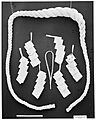
A tsuna belonging to the Metropolitan Museum of Art

See also
 In Spanish: Makuuchi para niños
- Glossary of sumo terms
- List of sumo record holders
- List of sumo tournament top division champions
- Professional sumo divisions
- List of active sumo wrestlers
