
Mooers–Hemmingford Border Crossing facts for kids
Quick facts for kids Mooers-Hemmingford Border Crossing |
|
|---|---|

Hemmingford, Quebec Border Inspection Station
|
|
| Location | |
| Country | United States; Canada |
| Location |
|
| Coordinates | 45°00′16″N 73°36′11″W / 45.004459°N 73.602991°W |
| Details | |
| Opened | 1935 |
| US Phone | (518) 298-3182 |
| Canadian Phone | (800) 461-9999 |
| Hours | Open 24 Hours |
|
U.S. Inspection Station—Mooers, New York
|
|

US Border Inspection Station at Mooers as seen in 1996
|
|
| Lua error in Module:Location_map at line 420: attempt to index field 'wikibase' (a nil value). | |
| Location | Hemmingford Road, Mooers, New York |
| Area | 3.5 acres (1.4 ha) |
| Built | 1932 |
| Architect | Simon, Louis A.; Wetmore, James A. |
| Architectural style | Colonial Revival |
| MPS | U.S. Border Inspection Stations MPS |
| NRHP reference No. | 14000572 |
| Added to NRHP | September 10, 2014 |

The Mooers–Hemmingford Border Crossing is a special place where Canada and the United States meet. It links the small town of Hemmingford in Quebec with Mooers, New York. You can get there by following Quebec Route 219 in Canada or Hemmingford Road in the U.S. This border crossing is always open, every hour of every day, all year long! The main building used by the U.S. government is the same one built way back in 1935. Because it's so old and important, it was added to the U.S. National Register of Historic Places in 2014.
Contents
The Mooers Border Station Building
The main building for checking people and cars at the Mooers border is on the west side of State Route 22 in Mooers, New York. It sits on a large piece of land, about the size of two football fields. The area around it is mostly farmland and woods. You can even see the Canadian border station from here! Cars drive in a special oval shape to get to the building. The area around the station has some older evergreen trees that were part of the original design.
The border station is part of a group of three buildings. The other two are houses for the customs and immigration officers. These houses are located a short distance away from the main station.
What the Building Looks Like
The main building has three parts. The middle part is taller, with one and a half stories, and is made of white-painted brick. On each side, there are two smaller, one-story sections made of wood. The central part has a steep roof made of slate. It has windows on the second floor that stick out from the roof.
The smaller sections on the sides have sloped roofs. The section on the south side was used to inspect vehicles. The section on the north side was a garage for government cars. Over the years, some changes have been made, like adding new doors or filling in old openings.
A long canopy, or roof, extends from the main building. This canopy covers the lane where cars stop for inspection. It was replaced in 1972 with a larger one. Two flagpoles stand on either side of this canopy.
Inside the Station
When you go inside the main building, there's a small entrance area. There are counters that still have their original oak tops, which is pretty cool! There are also small bathrooms. The inside has plaster walls and wooden trim, which was common for buildings like this. The public areas have red tile floors, while the office spaces have linoleum over wood. Some of the original bathroom fixtures are still there, but the lighting has been updated.
Downstairs, in the basement, there are rooms for machines and storage. The second floor has wooden floors and used to have an office and two rooms where people could be held temporarily. Many of the original doors are still in place.
Homes for Border Officers
There are two houses on the property that were built for the border officers. One of these houses is on the southwest side. It's a single-story building with a classic American house style. It has a slate roof and a chimney in the middle. The house has five windows across the front. It's currently empty, and the windows are sealed. Old photos show that these houses used to have windows with many small panes of glass. There's also a small, round window in the attic.
The front porch of the house is now enclosed with windows. There's another entrance on the side with a small covered porch. Some decorative bushes are planted close to the house. The inside of the house could not be seen because it is sealed off.
Why is this Border Station Special?
The Mooers Border Inspection Station is one of seven similar stations built in New York along the Canadian border between 1931 and 1934. It was designed in a style called Colonial Revival, which looks like older American homes. The building was designed by a famous architect named Louis A. Simon in 1932.
These border stations were built to look like houses, not big government buildings. They were designed to handle both customs (checking goods) and immigration (checking people).
A Look Back: The Story of the Border Station
These border stations are important because they connect to big events in U.S. history:
- Prohibition (1919-1933): This was a time when making, selling, and transporting alcohol was illegal in the U.S. People would try to bring alcohol illegally across the border from Canada. This was called "bootlegging."
- The Public Buildings Act of 1926: This law allowed the government to build many new public buildings. It was especially important during the Great Depression, as it created jobs for many people who didn't have work.
- The Rise of Cars: As cars became more affordable, more people traveled across the border. This made it easier for people to try to smuggle things.
The Mooers station was built to help stop illegal activities like bootlegging. Even after Prohibition ended, smuggling continued, so the station remained important. It was part of a route known as the "Rum Trail," where illegal alcohol was brought into New York.
The Mooers station was the last of the seven New York border stations to be built. It's still used today, even though the officer's houses are empty.
Designed by a Famous Architect
The Mooers Border Inspection Station is also special because it was designed by Louis A. Simon. He was a very important architect for the U.S. government from 1905 to 1939. He designed hundreds of government buildings! Simon believed in a "conservative-progressive" style, which meant his buildings looked classic and strong. He wanted government buildings to show "art, beauty, symmetry, harmony and rhythm."
While these border stations might not seem like grand works of art, they are important examples of how the U.S. government designed buildings during that time. The Mooers station is a good example of the Colonial Revival style chosen for upstate New York. Its steep roof might even be a nod to the Dutch style found in the state. The building was made with high-quality materials and excellent craftsmanship. It still looks and feels like it did when it was first used.
Images for kids
-
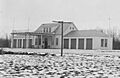
Mooers NY border station as seen in 1933

