
Motor Mill Historic District facts for kids
Quick facts for kids |
|
|
Motor Mill Historic District
|
|
 |
|

 Location in Iowa

Location in the United States
|
|
| Nearest city | Elkader, Iowa |
|---|---|
| Built | 1869 |
| MPS | Flour Milling in Iowa MPS |
| NRHP reference No. | 14000285 |
| Added to NRHP | June 9, 2014 |
The Motor Mill Historic District is a special place in Iowa, recognized as a historic district by the United States government. It's located near Elkader, Iowa. This area was added to the National Register of Historic Places in 2014. Before that, in 1977, it was already part of the historic Motor Townsite.
Contents
The Story of Motor Mill
The Motor Mill Historic District tells the story of a busy mill and a small town that once thrived. It's a great example of old-time industry and how communities grew around important businesses like mills.
Building a Dream: The Motor Mill
A group of partners, John Thompson, James Crosby, and J.P. Dickinson, decided to build a town and a mill. They chose a spot along the Turkey River called Hastings Bottom. Their new town was named Motor.
They spent a lot of money, about $50,000, to build the mill itself. Another $40,000 went into buying equipment and putting up other buildings. The stone for these buildings came from a nearby bluff. Workers used special cable cars on wooden rails to bring the heavy stones down.
Craftsmanship of the Mill
Skilled German stonemasons from a town called Communia helped build the main mill. This gristmill, which grinds grain, stands about 90-foot (27 m) tall and has six stories!
There's a cool legend about the stonemasons. People say four different masons worked on the mill, each on a different wall. They wanted to show off their skills. That's why three of the walls have rounded stones, but the fourth wall uses square-cut stones. The north side of the mill has flat stones because the builders hoped to add a woolen mill there later. However, they couldn't find enough money to build it.
Life at the Mill
The mill was finished in 1869 and started working the next year. It was a busy place! The mill ground different grains:
- Barley, oats, and rye were ground for animal feed.
- Wheat and buckwheat became flour for baking.
- Corn was turned into cornmeal.
Nearby, a cooperage made barrels. These barrels were used to ship the flour and cornmeal to other places.
Challenges and Changes
Even though the mill was important, it faced many problems it couldn't control. Tiny insects called chinch bugs destroyed wheat crops in the area. This meant less grain for the mill to grind. Also, many other mills competed for the same limited raw materials.
A narrow-gauge railroad was planned to help the town, but it was washed out by a flood. Then, a big flood in 1883 destroyed the mill's dam. The people who invested in the mill never got their money back. The partnership ended, and the property was sold at an auction in 1891.
Louis Klink bought the townsite in 1903. He sold the mill's machinery and used the buildings for his farm. His family owned the property for 80 years. In 1983, the Clayton County Conservation Board bought the property. They turned it into a park, so people today can visit and learn about its history.
Images for kids
-
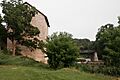
The historic Motor Mill, a six-story stone building.
