
New Caledonian wattled bat facts for kids
Quick facts for kids New Caledonian wattled bat |
|
|---|---|
| Conservation status | |
Scientific classification  |
|
| Kingdom: | Animalia |
| Phylum: | Chordata |
| Class: | Mammalia |
| Order: | Chiroptera |
| Family: | Vespertilionidae |
| Genus: | Chalinolobus |
| Species: |
C. neocaledonicus
|
| Binomial name | |
| Chalinolobus neocaledonicus Revilliod, 1914
|
|
| Script error: The function "autoWithCaption" does not exist. | |
| Synonyms | |
|
|
Script error: No such module "Check for conflicting parameters".
The New Caledonian wattled bat (Chalinolobus neocaledonicus) is a special type of bat. It belongs to a group called vesper bats. This bat is found only in a place called New Caledonia.
Contents
Meet the New Caledonian Wattled Bat
This unique bat was first described by a Swiss scientist named Pierre Revilliod in 1914. For a while, some thought it was a type of Gould's wattled bat. But now, most scientists agree it's its own distinct species.
Its scientific name, neocaledonicus, tells us where it lives. "Néos" means "new" in Ancient Greek, and "Caledonia" refers to New Caledonia. So, its name literally means "new Caledonian."
What Does This Bat Look Like?
The New Caledonian wattled bat is quite small! Its head and body together are only about 50.5 mm (1.99 in) long. That's about the length of a small paperclip.
Its forearm, which is part of its wing, is about 35.3 mm (1.39 in) long. Its tail is around 33 mm (1.3 in) long. This bat also has ears that are fairly long for its size, measuring about 12 mm (0.47 in).
It has a total of 32 teeth. These teeth help it catch and eat its food.
Where Does This Bat Live?
This bat lives only in New Caledonia, a group of islands in the Pacific Ocean. It is one of nine different bat species found there.
What makes it even more special is that it is one of only three bat species that are endemic to New Caledonia. This means these bats are found nowhere else in the world!
Why Is This Bat in Danger?
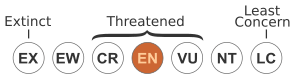
Sadly, the New Caledonian wattled bat is considered an endangered species by the IUCN. This means it is at a very high risk of disappearing forever.
There are a few reasons why this bat is in trouble:
- It lives in a very small area. The places where it can be found are less than 500 km2 (190 sq mi) in total.
- Scientists know of fewer than six specific locations where these bats live.
- The places where they live are getting smaller and less healthy. This is often due to human activities like building and farming.
Protecting the places where these bats live is very important to help them survive.
Sources
