
Orange River white-eye facts for kids
Quick facts for kids Orange River white-eye |
|
|---|---|
.jpg) |
|
| Adult bird, lower Orange River, showing the sulphur-coloured face markings and tawny buff flanks and sides of breast | |
| Conservation status | |
Scientific classification  |
|
| Kingdom: | Animalia |
| Phylum: | Chordata |
| Class: | Aves |
| Order: | Passeriformes |
| Family: | Zosteropidae |
| Genus: | Zosterops |
| Species: |
Z. pallidus
|
| Binomial name | |
| Zosterops pallidus Swainson, 1838
|
|
 |
|
| range
Z. pallidus only Z. pallidus in sympatry with Z. virens Cape white-eye (Z. virens) only |
|
| Script error: The function "autoWithCaption" does not exist. | |

Script error: No such module "Check for conflicting parameters".
The Orange River white-eye (Zosterops pallidus) is a small bird that lives in Namibia and South Africa. It belongs to a bird family called Zosteropidae, known for the white rings around their eyes.
This bird used to be considered the same species as the Cape white-eye (Zosterops virens). However, scientists found that these two types of white-eyes live in the same areas in central South Africa without mixing. This means they are different species, even though they look similar. They also have different genes.
Contents
Where Do Orange River White-eyes Live?
These birds are most common near the Orange and Vaal Rivers. You can find many of them there. They also live in other places, but in smaller numbers. These include the Nama Karoo, Namaqualand, and the Namib Desert.
In dry areas, they like to stay near plants that grow along streambeds. These streambeds might be dry for part of the year. Orange River white-eyes do not usually travel long distances.
What Kind of Places Do They Like?
Orange River white-eyes look for food in different kinds of plants. They like native and introduced willow trees (Salix species). They also forage in currant-rhus bushes (Searsia species) and thorn trees (Acacia). Reeds (Phragmites) are another favorite spot.
You can often see these birds in gardens, parks, and tree plantations. They will visit almost any plants they can find in these areas.
What Do Orange River White-eyes Look Like?
Both male and female Orange River white-eyes look alike. They are about 10 to 13 centimeters long, from their beak to the tip of their tail. Their upper feathers are a pale olive green color. They have a yellow throat and a yellow stripe above their eyes.
A special feature is the reddish-brown (called tawny buff) color on their sides and chest. This color helps tell them apart from other white-eyes in the region. The feathers around their eyes and their beaks are black. Young birds look like lighter versions of the adults. The famous white rings around their eyes appear when they are about two months old.
What Are Their Habits?
These birds mostly eat insects, which they pick off leaves and tree bark. They also enjoy small fruits, like the dry berries from Searsia bushes. When it's not breeding season, they often move around in small groups looking for food.
One bird usually leads, and the others follow loosely. Sometimes, they even join groups of Cape white-eyes that are not breeding. Their usual song is soft and quiet, unless they get excited. During the breeding season, you can hear them sing a longer, warbling song.
Nesting and Reproduction
Orange River white-eyes breed during the summer months. We don't know a lot about their breeding habits, but it has been recorded that they lay three pale blue eggs.
They build a deep, cup-shaped nest using soft, flexible plant materials. They hang their nests between horizontal twigs and make them stronger with spiderwebs.
Images for kids
-
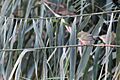
Perched on a Phragmitis reed near Aussenkehr, lower Orange River
-
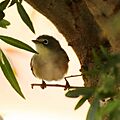
Near Aussenkehr on the lower Orange River
-2338_-_Flickr_-_Ragnhild_%26_Neil_Crawford.jpg)

