
Pantone facts for kids
 |
|
| Subsidiary | |
| Industry | Design services |
| Founded | 1962 in Carlstadt, New Jersey |
| Founder | Lawrence Herbert |
| Headquarters | Carlstadt, New Jersey,
United States
|
| Products | Pantone Color Matching System |
| Parent | X-Rite (Veralto) |
Pantone LLC (also known as PANTONE) is an American company. It is based in Carlstadt, New Jersey. Pantone is famous for its special way of naming and organizing colors. This system is called the Pantone Matching System (PMS).
Many different industries use the PMS. These include graphic design, fashion design, and product design. It's also used in the textile industry, printing, and manufacturing. Pantone helps manage colors from the first design idea to the final product. This includes colors on paper, cotton, polyester, nylon, and plastics.
Pantone is part of a larger company called X-Rite. X-Rite is owned by Veralto.
Contents
The Story of Pantone
Pantone started in New Jersey in the 1950s. It was a printing company owned by brothers Mervin and Jesse Levine. In 1956, they hired Lawrence Herbert, a smart chemistry graduate. Herbert found a way to organize and simplify the company's pigments (color powders) and colored inks.
By 1962, Herbert's ink and printing part of the business was doing very well. He bought this part of the company from the Levine brothers. He then renamed it "Pantone."

Pantone's main products are the Pantone Guides. These are like small "fan decks" of color samples. They are made of thin cardboard or plastic sheets. Each sheet has many related color swatches printed on it. For example, one page might show different shades of yellow.
The main idea behind the Pantone Matching System is simple. It helps designers choose exact colors. Then, when a design is made into a real product, the colors will match perfectly. This works no matter what equipment is used. Many graphic designers and printers use this system. Pantone suggests buying new color guides every year. This is because the inks can change color slightly over time.
In 2007, a company called X-Rite bought Pantone. X-Rite makes tools and software for measuring color. Later, in 2012, Danaher Corporation bought X-Rite. In 2023, Danaher created a new company called Veralto, which now owns Pantone.
A Challenge with Adobe
In 2022, there was a disagreement between Pantone and Adobe. Adobe makes popular design software like Photoshop. Because of this, some Pantone colors in Adobe programs became unavailable. Designers had to pay a separate fee to Pantone to use these colors. This caused problems for many artists who relied on these colors for their digital work.
How Pantone Matches Colors
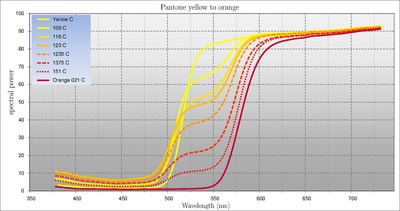

The Pantone Color Matching System is a way to standardize colors. This means that colors are made to look the same everywhere. As of 2019, the system had 2161 colors. By using this standard, different manufacturers can make sure their colors match. They don't even need to talk to each other directly.
One important use is in CMYK printing. CMYK is a common way to print colors. It uses four inks: cyan, magenta, yellow, and black. Most printed materials in the world use CMYK. Some Pantone colors can be made using CMYK inks. These are marked in Pantone's guides.
However, many Pantone colors are "spot colors." These are special colors mixed from 13 basic pigments (plus black). These spot colors cannot be perfectly made using only CMYK inks. Pantone also offers special colors like shiny metallics, bright fluorescents (neons), and soft pastels.
Pantone colors are identified by a special number, like "PMS 130." These colors are often used in branding. They even appear in government rules and military standards. For example, the blue in the Scottish flag is officially "Pantone 300." Countries like Canada and South Korea also use specific Pantone colors for their flags.
The Pantone Goe System (Discontinued)
In 2007, Pantone introduced a new system called Goe. It had 2058 new colors. This system aimed to make it easier to reproduce colors in printing. However, the Pantone Goe system was stopped in 2013. Some of its new colors and base colors were later added to the main Pantone system.
Other Cool Pantone Products
Pantone works with other companies to bring color into many areas.
- In 2006, Pantone teamed up with Fine Paints of Europe. They created a new line of paints for homes. This collection has over 3,000 colors.
- In 2015, Pantone worked with Redland London. They made a collection of bags inspired by Pantone's color expertise.
Pantone also had a special printing system called Hexachrome. This system used six colors instead of the usual four. It added orange and green inks to make even more vibrant colors. Hexachrome was stopped in 2008.
Pantone also provides tools that help designers use their colors in computer software like Adobe Creative Suite. These tools help make sure colors look accurate on different screens and in print.
Pantone's Color of the Year
Since 2000, the Pantone Color Institute has chosen a special "Color of the Year." Twice a year, experts from different countries meet in Europe. They discuss and choose a color for the next year. For example, the color for summer 2013 was chosen in London in the spring of 2012.
The chosen color often reflects the "zeitgeist" – the mood or spirit of the times. For instance, when Honeysuckle was chosen for 2011, Pantone said it was "a captivating, stimulating color that gets the adrenaline going – perfect to ward off the blues." Fashion designers, florists, and other companies use this color to guide their future products. In 2016 and 2021, Pantone even chose two colors for the Color of the Year!
See also
- Color chart – other ways to organize colors
- CMYK color model
- Natural Color System (NCS), Munsell color system – other color systems
- RAL colour standard
- Spot color
