
Parachondrostoma turiense facts for kids
Quick facts for kids Parachondrostoma turiense |
|
|---|---|
| Conservation status | |
Scientific classification  |
|
| Kingdom: | Animalia |
| Phylum: | Chordata |
| Class: | Actinopterygii |
| Order: | Cypriniformes |
| Family: | Cyprinidae |
| Subfamily: | Leuciscinae |
| Genus: | Parachondrostoma |
| Species: |
P. turiense
|
| Binomial name | |
| Parachondrostoma turiense (Elvira, 1987)
|
|
 |
|
| Script error: The function "autoWithCaption" does not exist. | |
| Synonyms | |
|
Chondrostoma turiense Elvira, 1987 |
|

Script error: No such module "Check for conflicting parameters".
The Parachondrostoma turiense is a type of ray-finned fish from the Cyprinidae family, which includes carps and minnows. This fish is special because it's only found in Spain. It usually lives in rivers, but its home is currently at risk.
Contents
What Does It Look Like?
This fish has a long body and a fairly small head. Its mouth is located on the bottom of its head. It usually grows to be about 300 millimeters (about 12 inches) long. The bottom lip is thick and has a curved, hard edge. This is different from a similar fish, the Iberian Nase, which has a straight edge on its lip.
The Parachondrostoma turiense has a long, narrow tail section. Its fins are also long. The fin on its back (dorsal fin) has 8 branched rays, and the fin underneath (anal fin) has 8 to 10 branched rays. It has large scales, usually 44 to 45 of them along its side.
Where Does It Live?
This fish typically lives in rivers where the water is moving. However, it can also survive in still water, like in lakes or reservoirs. When it's time to lay eggs, these fish can travel upstream in rivers.
Reproduction
Scientists don't know a lot about how this fish reproduces. We do know that they swim back up rivers to the higher parts to lay their eggs. This usually happens between March and May. They lay their eggs in shallow water that has stones or gravel at the bottom.
Where Can You Find It?
The Parachondrostoma turiense is an endemic species, which means it's found only in a specific area. For this fish, that area is the Iberian Peninsula. You can find it in the river basins of the Turia and Mijares rivers in Spain.
What Threatens This Fish?
Several things put the Parachondrostoma turiense at risk:
- New Fish Species: When non-native fish are introduced into Spanish rivers, especially those that eat other fish, they become a big danger to this species.
- Changes to Rivers: Building things like pipelines and dams can change the rivers where these fish live.
- Water Pollution: Waste from factories, cities, and farms can pollute the water, making it unhealthy for the fish.
- Taking Water for Farms: When too much water is taken from rivers for farming, the water levels can drop too low for the fish to survive.
- Gravel Mining: Taking gravel from rivers can destroy the places where the fish lay their eggs.
How Can We Help?
To protect the Parachondrostoma turiense, people are trying to:
- Control and treat dirty water before it goes into rivers.
- Fix the problems caused by building things like dams near rivers.
- Make sure enough water stays in rivers for fish, especially when water levels are low.
- Manage how much gravel is taken from rivers to protect fish breeding areas.
- Control non-native species that are already in Spain's rivers.
- Stop new non-native species from being introduced.
- Keep track of how many of these fish are left to see if their numbers are changing.
Images for kids
-
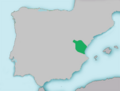
Map showing where Parachondrostoma turiense lives.
