
Parosphromenus harveyi facts for kids
Quick facts for kids Parosphromenus harveyi |
|
|---|---|
 |
|
| Conservation status | |
Scientific classification  |
|
| Kingdom: | Animalia |
| Phylum: | Chordata |
| Class: | Actinopterygii |
| Order: | Anabantiformes |
| Family: | Osphronemidae |
| Genus: | Parosphromenus |
| Species: |
P. harveyi
|
| Binomial name | |
| Parosphromenus harveyi B. Brown, 1987
|
|
 |
|
| Script error: The function "autoWithCaption" does not exist. | |

Script error: No such module "Check for conflicting parameters".
The Parosphromenus harveyi is a special type of gourami fish. It's found only in Malaysia, specifically in a state called Selangor. These fish live in unique places called peat swamp forests. These forests have very dark, highly acidic water.
Parosphromenus harveyi is also known as the licorice gourami. It's a small labyrinth fish, which means it has a special organ to breathe air. These fish are usually less than 30 millimeters long. They live in black water streams where very little sunlight gets through. This species was first officially named by B. Brown in 1987. There are currently 20 known types of Parosphromenus fish.
Contents
What's in a Name?
The first part of its name, Parosphromenus, means "similar to Osphronemus". Osphronemus is a name that means "smelly" or "olfactory". This refers to the fish's special breathing organ, which people once thought was for smelling.
The second part of its name, harveyi, honors Will Harvey. He was a German aquarist (someone who keeps fish) who lived in Scotland.
How it Was Discovered
A. and B. Brown brought this fish to Europe in 1984 and 1985. This was when people first started learning about it outside of Malaysia.

Other Names for the Fish
In Finland, this fish is called Turkoosigurami. It's also sometimes known as the Ornate paradisefish or Harvey Licorice Gourami.
What it Looks Like
This fish is quite small, growing up to 30–35 millimeters long.
- It has 11 to 13 spines on its back fin.
- It also has 5 to 7 soft rays on its back fin.
- Its anal fin (on its belly) has 11 to 13 spines.
- It has 8 to 11 soft rays on its anal fin.
The Parosphromenus harveyi has a long, flat body and a round tail. When male fish are ready to mate, they look very colorful. They have bright blue-green glowing bands on their fins. Unlike some other similar fish, they don't have any red colors. They also have a wide black band on the edge of their tail fin.
It's harder to tell the females apart from other similar fish. When a female is ready to mate, she becomes a pale color. Her clear fins turn a brownish color.
Where it Lives
The Parosphromenus harveyi lives in freshwater. It's a tropical fish that swims freely in the water.
- Ecology: It lives in mangrove areas.
- Habitat: It prefers black water streams found in peat swamp forests.
- Water depth: The water can be anywhere from about 30 to 160 centimeters deep. The depth changes with how much it rains.
Where it's Found
This fish is found in Asia, specifically in Selangor and Bernam, Malaysia. It's also found near Tanjung Malim in Perak. It lives in the Oriental ecosystem, which is a specific area for animals.
You can find this fish in:
- Blackwater streams in the North Selangor peat swamp forest.
- Along the main road between Kampung Sungai Besar and Tanjung Malim.
- In West Malaysia, near Batu Arang. Sadly, much of this area is now gone. The fish still live in small parts of the remaining marshes.
Reproduction and Life Cycle
Parosphromenus harveyi males have a special way of attracting females. They perform a "head-down" courtship dance. If conditions are good, a male and female pair will mate and care for their eggs almost all the time. They usually lay a medium number of eggs.
Males are often in full breeding colors during August and September. This suggests they might breed more when water levels are low.
Males choose a small cave, often made from fallen leaves, as their territory. They try to get females to come into their cave with their colorful displays. During mating, the male wraps his body around the female. They release eggs and sperm in small groups. Some males build a small bubble nest inside the cave, while others don't. Both parents try to stick the eggs to the cave ceiling.
After the eggs are laid, the female leaves the cave and protects the area around it. The male stays inside to care for the eggs. The eggs hatch in about 24 to 36 hours. The baby fish can swim after 4 to 6 days. At first, they swim without much direction, and the male will gather them and put them back in the "nest." After another 3 to 5 days, they can swim freely and leave the cave. At this point, the parents stop caring for them.
What it Eats
This fish mainly eats tiny living things. In the wild, it eats small water insects like mosquito larvae, copepods, and ostracods.
If you keep this fish in an aquarium, you must feed it small live foods. These include baby brine shrimp, daphnia, and microworms. Sometimes they will eat frozen foods, but dried foods are usually refused.
How to Care for This Fish
This fish is very sensitive to air. If its body touches the air directly, it can get hurt. This is especially important during transport.
For a breeding pair, the tank should be at least 10 inches long. It needs dried leaves and hidden pipes for the fish to hide in. It's good to change 10–20% of the water every one or two weeks.
The water conditions are very specific:
- Temperature: 22 to 28 degrees Celsius (72 to 82 degrees Fahrenheit).
- pH: 3.0 to 3.8. It should not be higher than 6.0.
- Conductivity: Less than 100 micro Siemens/cm.
- KH (carbonate hardness): Should not be measurable.
This fish is not for beginners because it needs very specific care.
Why This Fish is Important
The Parosphromenus harveyi is important for the fish life in black water and peat swamp areas. It's also valuable for the aquarium trade because it's rare and beautiful. Even though it's an endangered species, it can be traded under strict rules. This helps people learn about animal conservation.
Threats to the Fish
Threat to the Species
The threat to this species is very high. The area where it was first found has been almost completely dried up and cut down. This made it very hard for the fish to live there. The fish seems to have moved to a protected area called "Selangor Forest." However, even this protected area has been drained and turned into farms.
P. harveyi is trying to survive in some drainage canals and remaining black water swamps.
Threat to Humans
This fish is harmless to humans.
Trade of the Fish
This species is rarely seen in the fish trade. It became even rarer after its habitat was mostly destroyed. Most of the fish kept by hobbyists came from a few private imports.
Because this fish can be confused with other similar species, fish labeled as "harveyi" should be checked carefully. Sometimes, real harveyi fish might have been sold under the wrong name, like "deissneri."
Images for kids
-
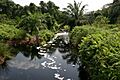
Blackwater can be found at peat swamp forest North Selangor, Malaysia

