
Pentagonal number facts for kids

Imagine you're building shapes with dots! A pentagonal number is a special kind of figurate number. These numbers show how many dots you need to make a pentagon shape. Think of it like building triangular or square numbers, but with five sides.
Unlike squares or triangles, pentagonal numbers aren't perfectly symmetrical when you stack them up. Instead, you start with one dot, then add layers around it to form bigger pentagons. Each new layer adds more dots to the shape.
The nth (or "number n") pentagonal number, written as pn, tells you the total number of dots in the nth pentagonal pattern. For example, the third pentagonal number uses 12 dots. It's made by combining the outlines of three pentagons that share a central point.
You can find any pentagonal number using this formula:
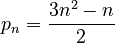
Here are the first few pentagonal numbers:
1, 5, 12, 22, 35, 51, 70, 92, 117, 145, 176, 210, 247, 287, 330, 376, 425, 477, 532, 590, 651, 715, 782, 852, 925, 1001, 1080, 1162, 1247, 1335, 1426, 1520, 1617, 1717, 1820, 1926, 2035, 2147, 2262, 2380, 2501, 2625, 2752, 2882, 3015, 3151, 3290, 3432, 3577, 3725, 3876, 4030, 4187... (sequence A000326 in OEIS).
Contents
How Pentagonal Numbers Grow
Pentagonal numbers grow in a special way. The nth pentagonal number is the sum of 'n' numbers, starting from 'n' itself and going up to (2n − 1).
There's also a cool connection to triangular numbers! If Tn is the nth triangular number, then the nth pentagonal number can be found using these relationships:



This shows how different types of figurate numbers are related to each other.
What are Generalized Pentagonal Numbers?
Sometimes, mathematicians like to explore numbers in different ways. Generalized pentagonal numbers are found using the same formula as regular pentagonal numbers, but we allow 'n' to be zero or even negative numbers (like 0, 1, -1, 2, -2, 3, -3, and so on).
This gives us a slightly different sequence of numbers:
0, 1, 2, 5, 7, 12, 15, 22, 26, 35, 40, 51, 57, 70, 77, 92, 100, 117, 126, 145, 155, 176, 187, 210, 222, 247, 260, 287, 301, 330, 345, 376, 392, 425, 442, 477, 495, 532, 551, 590, 610, 651, 672, 715, 737, 782, 805, 852, 876, 925, 950, 1001, 1027, 1080, 1107, 1162, 1190, 1247, 1276, 1335... (sequence A001318 in OEIS).
These generalized numbers are important in advanced math, especially in Euler's famous pentagonal number theorem. This theorem helps us understand how numbers can be broken down into sums of other numbers.
How to Test for Pentagonal Numbers
Want to know if a number 'x' is a pentagonal number? You can use a simple test!
First, calculate this value:
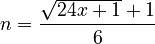
If the result 'n' is a whole number (a natural number like 1, 2, 3, etc.), then 'x' is indeed a pentagonal number! If 'n' is not a whole number, then 'x' is not pentagonal.
For generalized pentagonal numbers, you just need to check if the number 24x + 1 is a perfect square.
The Gnomon of Pentagonal Numbers
In math, a gnomon is the part you add to a shape to make the next, larger shape in a sequence. For pentagonal numbers, the gnomon tells us how many dots are added to get from one pentagonal number to the next.
The gnomon for the nth pentagonal number is: 
This means to get from the 1st to the 2nd pentagonal number, you add 3(1)+1 = 4 dots. To get from the 2nd to the 3rd, you add 3(2)+1 = 7 dots, and so on.
Square Pentagonal Numbers
A square pentagonal number is a number that is both a pentagonal number and a perfect square at the same time. It's like finding a number that fits two different patterns!
The first few square pentagonal numbers are:
0, 1, 9801, 94109401, 903638458801, 8676736387298001, 83314021887196947001, 799981229484128697805801, 7681419682192581869134354401, 73756990988431941623299373152801... (OEIS entry A036353)

See also
- Hexagonal number
- Triangular number
