
Phrynomantis microps facts for kids
Quick facts for kids Phrynomantis microps |
|
|---|---|
 |
|
| Conservation status | |
Scientific classification  |
|
| Kingdom: | Animalia |
| Phylum: | Chordata |
| Class: | Amphibia |
| Order: | Anura |
| Family: | Microhylidae |
| Genus: | Phrynomantis |
| Species: |
P. microps
|
| Binomial name | |
| Phrynomantis microps Peters, 1875
|
|
| Script error: The function "autoWithCaption" does not exist. | |

Script error: No such module "Check for conflicting parameters".
The Phrynomantis microps is an African frog, also known as the Accra snake-necked frog. These frogs have amazing ways to survive in the savannah. You can find them across Western and Central Africa. One special thing about them is a unique liquid they produce on their skin. This liquid helps stop large ants from biting or stinging them. Because of this, Phrynomantis microps frogs can live in damp burrows inside big ant nests and termite mounds, which is where they are often found. While these frogs eat insects like termites, they have never been seen eating the ants they share their homes with. These are medium-sized frogs with a bright red belly area.
Contents
What They Look Like
Phrynomantis microps frogs are medium-sized, growing to be about 40 to 60 millimeters long when they are adults. Their back and belly area are bright red, while the rest of their body is dark brown. The red color on their back can change to brown or even gray depending on where the frog is or what it's doing. However, their belly area will always stay the reddest part of their body.
Where They Live
These frogs live in many different natural places. These include dry and moist savannas, dry and moist shrublands, and dry or wet grasslands. They also live near temporary freshwater lakes and marshes, as well as on arable land (farmed land) and pastureland.
Adult Phrynomantis microps frogs live alone in burrows deep underground. This helps them stay in a humid (damp) environment. Often, their burrows connect directly to the nests of large ants. It's sometimes hard to tell if the frog dug the burrow or if it was originally an ant tunnel. Sometimes, these frogs are even found in scorpion burrows! Since not all tunnels in an ant nest are big enough for the frog, it probably digs its own home.
You can find Phrynomantis microps frogs all over Western and Central Africa, from Senegal to the Central African Republic and parts of South Sudan. Many studies about these frogs have been done in Comoé National Park in the Ivory Coast.
How They Are Doing
The Phrynomantis microps frog is not an endangered species. It is listed as "Least Concern," which means there are plenty of them around.
The young Phrynomantis microps (tadpoles) help keep freshwater ponds healthy. They eat tiny plants called algae that grow in the water. If there are too few tadpoles, the algae can grow too much, which is bad for the pond.
Their Home and Space
Phrynomantis microps frogs do not seem to guard their territory. They don't protect their space during the day or when they hunt at night. In fact, up to six Phrynomantis microps frogs can live together in the same ant nest. When male frogs call to find a mate, they travel to a nearby pond and don't claim any specific area. After mating, they lay their eggs in the pond, and other frog couples might lay their eggs there too.
What They Eat
Young Frogs (Tadpoles)
Young Phrynomantis microps tadpoles eat tiny living things that float in the water. They filter these small organisms from the water.
Adult Frogs
Adult Phrynomantis microps frogs are insect-eaters. They only eat ants and termites. Interestingly, they don't eat the ants they live with in their burrows. Instead, they leave their homes at night to hunt for food.
Reproduction and Life Cycle
When Phrynomantis microps frogs reproduce, the male holds onto the female, and she lays her eggs. They stay together as they move to a nearby pond. Once they reach the pond, the female lays her eggs right after they are fertilized. The number of eggs can vary a lot, from 100 to over 600 eggs in one laying! The eggs are white or yellowish. Tadpoles hatch after two days and are see-through. They turn into small frogs (froglets) in about 40 days and then leave the water.
Phrynomantis microps frogs only look for mates during the rainy season in their area. The amount of rain and how long the rainy season lasts can be different in various places. A female frog will lay several groups of eggs, splitting them into smaller batches. She might lay them in one pond or even in different ponds. For example, in one park, frogs only reproduced after heavy rainfalls (more than 16mm) in some years. But in other years, they reproduced after much lighter rain (only 2mm). However, more rain always means more eggs are laid.
After a day of enough heavy rainfall, male frogs come out of their burrows at night. They call out as they move towards ponds. They usually call for only 1 to 3 nights. A female frog arrives, and the egg-laying process takes about 20 to 34 minutes. They lay one to nine groups of eggs to make a full clutch. The frog couple spreads these eggs by swimming around the pond where they mated. They spread the eggs into many smaller groups, sometimes even in different ponds, to reduce the risk of all the eggs being eaten by predators. Because of this, the number of eggs in a single clutch can be very different, from 30 to 1400 eggs. Sometimes, this can even be the eggs from two females!
The tadpoles that hatch are see-through to help them hide from predators. They also gather in large groups (swarms) if a predator is nearby. These swarms can have up to 4000 tadpoles! Even with these defenses, only about 0.1% of tadpoles survive to become adult frogs. This is also because ponds can dry up, killing any tadpoles left in them. While some other frog species check if a pond will last before laying eggs, Phrynomantis microps frogs don't seem to do this. They also live much farther from ponds than other frog species, which might make it harder for them to check the ponds.
Parental Care
Even though Phrynomantis microps frogs are careful when laying their eggs, they go back to their burrows after laying them. They don't take care of their young at all. Smaller groups of eggs are laid closer to the water's surface, often attached to plants. Larger groups of eggs are laid deeper in the water where there are no plants.
How They Act Together
As adults, Phrynomantis microps frogs live alone. However, when they are tadpoles, they gather in large groups (swarm) if they sense a predator. Tadpole predators, like dragonfly larvae, usually rely on their eyesight to find food. Swarming can confuse predators, making it harder for them to pick out individual tadpoles. This also increases the chances that some tadpoles in the group will survive.
Swarms can include up to 4000 tadpoles and can last for a few seconds or a few minutes. Tadpoles of all sizes join the swarm, but they form smaller groups based on their size. It doesn't seem to matter if they are related to each other when they swarm.
Who Hunts Them?
Tadpoles are easily hunted, which is why they swarm. Besides dragonfly larvae, other water insects like water beetles and water scorpions also hunt tadpoles. Young African helmeted turtles also eat Phrynomantis microps tadpoles.
Once they are adults, Phrynomantis microps frogs have a special way to avoid being eaten during the day. Many of these frogs live in the nests of large ants or termites. These big ants, like the African stink ant and Megaponera foetens, are very aggressive. They can bite and sting, and their stings are strong enough to seriously hurt or even kill frogs. But even though the ants protect their territory, Phrynomantis microps frogs can live inside their burrows without getting stung and only rarely get bitten. This is thanks to the special liquid (peptide secretion) they produce on their skin.
When a frog enters a burrow or an ant gets aggressive, the Phrynomantis microps frog crouches down and covers its head with its front legs. It also raises its back end. This position is a common way for many frogs to defend themselves. It uses the markings on the frog's back end to look like the head of a bigger animal. So, it's probably not just for ants. Staying still allows the ants to touch and explore the frog with their antennae. The ants quickly rub their antennae against their front legs, which suggests the liquid is likely harmful to them. When termites were put in water that a Phrynomantis microps frog had been in, the ants didn't act aggressively towards the termites, even though termites are their favorite food.
How They Hide
Tadpoles are see-through and stay near the water's surface during the day. They move very little, only using their tail fins to keep their head slightly pointed up towards the surface. Scientists think that their see-through bodies, when close to the surface, use the light coming into the water to help them blend in and hide from predators. When it's dark, any light would make them shine instead of blending in. This explains why tadpoles move into deeper water at night and never swarm in the dark.
Images for kids
-
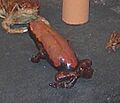
A Phrynomantis microps frog.
Sources
- C. Michael Hogan. 2013. Phrynomantis microps. African Amphibians Lifedesk. ed. B.Zimkus
- AmphibiaWeb. 2022. https://amphibiaweb.org University of California, Berkeley, CA, USA. Accessed 12 Oct 2022
- Carroll, John & Weldon, Paul. (2006). Vertebrate Chemical Defense. 10.1201/9781420006650.ch3.
- Hirschfeld, Mareike, and Mark-Oliver Rödel. “Variable Reproductive Strategies of an African Savanna Frog, ‘Phrynomantis Microps’ (Amphibia, Anura, Microhylidae).” Journal of Tropical Ecology, vol. 27, no. 6, 2011, pp. 601–09. JSTOR, JSTOR 23012407. Accessed 13 Oct. 2022.
- Marko Spieler, Risk of predation affects aggregation size: a study with tadpoles of Phrynomantis microps (Anura: Microhylidae), Animal Behaviour, Volume 65, Issue 1, 2003, Pages 179–184, ISSN 0003-3472, https://doi.org/10.1006/anbe.2002.2030.
- Rodel, M.-O., & Braun, U. (1999). Associations between Anurans and Ants in a West African Savanna (Anura: Microhylidae, Hyperoliidae, and Hymenoptera: Formicidae). Biotropica, 31, 178. https://doi.org/10.2307/2663971
- Rodel M-O, Brede C, Hirschfeld M, Schmitt T, Favreau P, et al. (2013) Chemical Camouflage – A Frog's Strategy to Co-Exist with Aggressive Ants. PLoS ONE 8(12): e81950.
- Rodel, M.-O. & Linsenmairk,. E. 1997: Predator-induced swarms in the tadpoles of an African savanna frog, Phrynomantis microps. Ethology 103, 902–91 4.
- Zongo, Bilassé & Boussim, Issaka. (2015). The effects of physiochemical variables and tadpole assemblages on microalgal communities in freshwater temporary ponds through an experimental approach. Aquatic biosystems. 11. 1. 10.1186/s12999-014-0013-4.
