
Pittsburgh Folk Festival facts for kids
Quick facts for kids Pittsburgh Folk Festival |
|
|---|---|

|
|
| Genre | multicultural, various international ethnic heritages represented in song, dance, and cuisine, as well as arts and crafts |
| Dates | first weekend of September (Labor Day weekend) |
| Frequency | Annually |
| Location(s) | Pittsburgh, Pennsylvania, USA |
| Years active | 1956–2019, 2021– |
| Inaugurated | 1956 |
| Website | Official website: http://www.pghfolkfest.org |
The Pittsburgh Folk Festival is a big celebration of different cultures from all over the world. It has been happening in Pittsburgh, Pennsylvania since 1956.
The festival was started by Duquesne University. Its goal was to help people from different backgrounds connect. It also aimed to celebrate their contributions to Pittsburgh, especially during the city's 200th birthday.
Contents
A Look Back: Festival History
The festival started in 1956. Duquesne University first helped organize it. Since then, it has happened every year. Many different cultures are shown at the festival. You can enjoy music, folk dance, and live performances. There are also vendors selling traditional food and arts and crafts.
Early Years: The 1950s
The very first festival took place in 1956 at the Syria Mosque. It was held on a Saturday and Sunday in June. Food booths were on the ground floor. Exhibits about history, crafts, and products were upstairs.
The first festival featured dances, folk singers, and storytellers. Groups from Scottish, Hungarian, Bulgarian, American, Croatian, Russian, Slovak, Greek, and German traditions performed. The next day, Italian, Lithuanian, Lebanese, Carpatho-Russian, Polish, Irish, Israeli, Chinese, and Ukrainian cultures were featured.
The third festival in 1958 also happened at the Syria Mosque. Its theme was "Unity in Diversity." This meant celebrating how different cultures can come together.
In 1959, the fourth festival was held. Performances included Swiss, Indian, Italian, and Hungarian traditions. Slovak, German, Croatian, Chinese, Ukrainian, and Greek groups also performed. Over 3,000 people attended the opening day that year.
Growing Bigger: The 1960s
In 1962, Robert Morris Junior College took over as the festival's sponsor.
The tenth festival in 1966 included French shows and booths for the first time. It was still held at the Syria Mosque.
By 1967, the festival had grown very large. It moved to Pittsburgh’s Civic Arena to fit more people.
The 1970s: A Major Celebration
In 1976, the festival celebrated its 20th anniversary. This was also the year of the United States Bicentennial, America's 200th birthday. Newspapers across the country said Pittsburgh's festival was one of the nation's largest outdoor events.
The festival received money to add two more days to its schedule. This also allowed students and older adults to attend for free. In 1977, more than 30,000 people were expected to come.
New Features: The 1980s
In 1985, the festival added new things. They created an International Bazaar where people could buy "authentic ethnic artifacts." They also offered a new family ticket plan. This allowed families to save money on admission.
Attendance dropped a bit that year. This was partly because the city held a free carnival event nearby.
For the festival's 30th anniversary in 1986, organizers highlighted the cultures of India, Korea, and Poland. India's special programming matched a big exhibition touring the United States.
Carol Cubelic became the festival director in 1989. Her husband, Charles Cubelic, had been a longtime organizer. The 1989 festival was very successful, with over 40,000 people attending.
Changes and New Venues: The 1990s
The 34th festival in 1989 was the first led by Carole Cubelic. Its theme was "A Taste of the Old World." There were even live cooking demonstrations.
In 1992, Robert Morris College stopped sponsoring the festival. They had lost money over the years. The festival's leadership then changed. The cultural groups themselves took over running the event.
The festival also moved from the David L. Lawrence Convention Center. This was because the center wanted to change the festival too much. The 36th festival moved to the Melody Tent and Amphitheater at Station Square.
In 1993, the festival moved again. It was held outside Pittsburgh city limits for the first time. It opened at the Pittsburgh Expo Mart in Monroeville. The event had three stages with continuous performances.
By its 40th anniversary in 1996, the Pittsburgh Folk Festival returned to the David L. Lawrence Convention Center.
50th Anniversary: 2006
In 2006, the Pittsburgh Folk Festival celebrated its 50th anniversary. It was still held at the David L. Lawrence Convention Center. Twenty-five different ethnic groups participated. Five of these groups had been part of the festival since it began in 1956. These included Bulgaria, Greece, Lebanon, Lithuania, and Ukraine.
The Festival Today
In 2016, the festival celebrated its 60th anniversary. This was also Pittsburgh's 200th birthday. The festival was held in Schenley Plaza Tent in Oakland. More than 40 different cultures from 20 countries were celebrated. Bhutan, Egypt, Mexico, and Venezuela were represented for the first time. Admission was free that year.
The festival did not happen in 2020. It started up again a year later in 2021.
Gallery
-
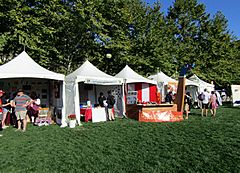
Some booths at the Pittsburgh Folk Festival in Schenley Plaza on September 3, 2016
-
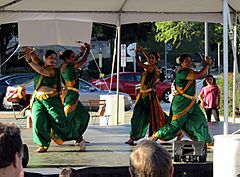
Dancers performing Indian dances at the Pittsburgh Folk Festival, September 3, 2016
-
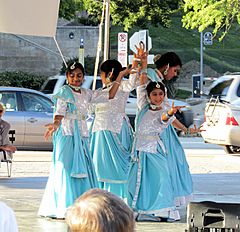
Dancers performing Indian dances at the Pittsburgh Folk Festival, September 3, 2016


