
Pouteria obovata facts for kids
Quick facts for kids Pouteria obovata |
|
|---|---|
 |
|
| Royal Botanic Gardens, Sydney | |
Scientific classification  |
|
| Kingdom: | Plantae |
| Clade: | Tracheophytes |
| Clade: | Angiosperms |
| Clade: | Eudicots |
| Clade: | Asterids |
| Order: | Ericales |
| Family: | Sapotaceae |
| Genus: | Pouteria |
| Species: |
P. obovata
|
| Binomial name | |
| Pouteria obovata (R.Br.) Pierre
|
|
| Script error: The function "autoWithCaption" does not exist. | |
| Synonyms | |
|
|
Script error: No such module "Check for conflicting parameters".
Pouteria obovata is a type of tree that belongs to the Sapotaceae plant family. In Australia, it is often called the northern yellow boxwood. This tree grows in many places across Southeast Asia, Micronesia, and on islands in the Indian Ocean. It has different local names in these areas.
It's important to know that this tree is not the same as another plant, Pouteria lucuma, even though they once shared a similar scientific name.
Contents
What's in a Name?
The Pouteria obovata tree was first described in 1810 by a botanist named Robert Brown. He first named it Sersalisia obovata. Later, in 1942, it was given its current scientific name, Pouteria obovata, by another scientist named Baehni.
The word obovata in its name describes the shape of its leaves. They are shaped like an egg, but wider at the top, which is called "reverse ovate." Scientists sometimes discuss if its name should be Planchonella obovata instead.
Where Does it Grow?
This tree is found in many warm parts of the world. You can see it growing in Southeast Asia, which includes countries like Indonesia. It also grows in Micronesia and on various islands in the Indian Ocean, such as the Seychelles. In Australia, it is common in the state of Queensland.
How it Looks
Pouteria obovata is a tree that can grow quite tall. It usually reaches a height of about 10 to 20 meters (33 to 66 feet). It has a crown of branches that looks bushy and full.
Leaves
When the leaves are young, they feel a bit hairy. As they get older, their top surfaces become smooth and shiny. The leaves are generally oval-shaped or look like a spear. They can be anywhere from 6 to 24 centimeters (2.4 to 9.4 inches) long and 1.5 to 15 centimeters (0.6 to 5.9 inches) wide.
Flowers and Fruit
The tree produces tiny flowers that are greenish-white in color. These flowers usually appear between August and October. After the flowers bloom, they turn into small, round berries. These berries can be red or blue and are about 1 to 1.5 centimeters (0.4 to 0.6 inches) across. Each berry can hold one to five seeds, which are yellow when they are ready.
Uses of the Tree
The wood from the Pouteria obovata tree is useful. People often use it for making furniture, like cabinets. It is also good for woodturning, which is a way of shaping wood using a special machine.
If you wanted to grow this tree, you would need to plant its seeds. It grows best in places where the soil drains well and where it gets plenty of sunshine.
Images for kids
-
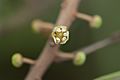
A Pouteria obovata tree by the coast.
-
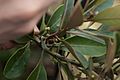
Close-up of Pouteria obovata leaves.
-
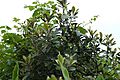
Another view of the Pouteria obovata tree.


