
Psidium sintenisii facts for kids
Quick facts for kids Psidium sintenisii |
|
|---|---|
 |
|
| 1974 illustration | |
| Conservation status | |
Scientific classification  |
|
| Kingdom: | Plantae |
| Clade: | Tracheophytes |
| Clade: | Angiosperms |
| Clade: | Eudicots |
| Clade: | Rosids |
| Order: | Myrtales |
| Family: | Myrtaceae |
| Genus: | Psidium |
| Species: |
P. sintenisii
|
| Binomial name | |
| Psidium sintenisii (Kiærsk.) Alain
|
|
| Script error: The function "autoWithCaption" does not exist. | |
| Synonyms | |
|
|
Script error: No such module "Check for conflicting parameters".
The Psidium sintenisii is a special kind of flowering plant that belongs to the Myrtaceae family, which also includes myrtle and eucalyptus trees. This tree is very rare and can only be found in Puerto Rico. It's known by a few names, like Sintenis' guava and hoja menuda.
This unique tree lives in wet mountain forests. Sadly, there are only a few small groups of these trees left, mostly inside the El Yunque National Forest. Because it's so rare and only found in one place, it's considered a critically endangered species.
Contents
Meet the Sintenis' Guava Tree
The Sintenis' guava is a type of wild guava tree. It's an evergreen tree, which means its leaves stay green all year round. This tree can grow quite tall, reaching up to 9 meters (about 30 feet) high!
What Does It Look Like?
The trunk of the Sintenis' guava tree has gray bark that looks grooved and can peel off in shreds. Its branches are a greenish color. The leaves are shiny green and have tiny glands, making them feel a bit bumpy. Each leaf can be up to 6.3 centimeters (about 2.5 inches) long.
When the tree blooms, its flowers grow one by one from where the leaves meet the stem. These flowers are on long stalks. The flower buds are shaped like spinning tops and have a lovely smell. After the flowers, the tree produces small fruits. These fruits are green or yellowish and grow to about 2 centimeters (less than an inch) long.
Where Does It Live?
This special tree is endemic to Puerto Rico. This means it naturally grows nowhere else in the world! It prefers to live in wet mountain forests, where it can get plenty of moisture. Most of the remaining trees are found within the beautiful El Yunque National Forest, a protected area.
Why Is It Critically Endangered?
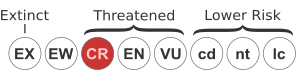
The Psidium sintenisii is listed as "critically endangered." This is the highest risk category for wild species. It means the tree faces an extremely high risk of disappearing forever in the wild. Its small number of remaining groups and limited habitat make it very vulnerable. Efforts are being made to protect these last remaining trees and their forest homes.
