
R.S. Blome Granitoid Pavement in Grand Forks facts for kids
Quick facts for kids |
|
|
R. S. Blome Granitoid Pavement in Grand Forks
|
|
 |
|

 Location in North Dakota

Location in the United States
|
|
| Location | Roughly, Lewis Blvd. S of Conklin Ave. and area around jcts. of Walnut St. and 3rd Ave. and Minnesota Ave. and 5th St., Grand Forks, North Dakota |
|---|---|
| Area | 55 acres (22 ha) (original) |
| Built | 1910-1911 |
| Architect | Blome, R.S., Co. of Chicago |
| NRHP reference No. | 91001583 and 10000605 |
| Added to NRHP | November 5, 1991 (original) August 30, 2010 (decrease) Grand Forks, 10000605, |
The R.S. Blome Granitoid Pavement is a special type of old road surface. You can find it in three of the oldest neighborhoods in Grand Forks, North Dakota. This pavement also includes some old sandstone curbs.
This unique road was made from a mix of Portland cement and small, sharp pieces of granite. It was designed to work for both horse-drawn vehicles and early automobiles. Horses needed a surface they could grip, while cars needed something strong and smooth. This pavement was a great solution for the early 1900s.
Contents
What is Granitoid Pavement?
R.S. Blome Granitoid was created using a special recipe. It combined Portland cement with angular granite chips, other stones, and sand. This mixture was laid over a carefully prepared roadbed.
How Was It Built?
First, a six-inch layer of loose gravel, called macadam, was put down. Then, the Granitoid was laid in five-foot sections. The spaces between these sections were sealed with a mix of asphalt and rubber. This allowed the pavement to expand and shrink with temperature changes.
One idea behind these sections was to make repairs easier. Workers could remove only the parts needed for utility work. However, in Grand Forks, this didn't always happen. You can still see patches of different concrete and asphalt where repairs were made.
The Top Layer
On top of these sections, a two-inch finish layer was added. This layer was made of Portland cement and carefully chosen angular granite chips. These chips were very small, about 1/8 to 3/8 of an inch. Angular chips were used instead of rounded river gravel. This made sure the pieces bonded strongly and wouldn't come loose.
As the surface dried, it was brushed and scored. This made it look like cut stone. It also created a good non-slip surface for horses. The Blome Company's original design used a grid pattern for scoring. But the pavement in Grand Forks has a different pattern called a running bond.
Why Was This Pavement Chosen?
Back then, Grand Forks had a big problem with mud. Every spring, when the snow melted and it rained, the streets would become ankle-deep in mud. City residents had many discussions about how to fix this.
They decided they wanted a high-quality pavement. They hoped it would last a long time, even "after it was paid for." Their choice was a good one! The Granitoid pavement is still useful today. It works well for modern car traffic, even after almost 100 years.
What Makes Grand Forks' Pavement Special?
R.S. Blome Granitoid pavement can be found in other cities too. These include Duluth, Minnesota, Calumet, Michigan, and Spokane and Seattle, Washington. But the sections in Grand Forks are particularly important.
Unique Features
Grand Forks has more surviving Granitoid pavement than any other city. It covers many streets in three different neighborhoods. It also has more of the original bronze name plates embedded in the pavement. These plates read: "Established 1888. GRANITOID. R.S. Blome. Chicago. 1907."
Another special thing about Grand Forks' pavement is the running bond pattern. This pattern is unique among all the remaining examples. It shows that the residents wanted the pavement to look nice, not just be practical.
A Historic Landmark
A large area of this pavement, about 55-acre (22 ha), was added to the National Register of Historic Places in 1991. This means it's recognized as an important historical site. In 2010, the listed area was slightly changed.
Images for kids
-
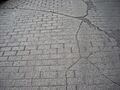
A section of R.S. Blome Granitoid pavement located on Chestnut St, Grand Forks, North Dakota.

