
Ringed torpedo facts for kids
Quick facts for kids Ringed torpedo |
|
|---|---|
 |
|
| Conservation status | |
Scientific classification  |
|
| Kingdom: | Animalia |
| Phylum: | Chordata |
| Class: | Chondrichthyes |
| Order: | Torpediniformes |
| Family: | Torpedinidae |
| Genus: | Torpedo |
| Species: |
T. mackayana
|
| Binomial name | |
| Torpedo mackayana Metzelaar, 1919
|
|
| Script error: The function "autoWithCaption" does not exist. | |
Script error: No such module "Check for conflicting parameters".
The Torpedo mackayana, often called the ringed torpedo ray, is a special type of electric ray. It belongs to the Torpedinidae family. This ray lives in the shallow waters along the western coast of Africa.
You can spot a ringed torpedo ray by its unique rounded breathing holes, called spiracles. It also has cool white and brown spots all over its body. Female ringed torpedo rays can grow to be about 35 to 50 centimeters long. Males are a bit smaller, usually reaching 31.5 to 38.2 centimeters.
Contents
What Does the Ringed Torpedo Ray Look Like?
The ringed torpedo ray has a round, "fleshy" body that looks like a disc. This disc is usually a bit wider than it is long. Its top side is gray-brown or rusty-brown, and its underside is white.
This ray is covered with small patches of brown or white. These spots can look very different in size and how they are spread out. The ringed torpedo ray has a long, strong tail and two fins on its back. The first back fin is wide, and the second one is a little smaller.
It has many rows of teeth, up to 38 rows! You can also see small flaps on its nostrils. A special feature of this ray is its rounded spiracles. No other species in its group, Torpedo, has spiracles shaped quite like these.
How Does It Grow?
The ringed torpedo ray is a small to medium-sized ray. Scientists studied how it grows off the coast of Senegal. They found that baby rays are about 9.55 centimeters long when they are born. They weigh around 20.64 grams.
Female rays usually become adults when they are about 35 centimeters long. Males become adults when they are about 31.5 centimeters long. As adults, females are generally bigger than males. Adult females can be 35 to 50 centimeters long. Adult males are typically 31.5 to 38.2 centimeters long. The heaviest female found weighed 2010 grams, and the heaviest male weighed 1255 grams.
Life Cycle and Reproduction
The ringed torpedo ray's full life cycle can take about a year. Pregnancy, or gestation, lasts for almost half a year. Females usually lay their eggs in May or June. The young rays are then born in August or September.
Like other electric rays, the eggs sometimes stop growing until the baby rays are ready to be born. Female rays have two uteri and two ovaries. Fertilized eggs weigh about 8.6 grams on average.
Where Does It Live?
The ringed torpedo ray lives in coastal areas. It prefers waters that are about 30 to 50 meters deep. You can find it in estuaries, which are places where rivers meet the sea. It also lives on the seafloor, especially where there is mud or sand.
This ray hunts and eats fish and smaller invertebrates. Scientists are still learning more about its daily life and habits.
Why Is It Endangered?
The ringed torpedo ray lives in the warm waters of the eastern Atlantic Ocean. It can be found in 16 countries along the western coast of Africa. Its range stretches from Senegal in the north to Angola in the south.
Sadly, this ray is often caught by accident in fishing nets. This is called "bycatch." Pollution and the destruction of its home are also big problems. This happens because people build more things along the coast.
We don't know exactly how many ringed torpedo rays there are or if their numbers are going up or down. In the adult population, there are more females than males. However, among young rays, there are more males than females.
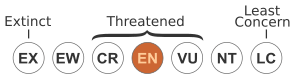
Right now, there are no special plans to protect this species. Because of the threats it faces, the ringed torpedo ray is listed as Endangered on the IUCN Red List. Scientists say we need to study its population more to figure out the best ways to help protect it.
